
Madhav Vidarbha Estate Pvt. Ltd. v. Praharsh Corporation Pvt. Ltd. & Ors., 2026
SC Restricts HC Revisional Powers Under Section 115 CPC
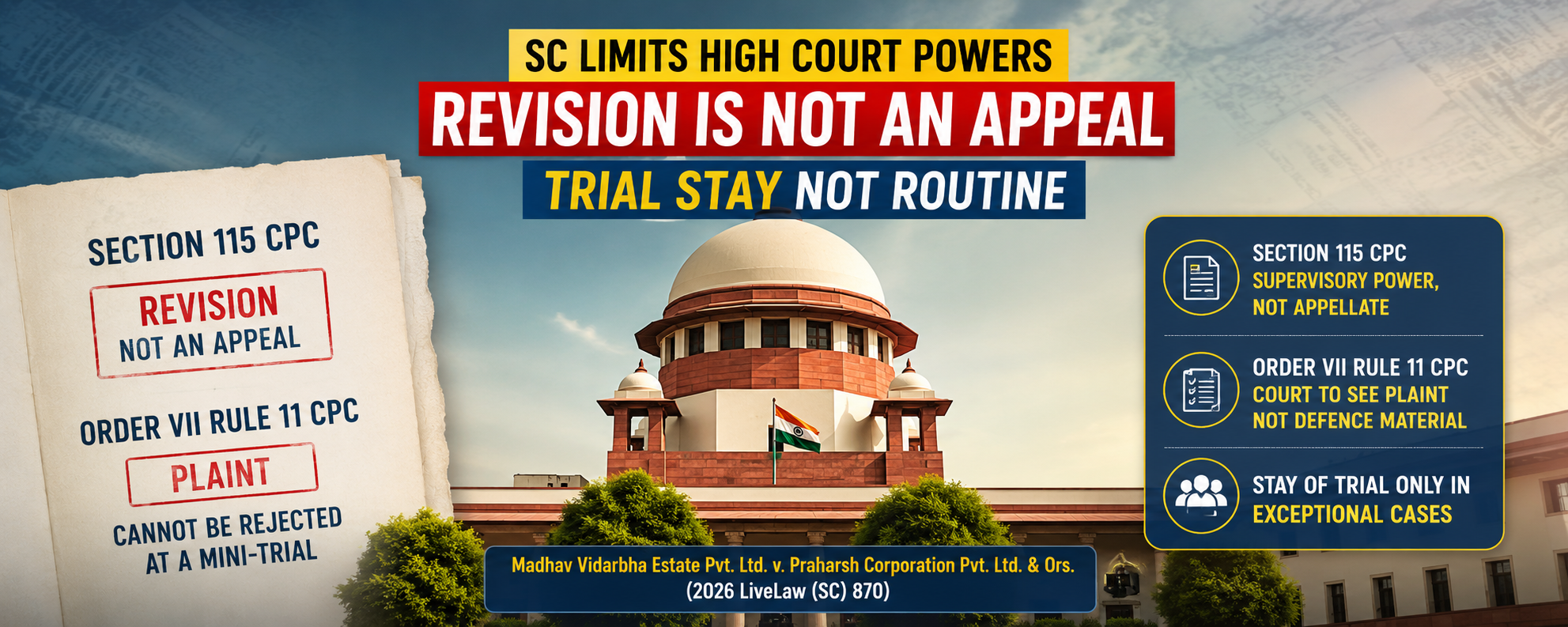
Judgement Details
Court
Supreme Court of India
Date of Decision
31 August 2026
Judges
Justice Dipankar Datta and Justice Satish Chandra Sharma
Citation
Acts / Provisions
Facts of the Case
-
The appellant filed a civil suit seeking a declaration that two sale deeds executed in 2015 and 2017 were null and void, along with a declaration that the respondents were in illegal possession of the suit property and claims for damages and compensation.
-
The respondents filed applications under Order VII Rule 11 CPC, arguing that the plaint disclosed no cause of action and was barred by res judicata under Section 11 CPC and Section 47 CPC.
-
The Trial Court rejected these applications. It held that, while deciding an application under Order VII Rule 11, the Court should examine the averments in the plaint and documents accompanying it, and that disputed questions concerning res judicata and limitation would have to be considered at trial.
-
The respondents challenged the Trial Court's order before the Nagpur Bench of the Bombay High Court under Section 115 CPC.
-
The High Court allowed the revision applications and rejected the plaints. The plaintiff consequently approached the Supreme Court.
Issues
-
Whether the Bombay High Court exceeded the limited scope of its revisional jurisdiction under Section 115 CPC?
-
Whether the High Court could exercise revisional jurisdiction as if it were exercising appellate jurisdiction?
-
Whether the High Court correctly applied the principles governing rejection of a plaint under Order VII Rule 11 CPC?
-
Whether the High Court could rely upon facts and documents beyond the contents of the plaint while deciding the Order VII Rule 11 applications?
-
Whether High Courts should routinely stay the trial of a suit while entertaining revisions against interlocutory orders?
Judgement
-
The Supreme Court allowed the appeals and set aside the judgment of the Bombay High Court, Nagpur Bench.
-
The Supreme Court found that the High Court had exceeded the permissible limits of Section 115 CPC. In particular, the High Court failed to identify the specific error committed by the Trial Court that justified revisional interference.
-
The Supreme Court noted that despite the High Court judgment running into 118 paragraphs, there was effectively no discussion identifying where or how the Trial Court had erred in rejecting the Order VII Rule 11 applications.
-
The Court held that Section 115 CPC is essentially a supervisory power and not an appellate jurisdiction. A revision cannot be used as an opportunity to reconsider the entire matter as though the High Court were the original court.
-
The Supreme Court also found that the High Court had gone beyond the permissible scope of Order VII Rule 11 CPC by considering facts and documents that were not part of the plaint.
-
The Court famously observed that the High Court had “donned the hat of the trial court.”
Held
The Supreme Court held that:
-
Revisional jurisdiction under Section 115 CPC is supervisory and not appellate.
-
A litigant does not possess a substantive right of revision comparable to the right of appeal.
-
The High Court must identify a legally permissible jurisdictional error before interfering under Section 115 CPC.
-
The High Court cannot conduct a fresh adjudication of the dispute while exercising revisional jurisdiction.
-
In an application under Order VII Rule 11 CPC, the Court must ordinarily examine the plaint and the documents relied upon by the plaintiff, rather than disputed defence material.
-
High Courts should not routinely stay trials merely because a revision petition against an interlocutory order is pending.
-
A stay should ordinarily be granted only where continuation of the trial would seriously and irreparably prejudice the revision proceedings or adversely affect the parties.
-
The suit was therefore restored before the Trial Court.
Analysis
-
The central importance of the judgment lies in its clear reaffirmation of the restricted nature of Section 115 CPC.
-
An appeal provides a broader avenue for reconsideration of a decision. Revision, on the other hand, is primarily concerned with supervising subordinate courts and correcting jurisdictional errors within the statutory limits.
-
The Supreme Court relied upon its earlier decision in Shiv Shakti Coop. Housing Society Ltd. v. Swaraj Developers to emphasise that Section 115 is a source of supervisory power, rather than a substantive right available to a litigant.
-
The Supreme Court strongly criticised the High Court for effectively reconsidering the matter from the beginning.
-
Its observation that the High Court had “donned the hat of the trial court” demonstrates the fundamental procedural error.
-
A revisional court cannot ordinarily undertake the same factual and legal exercise that the original court was required to perform.
-
The decision also reinforces an important principle concerning rejection of plaint.
-
At the Order VII Rule 11 stage, the Court generally proceeds on the basis of the plaintiff's pleadings. The defence cannot ordinarily be used to create disputed factual issues requiring a mini-trial.
-
The Supreme Court therefore objected to the High Court's reliance on material that did not form part of the plaint.
-
The Trial Court had considered the questions of res judicata and limitation unsuitable for summary determination at that stage.
-
The Supreme Court's reasoning reinforces the broader principle that where determination of such issues requires examination of facts, evidence or disputed circumstances, they ordinarily should not be prematurely decided through an Order VII Rule 11 application.
-
Another major contribution of the judgment concerns judicial delay.
-
The Supreme Court disapproved of the routine practice of staying trials whenever a party challenges an interlocutory order.
-
Such automatic stays can allow interlocutory challenges to become a mechanism for prolonging civil litigation.
-
The Court therefore stated that a stay should be granted only after a sufficiently deeper examination demonstrating that continuation of the trial would cause serious and irreparable prejudice.
-
The Court also criticised the High Court for spending considerable judicial time on what it considered an issue that did not warrant such an extensive judgment.
-
The reference to the 14th Report of the Law Commission of India demonstrates that the problem of revisions being used to delay proceedings is longstanding.
-
The Supreme Court's message is particularly important for judicial administration: length alone does not make a judgment better; judicial reasoning must remain proportionate to the complexity and significance of the dispute.
-
The judgment strengthens procedural discipline in three important ways:
-
First, it prevents Section 115 CPC from becoming a substitute for an appeal.
-
Second, it prevents Order VII Rule 11 CPC from becoming a vehicle for conducting a mini-trial.
-
Third, it discourages interlocutory litigation and routine stays from frustrating the progress of the main suit.
-
For judiciary aspirants, the case is particularly important for understanding the distinction between appeal and revision, the principles governing rejection of plaint, and the need to avoid unnecessary interference with ongoing trials.