
LY v. RY, 2026
The Court observed that the wife's allegations regarding dowry demand, harassment, physical assault, and cruelty were vague, omnibus, and unsupported by reliable evidence.
Judgement Details
Court
Madhya Pradesh High Court
Date of Decision
15 July 2026
Judges
Justice G.S. Ahluwalia and Justice Anuradha Shukla
Citation
Acts / Provisions
Facts of the Case
-
The parties were married in 2015 and had no children.
-
The wife filed a petition under Section 13 of the Hindu Marriage Act, 1955, seeking dissolution of the marriage on the grounds of cruelty and desertion.
-
She alleged that the husband used to consume liquor, physically assault her, demand dowry, compel her to establish illicit relationships with other persons, and make false allegations regarding her character.
-
She further claimed that she was compelled to leave the matrimonial home about three years before filing the divorce petition.
-
The husband denied all allegations and asserted that the wife had voluntarily left the matrimonial home along with her brother after taking her Stridhan and other valuable articles.
-
The husband also stated that when the wife went missing in 2019, he had lodged a missing person's report.
-
He maintained that he wished to resume matrimonial life and sought restoration of conjugal rights.
-
During the proceedings, it emerged that the wife had earlier lodged an FIR accusing several persons of offences including rape, kidnapping, criminal conspiracy, wrongful confinement, and criminal intimidation.
-
The Sessions Court acquitted the accused persons, recording a finding that one of the accused had established physical relations with the wife with her consent. The acquittal attained finality as it was not challenged.
-
The Trial Court found that the wife had failed to prove cruelty or desertion and dismissed the divorce petition, which led to the present appeal before the High Court.
Issues
-
Whether the wife proved cruelty by the husband so as to entitle her to a decree of divorce under Section 13 of the Hindu Marriage Act, 1955?
-
Whether the wife established that she had been compelled to leave the matrimonial home due to the husband's conduct?
-
Whether the wife, having voluntarily left the matrimonial home and being found to have engaged in an extramarital relationship, was disentitled to relief under Section 23(1)(a) of the Hindu Marriage Act, 1955?
-
Whether the Trial Court committed any error in dismissing the wife's petition for divorce?
Judgement
-
The High Court held that the Trial Court had correctly appreciated both the oral and documentary evidence on record.
-
The Court noted that the wife failed to specify the articles allegedly demanded as dowry or the precise instances of cruelty resulting from non-fulfilment of those demands.
-
The Court found that the evidence did not establish that the wife had been forced to leave the matrimonial home and accepted the husband's version that she had left voluntarily.
-
The Court also took note of the findings recorded by the Sessions Court in the earlier criminal proceedings, wherein one of the accused had been found to have maintained consensual physical relations with the wife.
-
Since the acquittal had attained finality, the High Court considered the finding while assessing the matrimonial dispute.
-
The Court held that the evidence established the wife's involvement in an extramarital relationship.
-
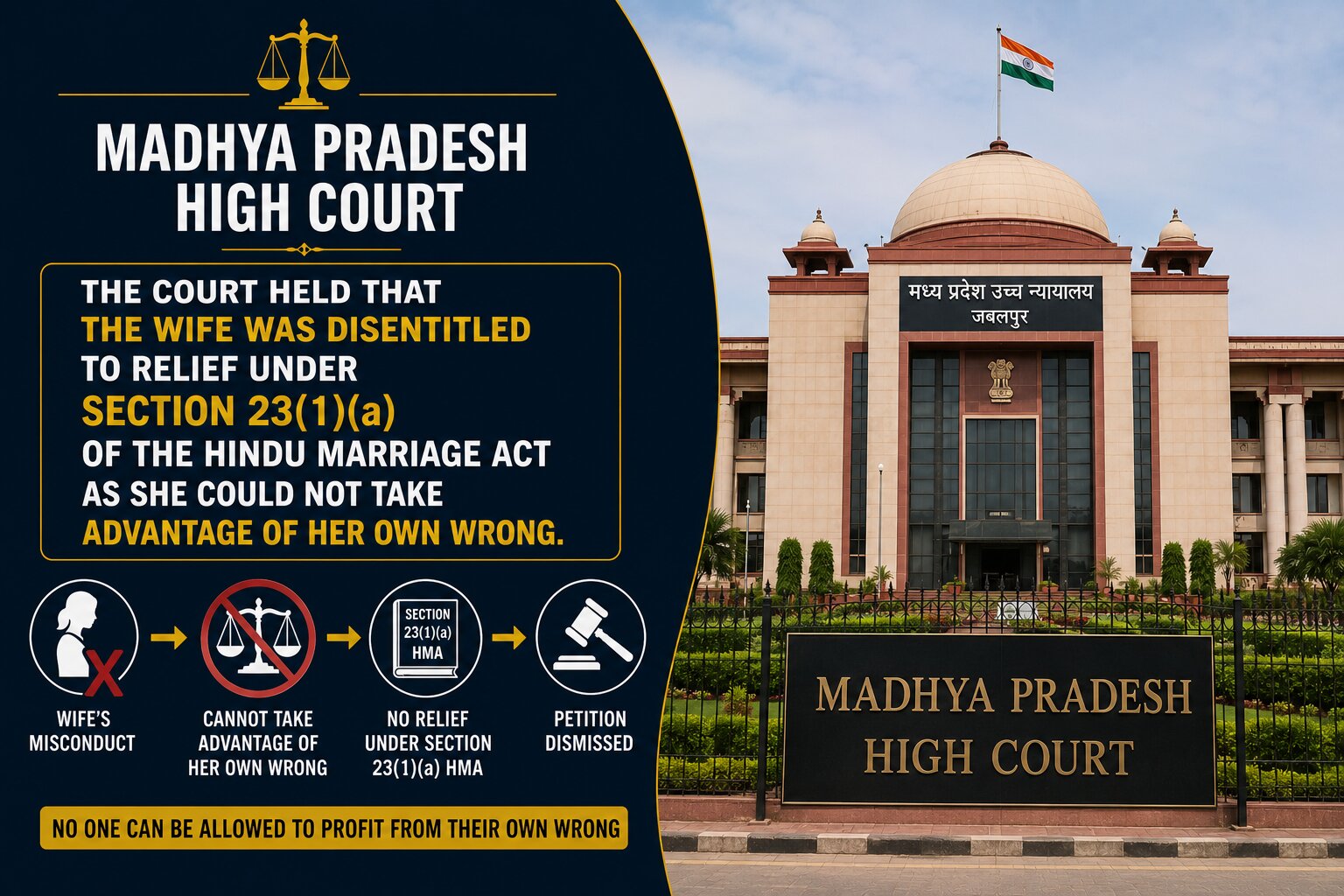
Invoking Section 23(1)(a) of the Hindu Marriage Act, the Court held that a spouse cannot seek matrimonial relief by taking advantage of his or her own wrong.
-
The Court concluded that the wife failed to establish any statutory ground for divorce while her own conduct disentitled her to equitable relief.
-
Accordingly, the appeal was dismissed, and the Trial Court's judgment refusing the decree of divorce was affirmed.
Held
-
The wife failed to prove cruelty or desertion under Section 13 of the Hindu Marriage Act, 1955.
-
The allegations regarding dowry demand and physical cruelty were vague and unsupported by evidence.
-
The evidence established that the wife had voluntarily left the matrimonial home.
-
The Court held that the wife was disentitled to relief under Section 23(1)(a) of the Hindu Marriage Act as she could not take advantage of her own wrong.
-
The Trial Court's dismissal of the divorce petition was upheld, and the appeal was dismissed.
Analysis
-
The judgment reiterates that allegations of cruelty must be supported by specific pleadings and credible evidence; vague or omnibus allegations are insufficient to obtain a decree of divorce.
-
The Court reaffirmed the equitable principle embodied in Section 23(1)(a) of the Hindu Marriage Act, namely that matrimonial relief cannot be granted to a party seeking to benefit from his or her own wrongful conduct.
-
The decision emphasizes the importance of proving matrimonial offences through reliable evidence rather than generalized accusations.
-
By considering the findings recorded in the earlier criminal proceedings, the Court assessed the overall conduct of the parties while deciding whether equitable relief should be granted.
-
The judgment also underscores that voluntary departure from the matrimonial home, if established, weakens a claim based on desertion or cruelty.
-
The ruling highlights the evidentiary burden resting upon the petitioner in matrimonial litigation and reinforces that statutory grounds for divorce must be affirmatively proved.
-
Overall, the decision illustrates the combined operation of Section 13 and Section 23(1)(a) of the Hindu Marriage Act in ensuring that divorce is granted only where the statutory grounds are established and the petitioner approaches the court with clean hands.