
Lucknow Development Authority v. Union of India & Ors., 2026
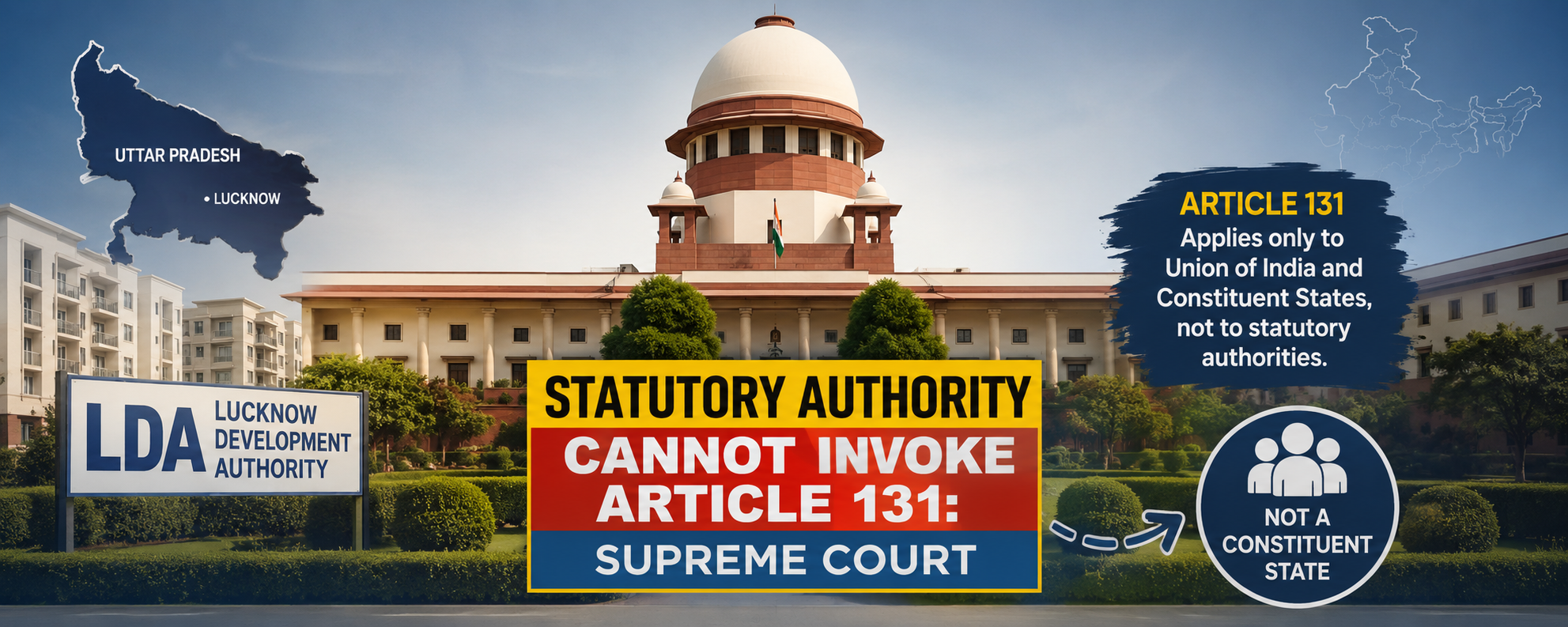
Statutory Bodies Cannot Invoke Article 131
Judgement Details
Court
Supreme Court of India
Date of Decision
29 August 2026
Judges
Justice Dipankar Datta and Justice Sheel Nagu
Citation
Acts / Provisions
Facts of the Case
-
The Lucknow Development Authority (LDA) is a statutory authority constituted under the Uttar Pradesh Urban Planning and Development Act, 1973.
-
The LDA had developed a colony in Lucknow and allotted plots and flats to various beneficiaries.
-
A dispute subsequently arose regarding possession of the land.
-
According to the LDA, officers of the Union Government and defence establishments were interfering with the physical possession of the land held by the allottees.
-
The LDA therefore approached the Allahabad High Court, Lucknow Bench, by filing a writ petition against the Union of India, GOC-in-C Central Command and Station Commander, Sub-Area, Cantonment, Lucknow.
-
The dispute remained pending for approximately two and a half decades.
-
Attempts were made to resolve the dispute between the concerned authorities, but these efforts were unsuccessful.
-
On September 19, 2023, the High Court dismissed the writ petition, observing that the dispute could not appropriately be adjudicated in the writ proceedings.
-
The High Court granted liberty to the parties to initiate proceedings under Article 131 of the Constitution.
-
The LDA challenged this order before the Supreme Court.
Issues
-
Whether the Lucknow Development Authority, being a statutory authority or instrumentality of the State, can invoke the original jurisdiction of the Supreme Court under Article 131 of the Constitution?
-
Whether the expression “States” occurring in Article 131 has the same meaning as the expression “State” defined under Article 12 of the Constitution?
-
Whether an authority falling within the definition of “State” under Article 12 can be treated as a constituent State for the purposes of Article 131?
-
Whether the Allahabad High Court was justified in dismissing the LDA's writ petition and granting liberty to pursue a remedy under Article 131?
-
Whether the High Court's characterization of the dispute as one between the Union and the State was legally sustainable when the actual petitioner was the LDA and not the State of Uttar Pradesh?
Judgement
-
The Supreme Court set aside the order of the Allahabad High Court.
-
The Court held that the High Court had committed a fundamental legal error by treating the LDA as though it were the State of Uttar Pradesh for the purposes of Article 131.
-
The Supreme Court drew an important distinction between: “State” under Article 12, and “States” under Article 131.
-
The Court explained that although the LDA may qualify as an instrumentality of the State and consequently fall within the broader definition of “State” under Article 12, this does not mean that it becomes a “State” capable of invoking Article 131.
-
Article 131 concerns disputes involving the constituent States of the Union, i.e. the States referred to in the First Schedule of the Constitution.
-
Therefore, a statutory authority such as the LDA cannot directly invoke the Supreme Court's original jurisdiction under Article 131.
-
The Supreme Court further found the High Court's approach particularly problematic because the writ petition had been filed by LDA itself, rather than by the State of Uttar Pradesh.
-
The Supreme Court consequently remitted the matter to the Allahabad High Court for fresh consideration in accordance with law.
-
Considering that the matter had already remained pending for a very long period, the Supreme Court requested the High Court to decide the matter expeditiously.
Held
-
The Supreme Court held that a statutory authority or instrumentality of the State cannot invoke the original jurisdiction of the Supreme Court under Article 131 merely because it falls within the definition of “State” under Article 12.
-
The expression “States” in Article 131 refers to the constituent States of the Union specified in the First Schedule, and not to every statutory body, authority or instrumentality that may fall within the wider definition of “State” under Article 12.
-
LDA may be “State” under Article 12, but it is not a “State” for the purposes of Article 131.
-
The High Court's order was therefore set aside, and the matter was remanded for fresh adjudication.
Analysis
-
The most important aspect of the judgment is the Court's distinction between the meaning of “State” under Article 12 and “States” under Article 131. The same constitutional word does not necessarily carry the same legal meaning in every constitutional provision.
-
Article 12 is primarily concerned with identifying authorities against which Fundamental Rights can be enforced. Its definition of “State” therefore extends beyond governments to include certain statutory authorities and instrumentalities.
-
Article 131 creates a special form of original jurisdiction of the Supreme Court. It is constitutionally restricted to disputes involving the Union and constituent States or disputes between constituent States.
-
Even if LDA qualifies as “State” under Article 12, that status does not transform it into a constituent State under Article 131.
-
The Court linked the expression “States” in Article 131 to the constituent States identified in the First Schedule. This provides a constitutional boundary to the parties capable of invoking Article 131.
-
The Supreme Court described the High Court's approach as a “gross error” because the High Court treated the dispute as though it were directly between the Union Government and the State of Uttar Pradesh, whereas the actual petitioner was the LDA.
-
The judgment makes clear that Article 131 is not a general mechanism through which statutory authorities can bring disputes involving the Union Government directly before the Supreme Court.
-
Development authorities, corporations, boards and other statutory bodies cannot assume that their classification as “State” under Article 12 automatically gives them access to every constitutional remedy available to a constituent State.
-
The decision demonstrates that constitutional provisions must be interpreted according to their context, purpose and specific language, rather than assuming that a term has an identical meaning throughout the Constitution.
-
The Supreme Court did not finally determine the underlying land-possession dispute. Instead, it corrected the High Court's legal approach and remanded the writ petition for fresh consideration.
-
The Supreme Court took note of the fact that the proceedings had remained pending for nearly two and a half decades and therefore requested an expeditious decision by the High Court.
-
The judgment reinforces the federal structure of the Constitution by preserving Article 131 as a mechanism for resolving disputes specifically involving the Union and constituent States, rather than expanding it to statutory bodies.