
LK v. State of Madhya Pradesh, 2026
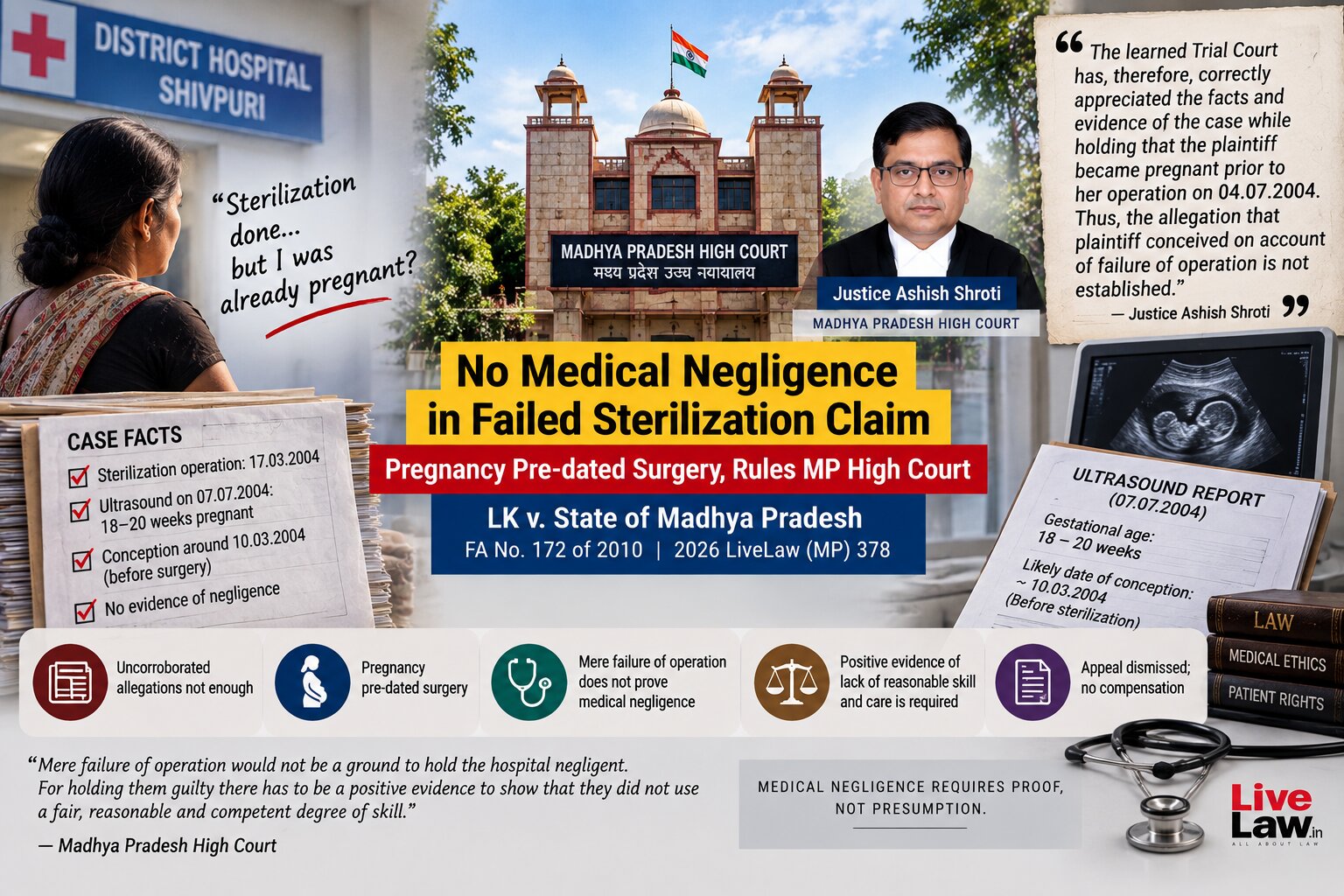
Mere failure of sterilization does not, by itself, establish medical negligence.
Judgement Details
Court
Madhya Pradesh High Court
Date of Decision
22 September 2026
Judges
Justice Ashish Shroti
Citation
Acts / Provisions
Facts of the Case
-
The appellant, a woman from a financially weaker section, approached the District Hospital, Shivpuri for a sterilization operation.
-
She stated that she already had five children and that her husband was a labourer.
-
After undergoing the required tests and formalities, she underwent a sterilization operation performed by Dr. Veena Kumra on 17.03.2004.
-
Approximately one or two months later, the appellant experienced stomach pain and visited the hospital for medical treatment.
-
She was prescribed medicines but did not obtain relief.
-
On a subsequent visit, she was advised to undergo an ultrasound examination.
-
The ultrasound revealed that she was pregnant.
-
The appellant alleged that the pregnancy resulted from the failure of the sterilization operation.
-
She further alleged that the hospital and doctor had failed to properly detect or disclose her pregnancy before the operation.
-
She claimed that she had made a complaint to the Collector of Shivpuri, which was forwarded to the Chief Medical and Health Officer for inquiry.
-
According to the appellant, the complaint was closed without a proper inquiry.
-
The hospital and the concerned doctors denied negligence and maintained that the sterilization procedure had been performed in accordance with the prescribed medical procedure.
-
The hospital contended that the pre-operative tests had not revealed any pregnancy.
-
A sonography conducted on 07.07.2004 showed a pregnancy of approximately 18–20 weeks.
-
On the basis of the gestational age, the hospital contended that conception had occurred around 10.03.2004, before the sterilization operation on 17.03.2004.
-
The hospital further contended that a pregnancy of approximately one week could not ordinarily be detected through the ultrasound or pathological tests relied upon at the relevant time.
-
The appellant's witness, Dr. Uma Jain, who conducted the sonography, stated that the appellant had not disclosed that she had undergone sterilization.
-
Dr. Uma Jain also stated that a one-week pregnancy could not be detected through ultrasound, although it could be detected through a urine test.
-
The Chief Medical and Health Officer was examined as a defence witness and stated that the departmental inquiry had found no negligence on the part of the hospital or the doctor.
-
The Trial Court, after considering the evidence, held that there was no medical negligence on the part of the hospital or the concerned doctor.
-
The appellant challenged the Trial Court's decision before the Madhya Pradesh High Court.
Issues
-
Whether the appellant's pregnancy after the sterilization operation established that the sterilization procedure had failed?
-
Whether the hospital and the concerned doctor were guilty of medical negligence in performing the sterilization operation?
-
Whether the medical evidence established that the appellant was already pregnant before the sterilization operation?
-
Whether the alleged failure to detect or disclose the appellant's pregnancy before the operation constituted medical negligence on the part of the hospital or doctor?
-
Whether mere failure of a sterilization operation, without positive evidence of want of reasonable skill and care, is sufficient to establish medical negligence?
-
Whether the appellant was entitled to compensation on the allegation that the birth of the sixth child resulted from medical negligence?
Judgement
-
The Madhya Pradesh High Court dismissed the appeal.
-
The Court upheld the Trial Court's finding that the appellant had become pregnant before the sterilization operation conducted on 17.03.2004.
-
The Court therefore held that the pregnancy could not be attributed to a failure of the sterilization procedure.
-
The Court observed that the sonography conducted on 07.07.2004 showed a pregnancy of approximately 18–20 weeks.
-
On the basis of the medical evidence, the Court accepted that conception had occurred before the date of the sterilization operation.
-
The Court rejected the allegation that the hospital had negligently failed to disclose an existing pregnancy.
-
The Court noted that the pregnancy had not been detected through the tests conducted before the operation.
-
The Court referred to State of Punjab v. Shiv Ram (2005) and reiterated that mere failure of a sterilization operation does not automatically establish medical negligence.
-
The Court held that positive evidence must establish that the doctor failed to exercise a fair, reasonable and competent degree of skill and care.
-
Since the evidence indicated that the appellant was already pregnant before the operation, there was no failure of the sterilization procedure in the circumstances of the case.
-
The Court therefore found no basis for imposing liability upon the hospital or doctor.
-
The Trial Court's order was accordingly upheld.
Held
-
The appellant's pregnancy was found to have preceded the sterilization operation.
-
Therefore, the pregnancy could not be treated as the result of failure of the sterilization procedure.
-
Medical negligence requires positive evidence demonstrating failure to exercise the requisite reasonable degree of care and skill.
-
The hospital and doctor could not be held negligent merely because the pregnancy was not detected before the operation when the available medical evidence indicated that the pregnancy was at an early stage.
-
The appellant was therefore not entitled to compensation on the ground of medical negligence.
-
The appeal was dismissed.
Analysis
-
Medical negligence requires proof: The Court reiterated that an adverse medical outcome alone does not establish negligence. There must be evidence showing failure to exercise the required standard of care and skill.
-
Timing of conception: The central factual question was whether conception occurred before or after the sterilization procedure. The gestational age recorded in the subsequent sonography was important to this determination.
-
Pregnancy before surgery: Since the evidence indicated that the appellant was already pregnant when the sterilization operation was performed, the operation could not logically be treated as the cause of the pregnancy.
-
Failure versus negligence: The Court distinguished between a genuine failure of a medical procedure and a situation where the alleged outcome was already present before the procedure.
-
Pre-operative detection: The Court rejected the allegation of negligent non-disclosure because the evidence indicated that the pregnancy was not detected during the relevant pre-operative testing.
-
Standard of care: Relying on State of Punjab v. Shiv Ram, the Court emphasized that a doctor is required to exercise a reasonable and competent degree of professional skill and care.
-
Positive evidence: The judgment stresses that a finding of negligence requires evidence demonstrating the doctor's departure from the applicable standard of care.
-
Compensation: Since the causal connection between the sterilization procedure and the pregnancy was not established, the foundation for the claim for compensation was absent.
-
Concurrent factual assessment: The High Court found no sufficient basis to disturb the Trial Court's assessment of the medical and documentary evidence.