
Lala and Another v. State of U.P. and Another, 2026
A Magistrate may disagree with a negative final report and treat a protest petition as a complaint.
Judgement Details
Court
High Court of Allahabad
Date of Decision
4 September 2026
Judges
Hon’ble Justice Anil Kumar-X
Citation
Acts / Provisions
Facts of the Case
-
On 3 November 2013 at about 10:00 p.m., village Chaukidar Rajendra informed Police Station Ahmadgarh, District Bulandshahr, about the death of Rahul, son of Anokhe Lal.
-
According to the initial information given by the village Chaukidar, Rahul had consumed liquor, lost consciousness and accidentally fallen from the roof of Maharaj Singh.
-
Rahul was taken by villagers to the District Hospital, Bulandshahr, where he subsequently died from his injuries.
-
Later on the same day, Pradeep Kumar, the brother of Rahul, lodged an FIR alleging that Rahul had been murdered by the petitioners, Lala and Mahesh.
-
According to the FIR, the accused persons had first made Rahul consume liquor at their house and thereafter assaulted him, causing injuries to his head.
-
The police investigated the allegations and, after completing the investigation, submitted a final report concluding that no criminal case was made out against the accused.
-
The informant was dissatisfied with the negative final report and filed a protest petition before the Magistrate.
-
The Magistrate treated the protest petition as a complaint case.
-
During the complaint inquiry, statements of seven witnesses were recorded under the relevant provisions of the CrPC.
-
After considering the material, the Chief Judicial Magistrate concluded that sufficient grounds existed to proceed against the petitioners.
-
The Magistrate consequently summoned the petitioners for the offence punishable under Section 302 IPC.
-
The petitioners challenged the summoning order before the Sessions Court.
-
The Sessions Court upheld the Magistrate's order, leading the petitioners to approach the Allahabad High Court under Article 227 of the Constitution.
-
Before the High Court, the petitioners argued that the Magistrate had failed to meaningfully consider the police investigation and had relied upon allegations introduced subsequently during the complaint inquiry.
-
One particularly significant allegation was that Rahul had been carrying ₹35,000, and that the accused had allegedly taken him with them to obtain that money.
-
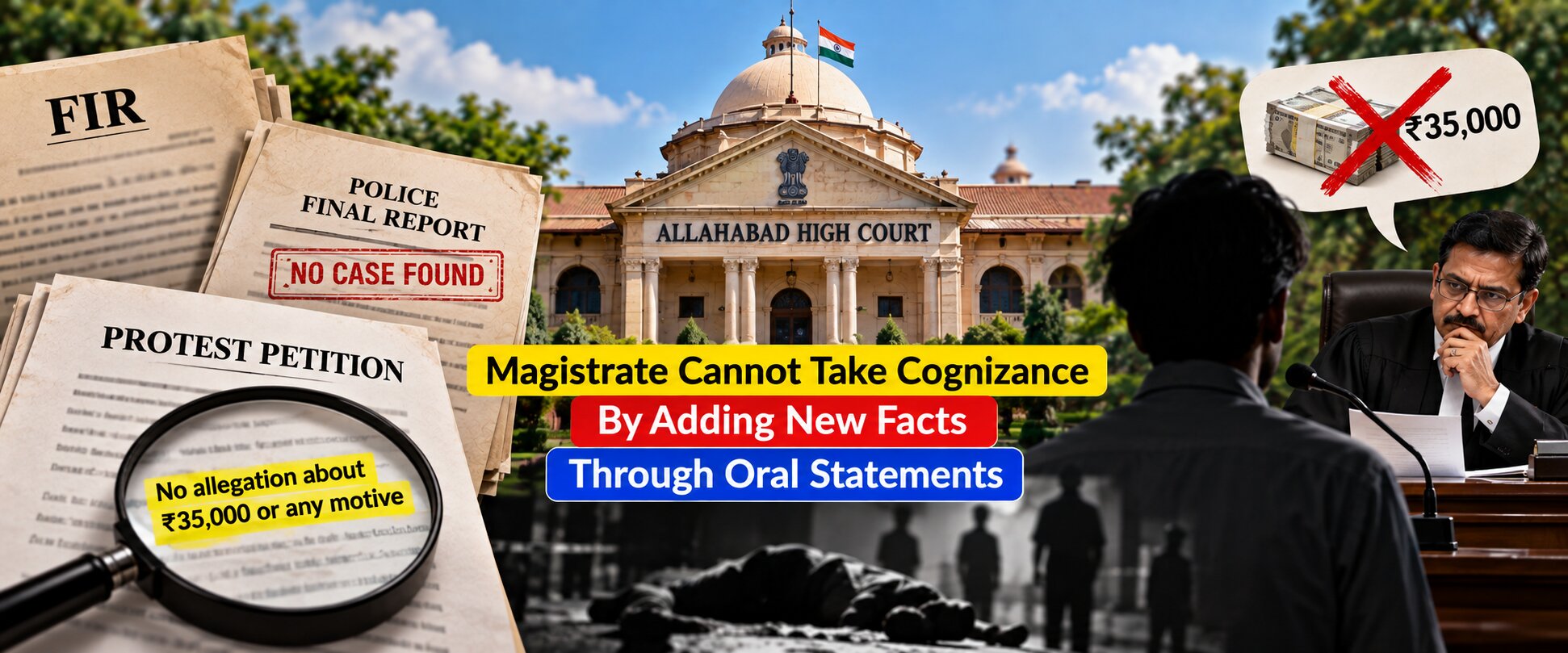
The High Court found that neither the FIR nor the protest petition contained any allegation concerning ₹35,000 or a motive to obtain that money.
-
These allegations appeared for the first time in statements recorded during the inquiry under Sections 200 and 202 CrPC.
-
The Court also noted that the deceased's body was ultimately found in front of Maharaj Singh's house, but there was no satisfactory explanation in either the investigation or complaint proceedings as to how Rahul reached that location.
-
The Court further found inconsistencies in the testimony of the witnesses and concluded that these circumstances required much more careful judicial scrutiny before the accused could be summoned for murder.
Issues
-
Whether a Magistrate can treat a protest petition challenging a negative final report as a complaint and proceed under Sections 200 and 202 of the Code of Criminal Procedure, 1973?
-
Whether material facts omitted from the FIR and protest petition can ordinarily be introduced for the first time through statements recorded during an inquiry under Sections 200 and 202 CrPC?
-
Whether the introduction of a new motive and allegation regarding possession of ₹35,000 during the complaint inquiry constitutes a material improvement requiring careful judicial scrutiny?
-
Whether a Magistrate, while disagreeing with a negative final report, is required to meaningfully consider the reasons and material collected by the Investigating Officer?
-
Whether a Magistrate can mechanically summon an accused for a grave offence under Section 302 IPC merely on the basis of statements recorded during a complaint inquiry without adequately examining omissions, contradictions and surrounding circumstances?
-
Whether the failure to scrutinize material inconsistencies, unexplained circumstances and improvements in the prosecution version renders a summoning order unsustainable for non-application of mind?
Judgement
-
The Allahabad High Court allowed the petition filed by the accused.
-
The Court held that a Magistrate is legally entitled to disagree with a negative final report submitted by the police.
-
However, such disagreement must be based upon proper judicial consideration of the investigation material.
-
The Court clarified that treating a protest petition as a complaint is legally permissible, but the power must be exercised with caution, particularly in cases involving grave offences such as murder.
-
The Court emphasized that the protest petition becomes the foundational pleading of the complaint case once it is treated as a complaint.
-
Material facts constituting the accusation should therefore ordinarily be disclosed in the protest petition itself.
-
The Court held that material facts omitted from the protest petition cannot ordinarily be supplied subsequently through oral testimony during the complaint inquiry.
-
In the present case, the allegation that Rahul was carrying ₹35,000 and that the accused had taken him for the purpose of grabbing that amount was absent from both the FIR and protest petition.
-
The allegation appeared for the first time during statements recorded under Sections 200 and 202 CrPC.
-
The Court regarded this as a material improvement in the prosecution version.
-
The Court observed that such an improvement becomes particularly significant when the newly introduced fact attempts to supply a motive that was absent from the original version.
-
The Court also considered the circumstances surrounding the discovery of the deceased.
-
Rahul was allegedly taken to the petitioners' house, yet his body was subsequently found in front of the house of another person.
-
No satisfactory explanation had been given as to how Rahul reached that location.
-
The Court considered this an important missing link in the prosecution story.
-
The Court also examined the testimony of P.W.-2 Somveer.
-
The witness claimed that he had seen the petitioners assault Rahul but also stated that the petitioners subsequently confessed before him that they had not intended to kill Rahul.
-
The Court found the circumstances surrounding this alleged observation and subsequent confession to be sufficiently unusual to require careful scrutiny.
-
The Court emphasized that where a police investigation has resulted in a final report, the Magistrate should carefully consider the reasons given by the Investigating Officer.
-
If the Magistrate disagrees with the investigation, the order should identify the specific material that justifies such disagreement.
-
Improvements, omissions and contradictions between the FIR, protest petition and subsequent statements must be carefully examined.
-
Where the prosecution case depends upon circumstantial evidence, the circumstances should at least prima facie form a coherent chain pointing towards the accused.
-
The summoning order in a serious offence must demonstrate application of judicial mind and disclose the reasons for proceeding against the accused.
-
The Court further observed that a complaint inquiry cannot always substitute for a full-fledged police investigation.
-
Where establishing the truth requires scientific, medical, forensic, electronic or other investigative material, the Magistrate should consider whether further investigation would be more appropriate.
-
The Court therefore concluded that the Magistrate had failed to properly scrutinize the material before summoning the petitioners.
-
The summoning order consequently suffered from non-application of mind.
-
The High Court set aside the order dated 20 January 2024 passed by the Chief Judicial Magistrate.
-
The Court also set aside the order dated 18 December 2024 passed by the Additional Sessions Judge in the criminal revision.
-
The proceedings arising from the impugned summoning order were consequently brought to an end.
Held
-
However, such power must be exercised cautiously and through meaningful judicial scrutiny.
-
A protest petition, once converted into a complaint, constitutes the foundational pleading of the complaint case.
-
Material facts omitted from the protest petition cannot ordinarily be supplied later through oral statements recorded under Sections 200 and 202 CrPC.
-
Introduction of a new material fact during the inquiry may constitute a material improvement and raise doubts concerning the genuineness of the accusation.
Analysis
- If the Magistrate disagrees with the Investigating Officer, the Magistrate should identify the specific material supporting that disagreement.
-
Contradictions, omissions and improvements between the FIR, protest petition and inquiry statements must be carefully examined.
-
In a case based on circumstantial evidence, the circumstances relied upon should prima facie form a coherent chain pointing towards the accused.
-
A summoning order for a grave offence must demonstrate application of judicial mind and disclose the reasons for proceeding against the accused.
-
A mechanical inquiry under Sections 200 and 202 CrPC is insufficient where the surrounding circumstances and witness testimony require deeper scrutiny.
-
The summoning order in the present case was unsustainable because the Magistrate failed to properly scrutinize the relevant material.