
Lal Babu v. State of Uttar Pradesh, 2026
The Court reaffirmed the central importance of the accused's right to cross-examination, recognizing it as an indispensable component of a fair criminal trial.
Judgement Details
Court
Allahabad High Court
Date of Decision
14 July 2026
Judges
Justice Subhash Vidyarthi
Citation
Acts / Provisions
Facts of the Case
-
The complainant lodged an FIR on 11 March 2009, alleging that his 14-year-old daughter had been kidnapped in a Maruti car by the appellant, Lal Babu, and his brother.
-
The victim was recovered the following day while she was in the company of the appellant.
-
The medico-legal examination revealed no injuries on any part of the victim's body, including her private parts, and her age was radiologically assessed to be approximately 16 years.
-
During the investigation, the victim gave a statement before a Magistrate under Section 164 CrPC, supporting the prosecution's allegation of kidnapping.
-
During the trial, however, the complainant, the victim's younger sister, and the victim herself turned hostile and did not support the prosecution case.
-
The victim deposed before the Trial Court that she had voluntarily left her home after becoming angry and had gone to stay with a relative. She categorically denied that she had been kidnapped.
-
The victim further stated that her statement recorded under Section 164 CrPC had been made under police pressure.
-
Despite all the material witnesses turning hostile, the Trial Court relied upon the victim's Section 164 CrPC statement and the charge-sheet to convict the appellant.
-
The Trial Court reasoned that the witnesses had changed their version due to social pressure and concern for the family's reputation.
-
Aggrieved by the conviction and sentence of five years' imprisonment, the appellant preferred a criminal appeal before the Allahabad High Court.
Issues
-
Whether an accused can be convicted solely on the basis of a statement recorded under Section 164 CrPC when the maker of the statement has resiled from it during trial?
-
Whether a statement recorded under Section 164 CrPC constitutes substantive evidence capable of sustaining a conviction by itself?
-
Whether reliance on a Section 164 CrPC statement violates the accused's statutory right to cross-examine witnesses under Section 273 CrPC?
-
Whether the Trial Court committed an error in convicting the appellant despite all the prosecution witnesses, including the victim, turning hostile?
Judgement
-
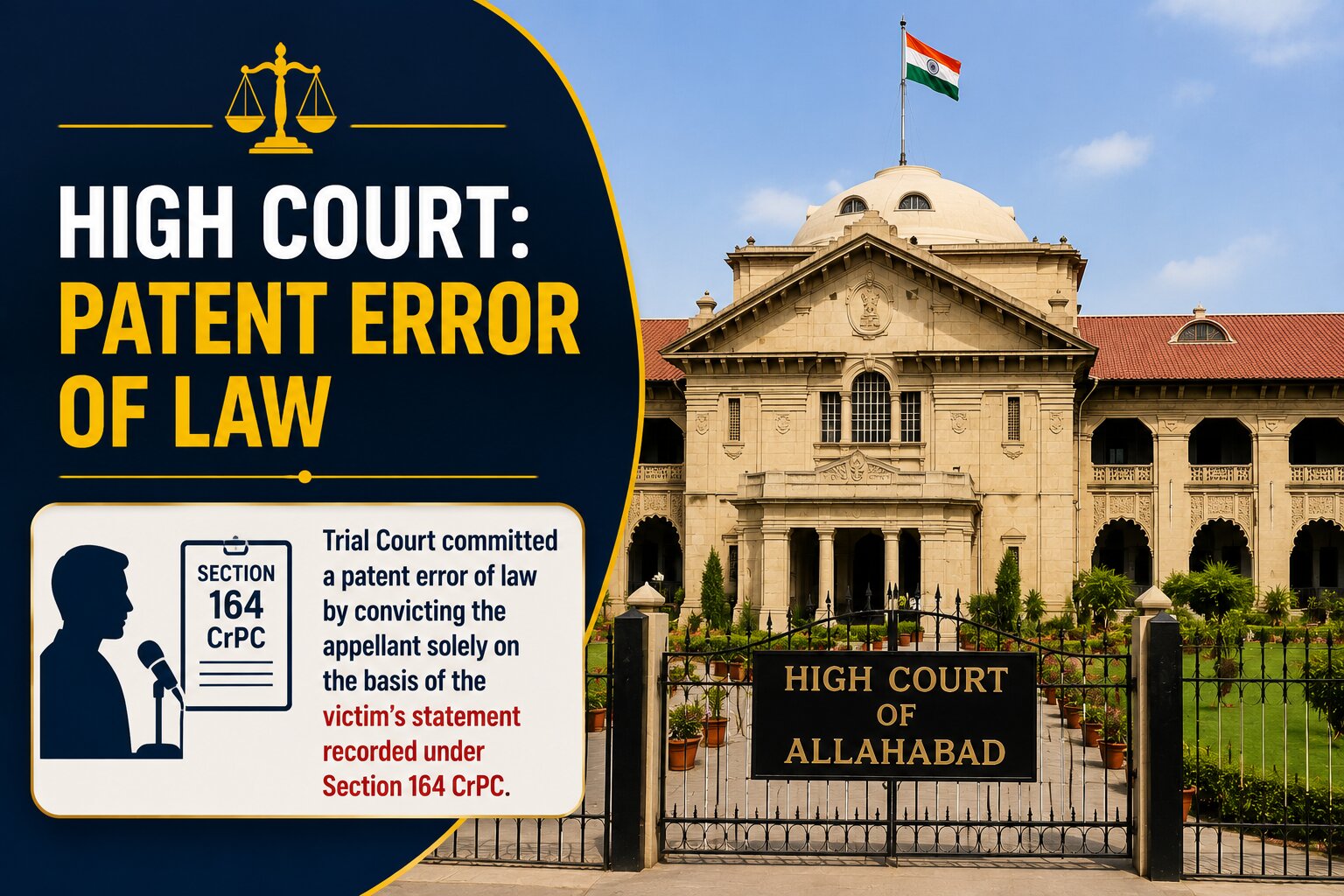
The High Court held that the Trial Court committed a patent error of law by convicting the appellant solely on the basis of the victim's statement recorded under Section 164 CrPC.
-
The Court observed that a statement recorded under Section 164 CrPC is made during the investigation stage and not during the trial.
-
The Court held that since the accused has no opportunity to cross-examine the witness at the time such a statement is recorded, it cannot be treated as substantive evidence.
-
The Court emphasized that criminal convictions must be founded upon evidence recorded in the presence of the accused in accordance with Section 273 CrPC.
-
The Court reiterated that the right to watch prosecution witnesses depose before the Court and to cross-examine them is a valuable statutory safeguard essential to a fair trial.
-
The Court held that when the victim and other prosecution witnesses turned hostile and withdrew support from the prosecution case, the earlier Section 164 CrPC statement alone could not sustain the conviction.
-
The Court found that the Trial Court had improperly relied upon material collected behind the back of the accused, thereby violating settled principles of criminal jurisprudence.
-
Consequently, the High Court allowed the appeal, set aside the judgment of conviction dated 2011, and acquitted the appellant of the charge under Section 366 IPC.
Held
-
A statement recorded under Section 164 CrPC is not substantive evidence.
-
An accused cannot be convicted solely on the basis of a Section 164 CrPC statement.
-
Evidence relied upon for conviction must ordinarily be recorded in the presence of the accused, ensuring the right of cross-examination under Section 273 CrPC.
-
Where the victim and other prosecution witnesses turn hostile during trial, a conviction cannot rest solely upon the earlier Section 164 CrPC statement.
-
The appellant's conviction under Section 366 IPC was set aside, and he was acquitted.
Analysis
-
The judgment reinforces the distinction between investigative statements and substantive evidence, clarifying that statements recorded under Section 164 CrPC serve only a limited evidentiary purpose unless duly proved during trial.
-
By relying upon Section 273 CrPC, the Court emphasized that criminal convictions must be based on evidence tested through adversarial proceedings rather than untested investigative material.
-
The decision follows the Supreme Court's ruling in Jayendra Vishnu Thakur v. State of Maharashtra (2009), strengthening the principle that procedural safeguards cannot be sacrificed for securing convictions.
-
The judgment serves as an important reminder to Trial Courts that hostility of witnesses cannot justify reliance solely upon previous statements recorded during investigation.
-
The ruling strengthens the constitutional guarantee of a fair trial by preventing convictions founded upon evidence obtained without giving the accused an opportunity to challenge its credibility.
-
Overall, the decision reinforces the principles of natural justice, due process, and the requirement that guilt must be proved beyond reasonable doubt through legally admissible evidence.