
Lakshmi v. Gopi & Others, 2026
The Bench observed that appellate courts are under a duty to carefully reappreciate the evidence before reversing findings of fact.
Judgement Details
Court
Supreme Court of India
Date of Decision
14 July 2026
Judges
Justice Sanjay Karol & Justice Vipul M. Pancholi
Citation
Acts / Provisions
Facts of the Case
-
The dispute concerned the estate of Thankam, who died on 27 August 2011.
-
The plaintiff, Thankam's daughter, instituted a suit for partition, claiming that she had no knowledge of any Will executed by her mother.
-
The defendants resisted the suit by relying upon a registered Will dated 22 March 1999, contending that Thankam had bequeathed her properties in their favour.
-
After examining the oral and documentary evidence, the Trial Court held that the defendants failed to prove the Will in accordance with Section 63 of the Indian Succession Act and the relevant provisions of the Evidence Act.
-
The Trial Court consequently passed a preliminary decree for partition, granting the plaintiff 2/10th share in the property.
-
The Kerala High Court, in first appeal, briefly reversed the Trial Court's decree, upheld the Will, and additionally directed that the Principal Sub Judge who delivered the original judgment be sent for training.
-
Aggrieved, the plaintiff approached the Supreme Court.
Issues
-
Whether a first appellate court can reverse a reasoned trial court judgment without independently evaluating the evidence and recording its own reasons?
-
Whether the Kerala High Court was justified in reversing the Trial Court's findings regarding the validity of the Will through a brief and unreasoned judgment?
-
Whether the High Court was justified in making adverse remarks against the Trial Judge and directing that the judicial officer undergo training?
-
Whether the Will had been proved in accordance with the requirements of the Indian Succession Act and the Indian Evidence Act?
Judgement
-
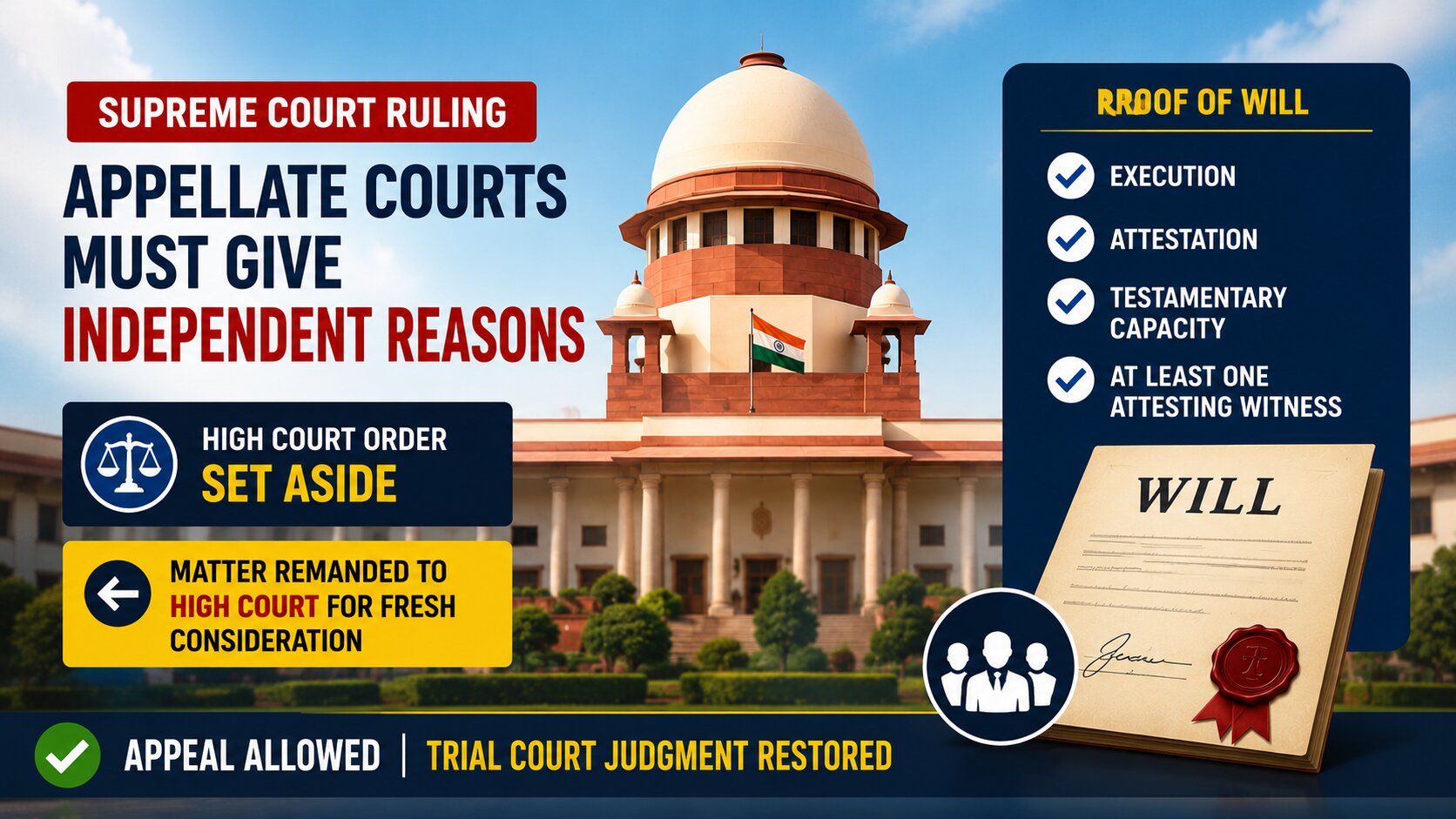
The Supreme Court allowed the appeal and set aside the judgment of the Kerala High Court.
-
The Court held that a first appellate court cannot merely declare the Trial Court's judgment erroneous without independently analysing the evidence and recording its own findings.
-
The Bench observed that appellate courts are under a duty to carefully reappreciate the evidence before reversing findings of fact.
-
The Court criticized the High Court for mechanically extracting portions of the Trial Court's reasoning and rejecting them through a brief observation without meaningful analysis.
-
The Supreme Court held that if the High Court believed the Trial Court had committed an error, it was incumbent upon it to explain, through independent reasoning, the correct application of law and evidence.
-
On the issue of proof of the Will, the Court observed that once the Trial Court had found suspicious circumstances surrounding the Will, the High Court was required to examine whether the statutory requirements under the Indian Succession Act and the Evidence Act had been duly satisfied.
-
The Court reiterated the legal requirements governing proof of a Will, including proof of execution, attestation, testamentary capacity, and examination of at least one attesting witness.
-
The Supreme Court expunged the adverse remarks made against the Trial Judge and set aside the direction requiring the judicial officer to undergo training.
-
The matter was remanded to the Kerala High Court for fresh consideration in accordance with law.
Held
-
The Supreme Court allowed the appeal and set aside the judgment of the Kerala High Court.
-
The Court held that a first appellate court cannot merely declare the Trial Court's judgment erroneous without independently analysing the evidence and recording its own findings.
-
The Court criticized the High Court for mechanically extracting portions of the Trial Court's reasoning and rejecting them through a brief observation without meaningful analysis.
-
The Supreme Court held that if the High Court believed the Trial Court had committed an error, it was incumbent upon it to explain, through independent reasoning, the correct application of law and evidence.
-
On the issue of proof of the Will, the Court observed that once the Trial Court had found suspicious circumstances surrounding the Will, the High Court was required to examine whether the statutory requirements under the Indian Succession Act and the Evidence Act had been duly satisfied.
-
The Court reiterated the legal requirements governing proof of a Will, including proof of execution, attestation, testamentary capacity, and examination of at least one attesting witness.
-
The Supreme Court expunged the adverse remarks made against the Trial Judge and set aside the direction requiring the judicial officer to undergo training.
-
The matter was remanded to the Kerala High Court for fresh consideration in accordance with law.
Analysis
-
The judgment reaffirms the settled principle that a first appeal is a valuable statutory right involving a complete rehearing on facts and law, requiring a comprehensive appreciation of evidence.
-
The Supreme Court emphasized that appellate courts discharge a corrective function and therefore must provide independent reasons while reversing factual findings of the Trial Court.
-
The Court discouraged a supervisory or hierarchical approach toward subordinate courts, observing that appellate courts should function as "a friend, philosopher and a guide" rather than merely highlighting perceived errors.
-
The decision also restates the well-established principles governing proof of Wills, emphasizing that mere proof of signatures or attestation is insufficient where suspicious circumstances exist.
-
By summarizing the statutory requirements under the Indian Succession Act and Evidence Act, the Court has provided a useful checklist for courts dealing with testamentary disputes.
-
The judgment also reinforces judicial discipline by cautioning higher courts against making unnecessary or disparaging remarks against subordinate judges without compelling reasons.
-
Overall, the ruling strengthens the standards of appellate review, promotes reasoned judicial decision-making, and safeguards the independence and dignity of subordinate judiciary.