
Kxxxxx V. The State Govt. Of Nct Of Delhi & Anr., 2026
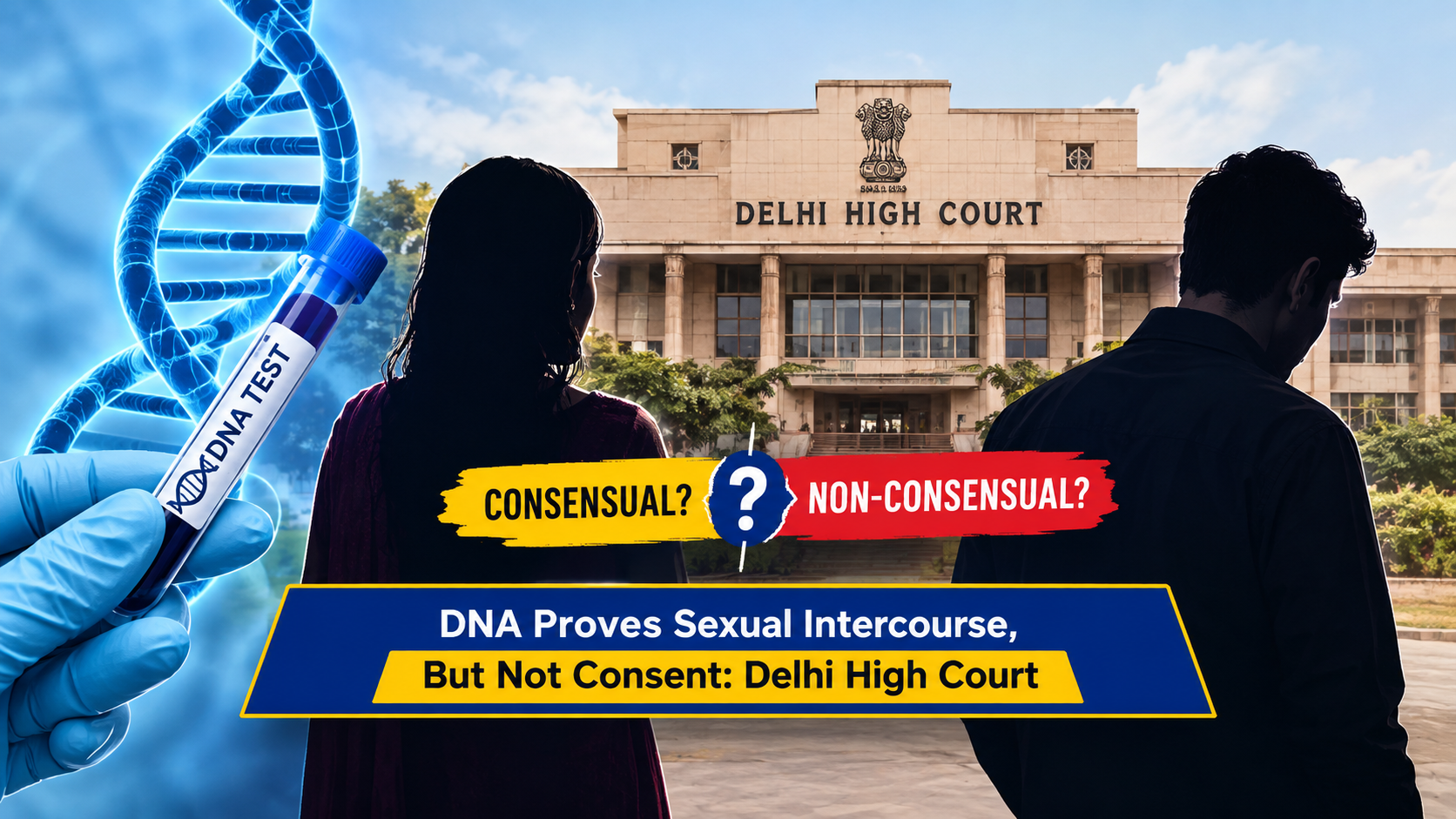
DNA Proves Intercourse, Not Consent: Delhi High Court Upholds Acquittal
Judgement Details
Court
Delhi High Court
Date of Decision
18 September 2026
Judges
Hon’ble Justice Madhu Jain
Citation
Acts / Provisions
Facts of the Case
-
The prosecutrix alleged that the accused, who was known to her family, had established physical relations with her from around 2017 onwards against her wishes, allegedly through threats, inducements and, on one occasion, after administering an intoxicating substance.
-
She further alleged that the accused repeatedly subjected her to sexual acts, including alleged unnatural sexual acts, and threatened her. She became pregnant and gave birth to a child on 20 June 2019.
-
During the investigation, DNA samples of the prosecutrix, accused and child were examined by the FSL, Rohini. The DNA report established that the accused was the biological father of the child, thereby establishing sexual intercourse between the parties.
-
The FIR was registered on 17 March 2021, and the accused was ultimately charged under Sections 328, 376(2)(n), 377, 506 and 509 IPC. The Trial Court acquitted him on 7 October 2024, finding material inconsistencies in the prosecutrix's evidence and other deficiencies in the prosecution case.
-
The prosecutrix challenged the acquittal before the Delhi High Court.
Issues
-
Whether the Trial Court's order of acquittal suffered from perversity, patent illegality or material misappreciation of evidence warranting interference by the High Court.
-
Whether the DNA report establishing the accused as the biological father of the child conclusively established that the sexual intercourse was non-consensual.
-
Whether the statutory presumption under Section 114A of the Evidence Act rendered the prosecutrix's testimony immune from judicial scrutiny once sexual intercourse and alleged absence of consent were established.
-
Whether the inconsistencies and improvements in the prosecutrix's statements materially affected the credibility of the prosecution case.
-
Whether the prosecution had proved the charges under Sections 328, 377, 506 and 509 IPC beyond reasonable doubt.
Judgement
-
The Delhi High Court dismissed the appeal filed by the prosecutrix and upheld the acquittal recorded by the Additional Sessions Judge, Dwarka Courts.
-
The Court emphasized that the DNA report was significant because it established the accused's paternity and consequently the fact of sexual intercourse. However, DNA evidence alone could not establish the circumstances in which the intercourse occurred or whether it was consensual or non-consensual.
-
The Court also considered the scope of Section 114A of the Evidence Act. It held that although the statutory presumption must be given effect where its conditions are satisfied, it does not make the testimony of the prosecutrix immune from judicial scrutiny. The foundational facts and the evidence as a whole still have to be examined.
-
The High Court noted several inconsistencies concerning the alleged administration of an intoxicating substance, the prosecutrix's state of consciousness, the circumstances surrounding the pregnancy and paternity, the alleged police call, and allegations concerning nude photographs/videos.
-
The Court further reiterated that in an appeal against acquittal, an appellate court should not substitute its own view merely because another view is possible. Interference is justified where the Trial Court's conclusion is perverse, manifestly illegal, based on material misreading of evidence, or where guilt is the only reasonable conclusion.
Held
-
The appeal was dismissed and the acquittal was upheld.
-
DNA evidence can establish paternity and the fact of sexual intercourse, but by itself it does not establish absence of consent or the circumstances in which the intercourse occurred.
-
The prosecution nevertheless had to establish the offence under Section 376(2)(n) IPC beyond reasonable doubt. The Court found that the Trial Court's assessment of the evidence was a reasonably possible view and did not warrant appellate interference.
-
The Court also clarified that the sole testimony of a prosecutrix can be sufficient for conviction, but the testimony must be reliable and inspire confidence; material contradictions and inconsistencies can legitimately be considered by the Court.
Analysis
-
The most significant aspect of the judgment is the distinction between proving sexual intercourse and proving lack of consent. The DNA report established that the accused was the biological father of the child and therefore provided strong scientific evidence of sexual intercourse. But DNA cannot ordinarily reveal whether the intercourse occurred voluntarily, through coercion, under threat, or in another circumstance.
-
For the offence under Section 376(2)(n) IPC, the relevant inquiry was not simply whether sexual intercourse occurred, but whether the prosecution proved the legally relevant circumstances demonstrating absence of consent and the other ingredients of the offence.
-
The Court recognized the statutory presumption under Section 114A of the Evidence Act, but clarified that the provision does not mean that every statement of the prosecutrix must automatically be accepted without examination. The Court may assess the credibility and consistency of the evidence and determine whether the statutory requirements are satisfied.
-
The High Court did not treat the delay in reporting as determinative by itself. It expressly noted that delay in reporting a sexual offence, standing alone, cannot be sufficient to discard a prosecution case. Instead, the Court considered the delay together with the alleged inconsistencies, improvements, surrounding circumstances and absence of corroboration relating to particular allegations.
-
The judgment also reinforces the established principle that an acquittal carries a strengthened presumption of innocence. Where the Trial Court's conclusion represents a reasonably possible view of the evidence, the appellate court ordinarily will not interfere merely because another interpretation is possible.
-
The judgment is particularly relevant to the evidentiary value of DNA/paternity evidence in sexual-offence prosecutions. It demonstrates that scientific evidence establishing biological parentage or intercourse does not, standing alone, answer the separate legal question of consent. The remaining evidence must still establish the prosecution's case beyond reasonable doubt.