
Kutubuddin Fakruddin Faruqui & Ors. v. Gujarat State Waqf Board & Ors., 2026
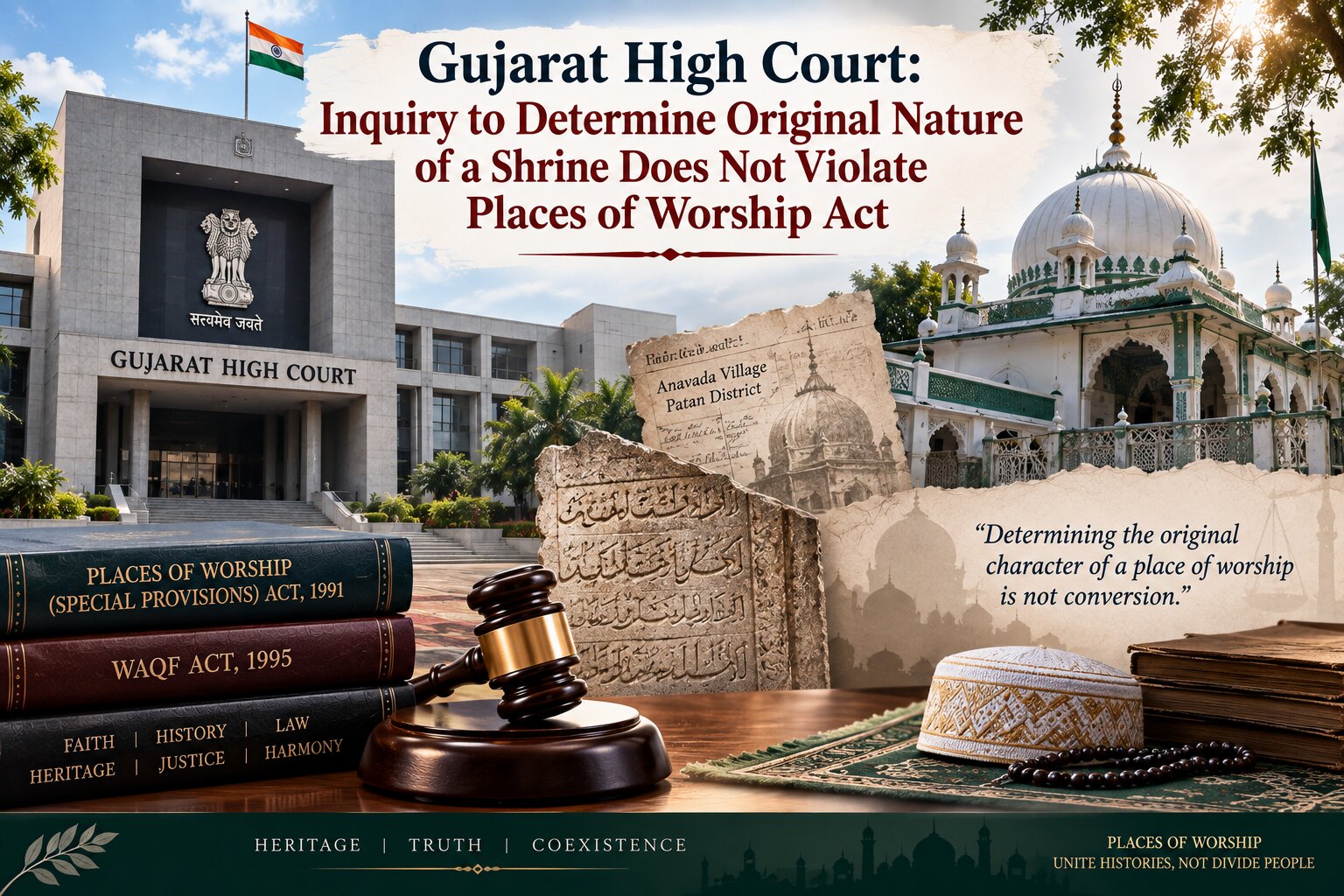
An inquiry into the original nature and character of a Waqf property is not, by itself, conversion of a place of worship.
Judgement Details
Court
Gujarat High Court
Date of Decision
14 September 2026
Judges
Justice J. C. Doshi
Citation
Acts / Provisions
Facts of the Case
-
The dispute concerned a historical holy shrine situated at Anavada village, Patan district, Gujarat.
-
The appellants, members of the Faruqui family, claimed that the shrine was “Maulana Mehbub Dargah Masjid and Kabrastan.”
-
According to the appellants, the shrine was built over the grave of Hazrat Maulana Mehbub, who died in 1377 AD, and followed the Sunni-Hanafi-Barelvi tradition.
-
The Faruqui family claimed that their predecessors had served as Mujawars, or caretakers, and subsequently claimed the position of Mutawallis.
-
The shrine was registered as a public trust in 1953, with Nanibai, described as a Mujawar, registering the property under the name “Maulana Mehbub Dargah Masjid and Kabrastan.”
-
The respondents claimed that the shrine was actually associated with Maulana Yaqub, a saint of the Dawoodi Bohra community, and sought alteration of the Waqf records accordingly.
-
Historical revenue records from the Gaekwad State period referred to the property as “Maulana Yaqub Saheb Dargah, Dawoodi Bohra Kabrastan Pir Ni Jago.”
-
The Court noted that the description “Maulana Mehbub Dargah Masjid and Kabrastan” appeared in the records only after the trust was registered.
-
An ancient inscription at the shrine referred to Maulana Yaqub and indicated that he was also respectfully described as Mehboob/Mashuk.
-
The Faruqui family relied upon their succession as Mujawars and later Mutawallis to support their claim over the shrine's administration.
-
The Waqf Board had earlier accepted a change report and appointed members of the Faruqui family as Mutawallis, but the High Court found that the statutory procedure had not been properly followed.
-
In a subsequent proceeding, the Waqf Board ordered alteration of the shrine's name to “Maulana Yaqub Saheb Dargah and Dawoodi Bohra Kabrastan.”
-
The Waqf Tribunal upheld the Waqf Board's decision and also set aside the earlier appointment of the Faruqui family members as Mutawallis.
-
The Faruqui family then approached the Gujarat High Court challenging the Waqf Tribunal's decision.
Issues
-
Whether an inquiry by the Waqf Board to determine the original religious identity and character of a Waqf property amounts to conversion of a place of worship prohibited under Section 3 of the Places of Worship Act, 1991?
-
Whether the appellants established that the shrine was a Sunni-Hanafi-Barelvi place of worship as on 15 August 1947?
-
Whether the historical and revenue records established that the shrine was originally associated with Maulana Yaqub and the Dawoodi Bohra community?
-
Whether the Faruqui family acquired a legally enforceable right to act as Mutawallis merely because their predecessors had acted as Mujawars?
-
Whether the appointment of the Faruqui family members as Mutawallis through the 2015 change report was legally valid in the absence of compliance with Section 63 of the Waqf Act?
-
Whether the Waqf Board was required to provide a mandatory oral or personal hearing in the nature of a full-fledged trial during its inquiry?
-
Whether the orders passed by the Waqf Board and Waqf Tribunal required interference by the Gujarat High Court?
Judgement
-
The Gujarat High Court dismissed the appeal filed by the Faruqui family and confirmed the findings of the Waqf Board and Waqf Tribunal.
-
The Court held that determining the original nature and religious character of the shrine is different from converting an existing place of worship from one religious character to another.
-
An inquiry undertaken by the Waqf Board to ascertain the historical identity and character of the Waqf property was therefore not barred by Section 3 of the Places of Worship Act, 1991.
-
The appellants failed to produce reliable documentary material establishing that the shrine originally belonged to the Sunni-Hanafi-Barelvi sect.
-
Historical revenue records supported the association of the shrine with Maulana Yaqub and the Dawoodi Bohra community.
-
The ancient inscription at the shrine further supported the connection with Maulana Yaqub.
-
The Court rejected the claim that the shrine had originally belonged to one sect and was subsequently converted to another.
-
The Court held that a Mujawar is essentially a caretaker and does not automatically acquire a hereditary right to the office.
-
The Faruqui family's claim to Mutawalliship could not be sustained merely because its members or predecessors had acted as Mujawars.
-
In the absence of a Waqf deed prescribing succession, the Waqf Board was required to follow the statutory procedure under Section 63 of the Waqf Act.
-
The earlier appointment of the Faruqui family members as Mutawallis through the change report was therefore not legally sustainable.
-
The Court rejected the argument that the Waqf Board's inquiry was invalid merely because a full-fledged oral hearing was not provided.
-
The appeal was consequently dismissed.
Held
-
Such an inquiry is therefore not barred by Section 3 of the Places of Worship Act, 1991.
-
The appellants failed to establish that the shrine was a Sunni-Hanafi-Barelvi place of worship on 15 August 1947.
-
Historical records and the ancient inscription supported the shrine's association with Maulana Yaqub and the Dawoodi Bohra community.
-
A Mujawar does not automatically possess a hereditary right to the office merely by virtue of acting as caretaker.
-
The Faruqui family's claim to Mutawalliship lacked sufficient legal foundation.
-
Where the right to act as Mutawalli is disputed and no valid succession mechanism exists, the Waqf Board must follow Section 63 of the Waqf Act.
-
The Board's inquiry did not require a mandatory oral hearing equivalent to a full trial.
-
The findings of the Waqf Board and Waqf Tribunal were supported by the material on record and did not warrant interference by the High Court.
Analysis
-
The central legal distinction is between conversion and determination of original religious character.
-
Section 3 of the Places of Worship Act protects the religious character of places of worship as existing on 15 August 1947; the Court treated an investigation into what that character actually was as different from changing it.
-
The judgment therefore does not treat every inquiry concerning the historical identity of a religious property as a prohibited conversion.
-
The Court placed importance on historical and revenue records rather than relying solely on later descriptions appearing in trust-registration documents.
-
The ancient inscription was considered important corroborative evidence connecting the shrine with Maulana Yaqub.
-
Registration of a trust under a particular name does not necessarily conclusively establish the historical origin or religious identity of the underlying property.
-
A Waqf property cannot be treated as the personal property of the persons managing it.
-
The Court distinguished the position of a Mujawar from that of a legally appointed Mutawalli.
-
Mere continuation of caretaking responsibilities within a family cannot by itself create a legally recognized hereditary right over Waqf administration.
-
Section 63 of the Waqf Act becomes significant when there is a vacancy or dispute concerning the right of a person to act as Mutawalli and there is no valid appointment mechanism under the Waqf deed.
-
The Court also considered the objection concerning natural justice and concluded that the nature of the Waqf Board's inquiry did not make a full oral hearing mandatory.
-
The decision ultimately upheld the findings of the Waqf Board and Waqf Tribunal on the basis of the historical, documentary and statutory material.