
Kusum v. State of Uttar Pradesh and 2 Others, 2026
A mother who is already receiving maintenance from her biological son pursuant to an order under Section 125 CrPC cannot seek another maintenance order against her stepson for the same purpose.
Judgement Details
Court
Allahabad High Court
Date of Decision
14 July 2026
Judges
Justice Lakshmi Kant Shukla
Citation
Acts / Provisions
Facts of the Case
-
The revisionist, Kusum, filed an application under Section 125 CrPC seeking maintenance from her biological son and her stepson.
-
The Family Court found that she was unable to maintain herself and directed her biological son (Opposite Party No. 3) to pay ₹8,000 per month as maintenance.
-
The Family Court did not fasten any liability upon the stepson (Opposite Party No. 2).
-
The biological son accepted the Family Court's order and did not challenge the direction requiring him to pay maintenance.
-
Aggrieved by the Family Court's refusal to direct the stepson to contribute towards maintenance, the mother filed the present criminal revision before the Allahabad High Court.
-
She contended that both her biological son and her stepson ought to have been held jointly liable to maintain her.
-
The State and the stepson opposed the revision, arguing that once the biological son, who had sufficient means, had been directed to maintain his mother, there was no legal basis to impose a second maintenance liability upon the stepson.
-
The High Court examined whether a parent already receiving maintenance from one legally liable person could seek another maintenance order from another person for the same purpose.
Issues
-
Whether a mother who has already been granted maintenance under Section 125 CrPC against her biological son can subsequently seek another maintenance order against her stepson for the same purpose?
-
Whether the Family Court erred in fastening liability solely upon the biological son while exempting the stepson from paying maintenance?
-
Whether a claimant who is already receiving maintenance under a judicial order continues to satisfy the requirement of being unable to maintain herself under Section 125 CrPC?
Judgement
-
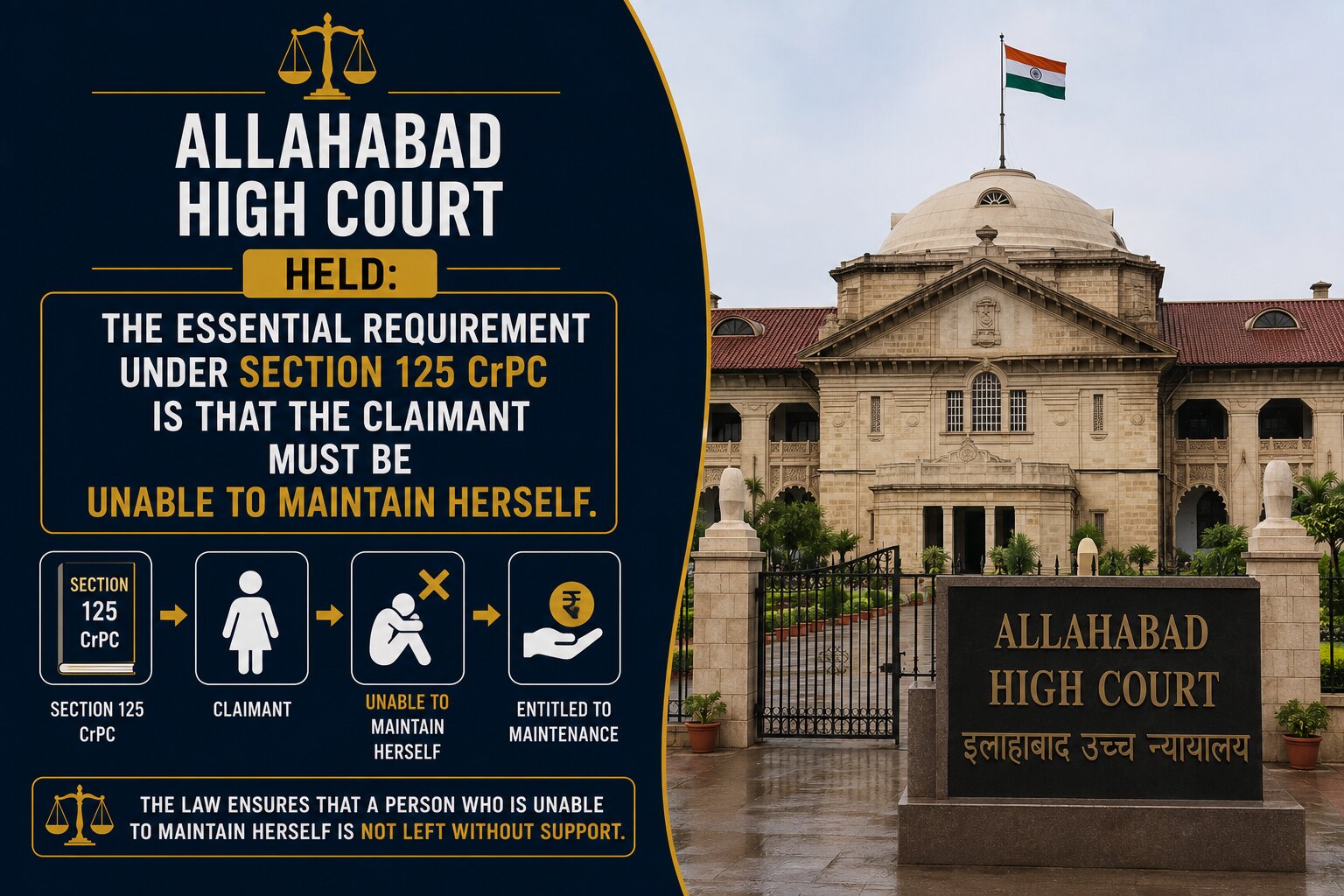
The High Court held that the essential requirement under Section 125 CrPC is that the claimant must be unable to maintain herself.
-
The Court observed that it was undisputed that the revisionist was the biological mother of Opposite Party No. 3 and the stepmother of Opposite Party No. 2.
-
The Court noted that the Family Court had already granted maintenance of ₹8,000 per month against the biological son, and that order had attained finality as it was not challenged.
-
The Court held that after the maintenance order came into operation, the revisionist was receiving maintenance and was therefore no longer in the position of being unable to maintain herself for the purpose of seeking another maintenance order.
-
The Court observed that once maintenance has been granted by a competent court, the claimant cannot seek another maintenance from another person for the same purpose.
-
The Court clarified, however, that where more than one person is legally obliged to maintain a claimant, it is for the court, at the time of deciding the maintenance application, to determine from whom and in what proportion maintenance should be recovered.
-
The Court found no illegality or perversity in the Family Court's decision to impose maintenance liability solely upon the biological son.
-
The Court further observed that the revision appeared to have been filed merely to harass the stepson and lacked any substantial legal foundation.
-
Accordingly, the criminal revision was dismissed.
Held
-
The requirement of inability to maintain oneself under Section 125 CrPC ceases once a valid maintenance order is operating and the claimant receives maintenance.
-
The court deciding the maintenance application has the discretion to determine which legally liable person should pay maintenance and in what proportion.
-
The Family Court rightly fastened liability only upon the biological son.
-
The criminal revision was dismissed.
Analysis
-
The judgment emphasizes that Section 125 CrPC is intended to prevent destitution, and the claimant must continue to satisfy the statutory requirement of being unable to maintain herself.
-
The Court interpreted the provision to mean that once an effective maintenance order provides adequate financial support, the claimant cannot seek duplicate maintenance from another person for the same need.
-
The decision distinguishes between apportionment of maintenance liability and multiple independent maintenance orders, clarifying that the former should be decided at the initial stage of adjudication.
-
The Court reaffirmed that where several persons may have a legal obligation to maintain a claimant, the responsibility should be appropriately allocated by the court rather than permitting successive claims against different persons.
-
The judgment seeks to prevent multiplicity of maintenance proceedings and unnecessary harassment of persons against whom no further maintenance liability is warranted.
-
At the same time, the Court recognized that allocation of liability among multiple persons legally bound to maintain a claimant remains within the discretion of the court at the time of passing the original maintenance order.
-
Overall, the ruling clarifies the scope of Section 125 CrPC by balancing the objective of protecting indigent parents with the need to avoid repetitive or overlapping maintenance claims.