
Krishnamurthy M v. State of Karnataka & Ors. and Connected Matters, 2026
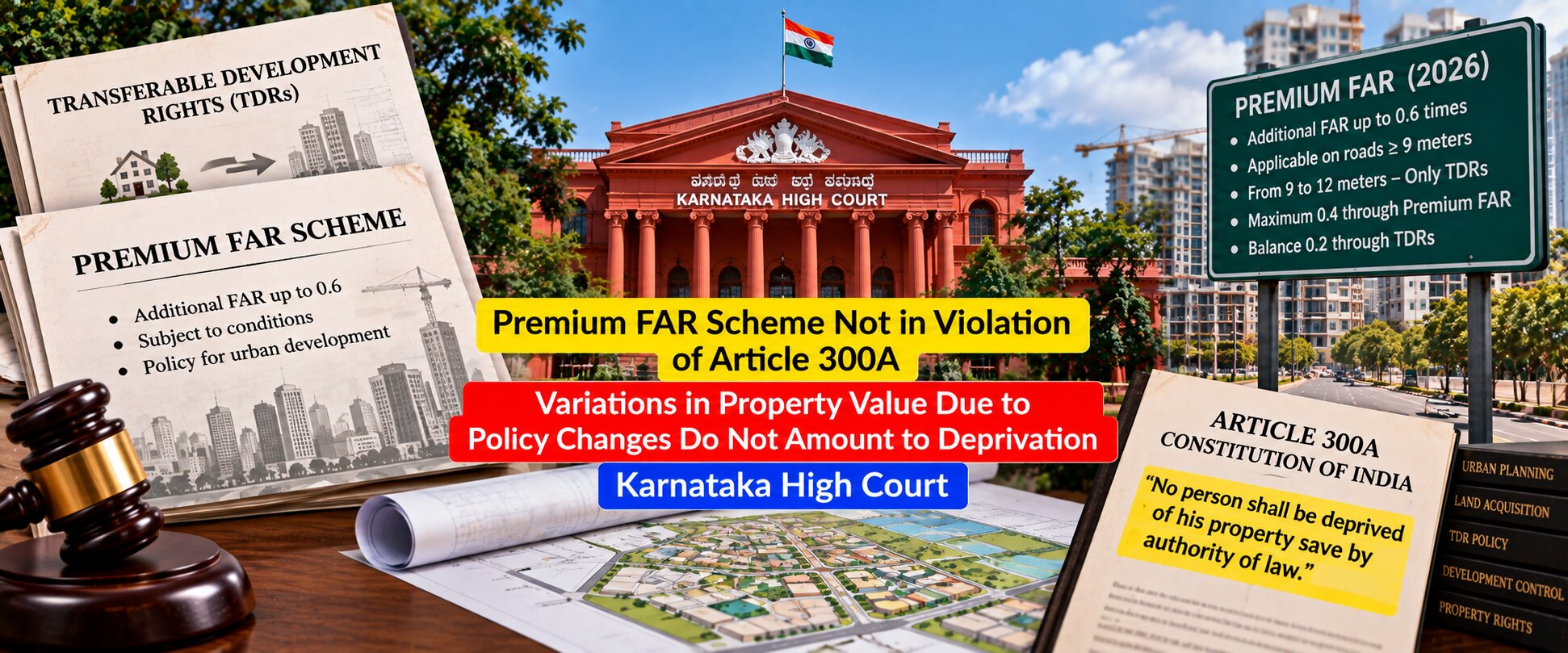
A governmental policy that merely causes fluctuation or reduction in the market value of property or TDRs does not amount to “deprivation of property” under Article 300A, unless the underlying property right itself is unlawfully taken or extinguished.
Judgement Details
Court
Karnataka High Court
Date of Decision
2 September 2026
Judges
Chief Justice Vibhu Bakhru and Justice C.M. Poonacha
Citation
Acts / Provisions
Facts of the Case
-
The petitioners included landowners whose properties had been acquired for public purposes.
-
Instead of monetary compensation, the concerned landowners had opted for or received Transferable Development Rights (TDRs), which could subsequently be utilised or transferred in accordance with the applicable planning regulations.
-
The State of Karnataka introduced the Premium Floor Area Ratio (Premium FAR) scheme, permitting developers to obtain additional floor area by paying a prescribed premium to the State.
-
The petitioners contended that permitting additional FAR through payment of a premium would reduce the demand for TDRs because developers could obtain additional development potential directly through Premium FAR.
-
According to the petitioners, reduced demand for TDRs would adversely affect their market value.
-
The petitioners therefore argued that the reduction in the economic value of their TDRs amounted to a form of deprivation of property, thereby violating Article 300A of the Constitution.
-
The challenge also raised concerns regarding the effect of increased FAR and urbanisation on the quality of life of Bengaluru residents, invoking Article 21.
-
The 2026 framework permits additional FAR of up to 0.6 times the ordinarily permissible/base FAR, subject to road width and other conditions.
-
For roads measuring 9 metres to less than 12 metres, additional development potential is to be achieved through TDRs, and Premium FAR is unavailable.
-
For roads of 12 metres and above, the framework permits a combination of Premium FAR and TDRs, with the relevant limits prescribed by the notifications.
-
The State pointed out that a substantial number of Bengaluru roads fall within the 9-metre-to-less-than-12-metre category, where TDRs continue to be relevant.
-
The petitioners nevertheless maintained that the availability of Premium FAR would adversely affect the economic value of their TDRs.
-
The State also submitted that a landowner whose land is acquired is not compelled to accept TDRs instead of monetary compensation and can claim compensation under the applicable 2013 land-acquisition framework.
Issues
-
Whether the introduction of the Premium FAR scheme, by permitting additional development potential upon payment of a premium, violates the property rights of TDR holders under Article 300A of the Constitution?
-
Whether a reduction or fluctuation in the market value of TDRs resulting from a change in government policy amounts to deprivation of property within the meaning of Article 300A?
-
Whether the Premium FAR scheme unlawfully diminishes the utility or market demand for TDRs by providing an alternative mechanism for obtaining additional FAR?
-
Whether permitting additional FAR through Premium FAR adversely affects the fundamental right to life and quality of life protected under Article 21?
-
Whether the Premium FAR framework is constitutionally invalid merely because an economic or planning-policy decision may adversely affect the value of an existing property-related right?
Judgement
-
The Karnataka High Court dismissed the writ appeal and connected petitions, upholding the challenge to the Premium FAR scheme as unsuccessful.
-
The Court rejected the fundamental premise that Article 300A guarantees preservation of the market value of property.
-
According to the Court, Article 300A protects a person from being deprived of property except by authority of law; it does not create a constitutional guarantee that the economic value of property or property-related rights must remain unchanged.
-
The Court observed that government decisions concerning economic, fiscal, planning and development policy can naturally cause fluctuations in the value of assets.
-
Such fluctuation, by itself, does not constitute deprivation of property.
-
The Court therefore rejected the argument that the possible reduction in TDR values resulting from the Premium FAR scheme amounted to unconstitutional deprivation.
-
The Court explained that accepting the petitioners' argument would effectively mean that the State would have a constitutional obligation to preserve the existing value of every property whenever it changes an economic or urban-planning policy.
-
The Court illustrated the point by referring to urban expansion: when a State expands city limits and permits additional land to be developed for residential or commercial purposes, the increased supply may affect the value of existing properties.
-
Such a policy-induced change in property value does not, by itself, amount to deprivation of property under Article 300A.
-
The Court also rejected the contention that the Premium FAR scheme rendered TDRs redundant. The applicable 2026 framework continues to require TDRs in specified circumstances, particularly for plots abutting roads between 9 metres and less than 12 metres.
-
For roads of 12 metres or more, the scheme permits the use of Premium FAR and TDRs subject to the prescribed limits.
-
The Court further noted that the State's Premium FAR framework was not equivalent to a scheme for regularising unauthorised construction. It represents a change in the permissible development potential under planning regulations, subject to approvals and sanctions.
-
The Court also rejected the Article 21 challenge, noting that the petitioners had not established that increased FAR under the scheme would necessarily deprive Bengaluru residents of their quality of life.
-
The Court ultimately concluded that the challenged policy did not amount to expropriation or deprivation of the petitioners' property and dismissed the proceedings.
Held
-
Article 300A does not constitutionally guarantee preservation of the market value of property.
-
A decline in property value caused by a governmental economic or planning policy is not, by itself, deprivation of property under Article 300A.
-
TDR holders do not acquire a constitutional guarantee that the market value of their TDRs will remain unaffected by subsequent policy changes.
-
The Premium FAR scheme does not amount to expropriation of TDRs merely because it may influence their demand or market value.
Analysis
- The continued availability and prescribed use of TDRs under the 2026 framework is relevant in rejecting the contention that Premium FAR completely displaces TDRs.
-
The Premium FAR scheme cannot be equated with regularisation of unauthorised construction, since it alters permissible development potential prospectively subject to statutory planning requirements.
-
A landowner is not necessarily compelled to accept TDRs in lieu of monetary compensation for acquired land; the Court noted the availability of compensation under the applicable 2013 statutory framework.