
Kondrakunta Chandrakanth v. State of Andhra Pradesh & Others, 2026
A writ of Habeas Corpus is ordinarily not maintainable in child custody disputes requiring a detailed inquiry into the welfare of the child.
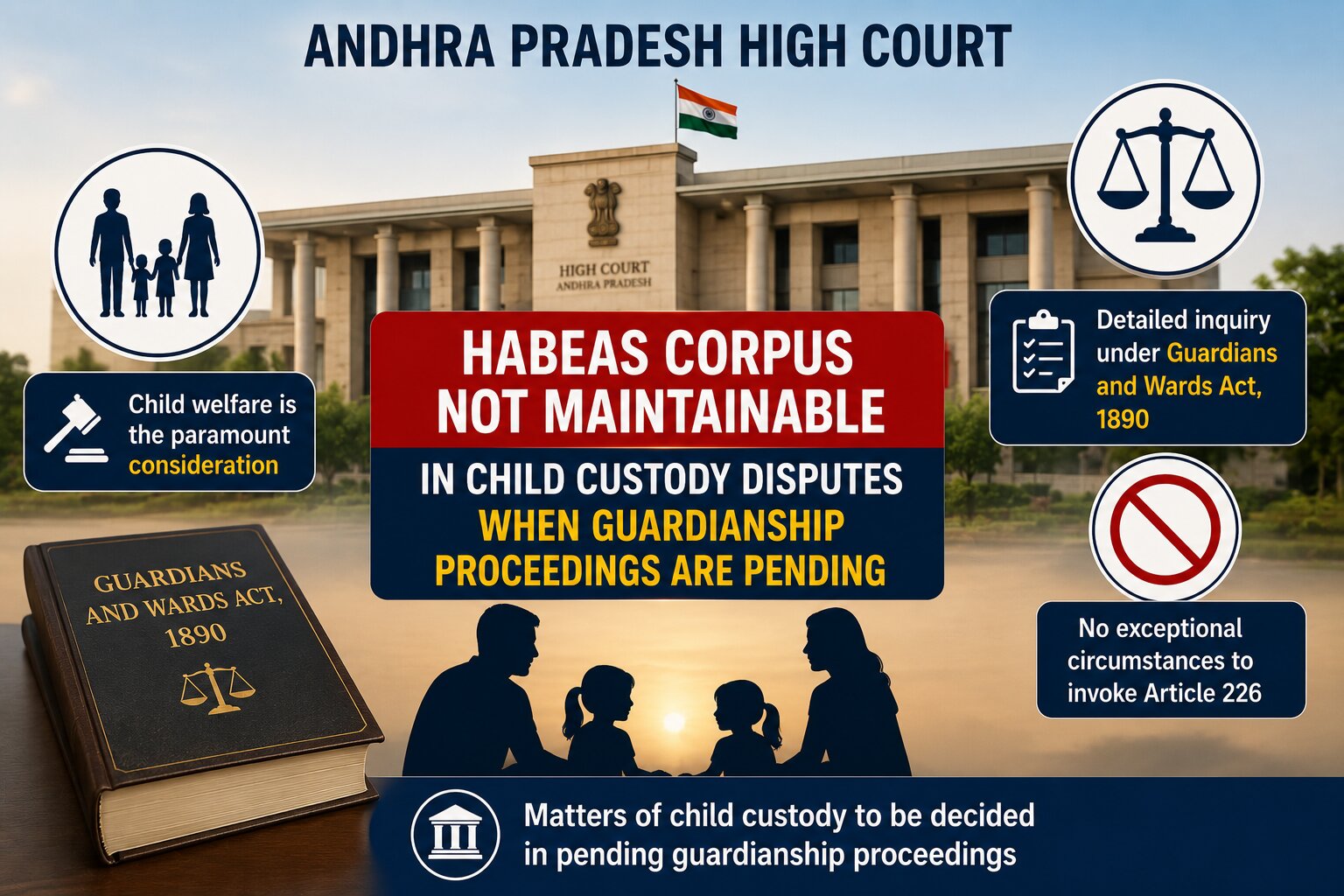
Judgement Details
Court
Andhra Pradesh High Court
Date of Decision
18 July 2026
Judges
Justice Ravi Nath Tilhari & Justice Subhendu Samanta
Citation
Acts / Provisions
Facts of the Case
-
The petitioner-father filed a writ petition under Article 226 seeking a writ of Habeas Corpus for the custody of his two minor daughters aged five and three years.
-
The children's mother had died under suspicious circumstances.
-
Following her death, the children began residing with their maternal grandmother.
-
An FIR under Sections 498A and 306 IPC had been registered against the petitioner-father in connection with the death of his wife.
-
The petitioner claimed that, being the natural guardian, he was legally entitled to the custody of his daughters.
-
He alleged that the maternal grandmother was illegally detaining the children and sought their production before the High Court.
-
The respondents objected to the maintainability of the habeas corpus petition.
-
They pointed out that the petitioner had already filed guardianship proceedings under Sections 10, 17 and 25 of the Guardians and Wards Act, 1890.
-
The respondents argued that determination of child custody required a detailed inquiry into the welfare of the minors, which could not be undertaken in summary writ proceedings.
-
The High Court considered whether extraordinary jurisdiction under Article 226 should be exercised despite the pending guardianship proceedings.
Issues
-
Whether a writ of Habeas Corpus is maintainable in a child custody dispute where proceedings under the Guardians and Wards Act, 1890 are already pending?
-
Whether the High Court should exercise its extraordinary jurisdiction under Article 226 of the Constitution in a custody dispute requiring a detailed inquiry into the welfare of minor children?
-
Whether the father's status as the natural guardian entitles him to immediate custody through a writ of Habeas Corpus?
-
Whether the custody of the minor children with their maternal grandmother amounted to illegal detention warranting issuance of a writ of Habeas Corpus?
-
Whether the welfare of the minor children should be determined exclusively in proceedings under the Guardians and Wards Act, 1890?
Judgement
-
The Andhra Pradesh High Court dismissed the writ petition.
-
The Court held that Habeas Corpus is ordinarily not maintainable in child custody disputes where determination of the child's welfare requires a detailed inquiry.
-
It observed that proceedings under the Guardians and Wards Act are specifically designed to determine custody by treating the welfare of the child as the paramount consideration.
-
The Court noted that the petitioner had already invoked the jurisdiction of the competent guardianship court under the Guardians and Wards Act.
-
It found that the existence of pending guardianship proceedings made it inappropriate to invoke the extraordinary writ jurisdiction under Article 226.
-
The Court took into account that the children's mother had died under suspicious circumstances and that an FIR under Sections 498A and 306 IPC was pending against the petitioner.
-
It also considered the tender age of the children and the fact that they were presently residing with their maternal grandmother.
-
The Court held that these circumstances required a comprehensive examination of facts and the welfare of the children, which could not be effectively undertaken in summary habeas corpus proceedings.
-
Finding no exceptional circumstances warranting interference under Article 226, the Court dismissed the petition while leaving the custody issue to be decided in the pending guardianship proceedings.
Held
-
Where proceedings under the Guardians and Wards Act, 1890 are already pending, custody disputes should ordinarily be decided therein.
-
The welfare of the child remains the paramount consideration in custody matters.
-
Summary proceedings under Article 226 are not appropriate for deciding complex custody disputes involving disputed facts.
-
The habeas corpus petition was dismissed, leaving the custody dispute to be adjudicated by the competent guardianship court.
Analysis
-
The judgment reinforces the well-established principle that child welfare supersedes the legal rights of parents in custody disputes.
-
The Court correctly distinguished the limited scope of habeas corpus proceedings from comprehensive guardianship proceedings under the Guardians and Wards Act.
-
By declining to exercise writ jurisdiction, the Court ensured that custody would be decided after a detailed assessment of all relevant circumstances affecting the children's welfare.
-
The decision recognizes that allegations relating to the mother's suspicious death and pending criminal proceedings against the father are relevant factors requiring thorough judicial examination.
-
The ruling discourages litigants from bypassing the statutory guardianship mechanism by invoking extraordinary constitutional remedies.
-
The judgment strengthens the principle that Article 226 is not intended to replace the detailed adjudicatory process prescribed under special statutes where adequate remedies exist.
-
The decision also reiterates that habeas corpus in child custody matters remains an exceptional remedy, to be exercised only in cases involving clear illegal detention or extraordinary circumstances.