
Kondapaka Sridhar @ Shekar @ Madhu @ Gopi @ Chinna v. State of Telangana, 2026
Call records cannot automatically be treated as proved merely because the Investigating Officer relies upon them; the prescribed evidentiary foundation must be established.
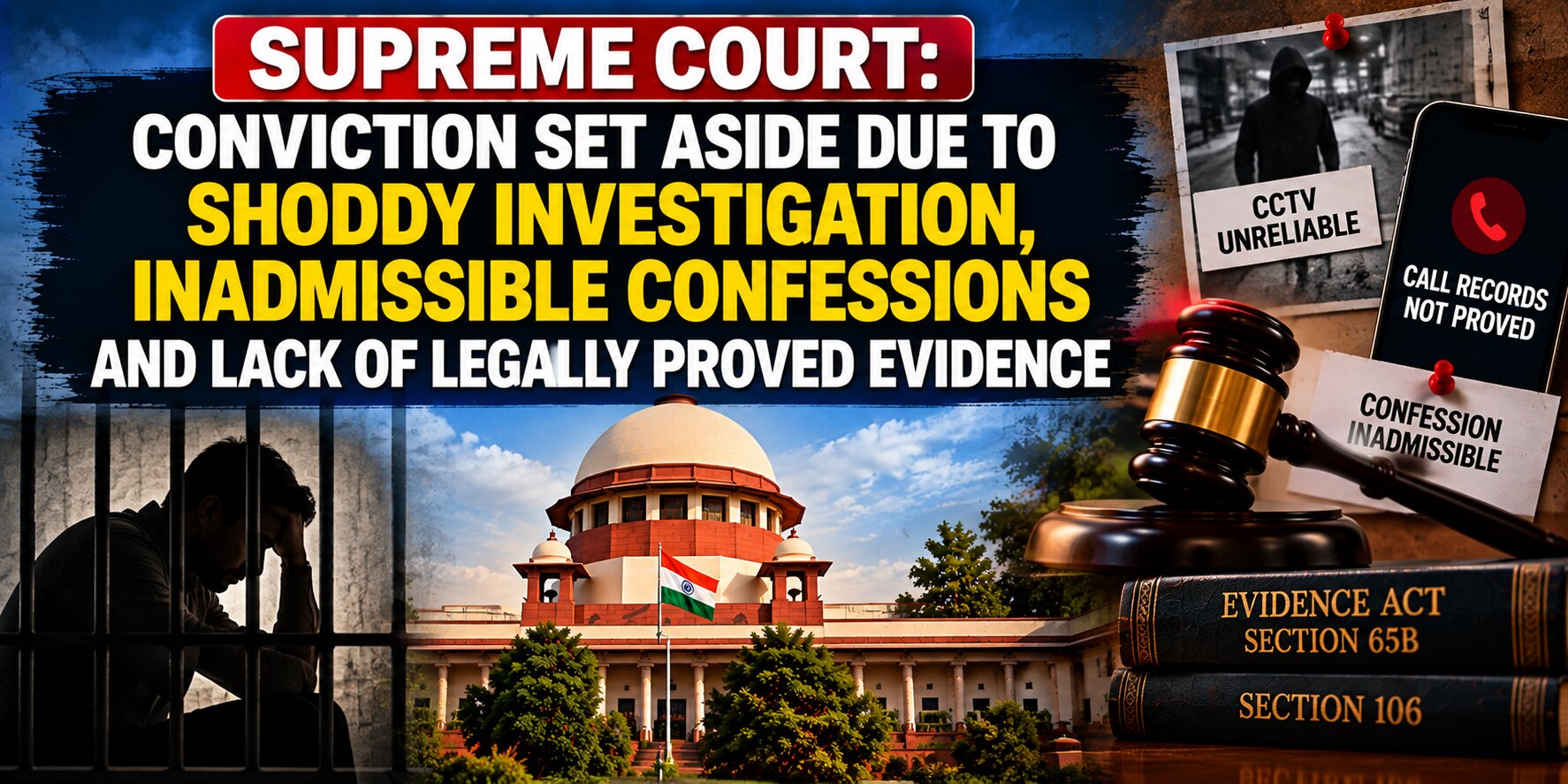
Judgement Details
Court
Supreme Court of India
Date of Decision
24 September 2026
Judges
Justice J.B. Pardiwala and Justice K. Vinod Chandran
Citation
Acts / Provisions
Facts of the Case
-
The prosecution alleged that the deceased left his home for Hyderabad and subsequently became untraceable.
-
Two days later, the deceased's father, examined as PW1, allegedly received a ransom call demanding ₹2,00,000 and directing him to deposit the money into a bank account.
-
PW1 lodged a police complaint and deposited ₹1,50,000 into an account standing in the name of Geetanjali.
-
The Investigating Officer claimed that analysis of telephone calls led the police to A6. A6 was arrested and allegedly made a confession.
-
According to the prosecution, A6's information led the police to an apartment where the deceased's body was found concealed inside a refrigerator.
-
A6 allegedly disclosed the involvement of A1 to A5. The prosecution subsequently developed a narrative concerning relationships between the accused and the deceased and an alleged plan to kidnap the deceased for ransom.
-
Six persons were originally arrayed as accused. A4 died during the trial.
-
The Trial Court convicted A1, A2, A3, A5 and A6. The High Court subsequently acquitted A2, A3, A5 and A6 but maintained the conviction of A1.
-
The High Court principally relied upon the testimony of PW3, stated to be a watchman at the apartment complex, and upon A1's alleged failure to explain the presence of the deceased's body in the flat which he was said to have taken on lease.
-
The High Court treated this circumstance as relevant under Section 106 of the Indian Evidence Act, 1872.
-
The prosecution also relied upon call records, ATM CCTV footage concerning withdrawal of the ransom money, recovery of cash, the alleged lease of the apartment, the last-seen circumstance and a Test Identification Parade.
-
The Supreme Court found that the prosecution's narrative regarding the accused's involvement substantially originated from confessions allegedly made by the accused themselves.
-
The Court held that the confessional material could not be used to supply the missing substantive evidence connecting the accused with the crime.
-
The Court further found serious deficiencies in the proof of the electronic evidence. The call records were not properly proved through the concerned Nodal Officer and the requisite Section 65B certificate was absent.
-
The ATM CCTV footage also suffered from the absence of the required electronic-evidence certificate and, independently, did not clearly identify the accused.
-
The prosecution failed to produce adequate documentary evidence establishing ownership of the flat or a lease agreement connecting A1 with Flat No. 402.
-
PW3's status as a watchman was itself not independently established, and no visitor register or testimony of apartment residents was produced to corroborate his account.
-
The Court also noted that PW3 had been shown photographs of the suspects before the Test Identification Parade, substantially undermining the reliability of the identification.
-
The bank account into which the ransom money was deposited was not properly investigated, the account-holder was not examined, and the relevant bank statement was not proved through a bank official.
-
The Court consequently found that the prosecution had established the fact of death and the recovery of the body, but had failed to establish legally reliable evidence connecting A1 with the kidnapping, ransom demand, murder or the apartment.
Issues
-
Whether the conviction of A1 could be sustained when the prosecution's narrative concerning his involvement substantially originated from confessions of the accused that could not independently inculpate him?
-
Whether the call detail records could be relied upon when they were not properly proved through the telecom service provider's Nodal Officer and no certificate under Section 65B of the Indian Evidence Act was produced?
-
Whether the ATM CCTV footage could constitute reliable incriminating evidence when the accused could not be clearly identified from the footage and the statutory certificate for electronic evidence was absent?
-
Whether Section 106 of the Indian Evidence Act could be invoked against A1 on the basis that he failed to explain the presence of the deceased's body in an apartment when the prosecution itself had not satisfactorily proved his lease or connection with the apartment?
-
Whether the testimony and identification evidence of PW3 could safely be relied upon when his status as a watchman and the alleged lease of the flat were not independently established and photographs of the accused had been shown to him before the Test Identification Parade?
-
Whether the alleged discovery of the deceased's body pursuant to information supplied by A6 could be used to incriminate A1 after A6 himself had been acquitted?
-
Whether the prosecution had established a complete and legally admissible chain of circumstances sufficient to sustain A1's conviction for kidnapping and murder?
Judgement
-
The Supreme Court allowed the appeal filed by A1 and set aside the conviction and sentence imposed upon him by the High Court.
-
The Court held that the prosecution's alleged story of the accused's involvement was not supported by substantive evidence independent of the confessions.
-
The Court emphasised that the confessions could not be relied upon to fill the evidentiary gaps and establish the guilt of the accused.
-
The call records, which allegedly formed the starting point for tracing A6, were not legally proved because the concerned Nodal Officer was not examined and the required Section 65B certificate was not produced.
-
The Court consequently held that the prosecution's claimed chain of investigation beginning with analysis of the call records could not be treated as established evidence.
-
The ATM CCTV footage was also rejected as incriminating evidence because it was not properly proved under Section 65B and did not clearly identify the accused.
-
The prosecution failed to connect the cash allegedly recovered from A1 and A6 with the ransom amount or the alleged kidnapping.
-
The person in whose account the alleged ransom amount was deposited was not examined, and the relevant bank records were not properly proved.
-
The Court found that the prosecution had failed to establish the ownership of the apartment through documentary evidence.
-
No lease deed connecting A1 with the apartment was produced, and even the alleged employment of PW3 as the apartment watchman was not independently established.
-
The absence of a visitor register and the failure to examine residents of the apartment complex further weakened PW3's evidence.
-
The Test Identification Parade was found unreliable because PW3 had already been shown photographs of the suspects before the identification proceedings.
-
Because the prosecution had not first established A1's connection with the apartment, his failure to explain the presence of the body could not be converted into substantive evidence of guilt through Section 106.
-
The alleged discovery pursuant to A6's statement could not be used to incriminate A1, particularly after A6 himself had been acquitted and no independent witness was examined concerning the alleged discovery.
-
The Supreme Court held that the post-mortem report established that the deceased died from asphyxia due to smothering associated with strangulation, and the body was recovered from a refrigerator inside an apartment.
-
However, those circumstances did not establish who committed the murder or connect A1 with either the deceased or the apartment.
-
The Court concluded that the investigation had been driven primarily by confessions rather than by collection of independent and legally admissible evidence.
-
A1 was therefore directed to be released forthwith if he was still in custody and was not required in any other case.
Held
-
A conviction cannot be sustained merely on an investigative narrative derived from confessions when independent substantive evidence connecting the accused to the crime is absent.
-
Electronic evidence must satisfy the statutory requirements governing its proof and admissibility.
-
CCTV footage which neither reliably identifies the accused nor satisfies the statutory requirements for electronic evidence cannot by itself establish an incriminating circumstance.
-
Section 106 does not relieve the prosecution of its primary burden to establish the foundational facts of its case.
-
Before an adverse inference is drawn from an accused's failure to explain a circumstance, the prosecution must first establish the underlying circumstance through reliable evidence.
-
A Test Identification Parade loses substantial evidentiary value where the identifying witness has previously been exposed to photographs of the suspects.
-
A discovery allegedly made pursuant to information supplied by a co-accused cannot automatically be used to incriminate another accused, particularly where the co-accused has himself been acquitted and independent corroboration is absent.
-
Proof that a person died and that the body was recovered does not by itself establish the identity of the perpetrator.
-
The prosecution must establish a complete chain of circumstances through legally admissible and reliable evidence before a conviction can be sustained.
Analysis
-
The judgment reinforces the fundamental criminal-law principle that the burden of proving guilt remains on the prosecution. Section 106 cannot be transformed into a mechanism by which an accused is required to prove his innocence before the prosecution establishes the foundational facts.
-
The Court's treatment of the alleged lease of Flat No. 402 is particularly significant. The prosecution relied upon A1's supposed occupation of the flat, but it failed to produce a lease deed or reliable documentary evidence establishing the ownership and letting of the premises. Consequently, the very factual foundation required for invoking Section 106 was missing.
-
The Court also scrutinised the reliability of PW3 rather than treating his testimony as sufficient merely because he was described as a watchman. His employment was not independently proved, the visitor register was not produced, and residents of the apartment were not examined.
-
The judgment demonstrates that electronic evidence requires proper foundational proof. The prosecution's failure to examine the telecom Nodal Officer and produce the required certificate meant that the call records could not perform the central role assigned to them in the prosecution narrative.
-
The same evidentiary discipline was applied to ATM CCTV footage. The Court did not accept the footage merely because investigators claimed that it showed withdrawals. There was both a statutory defect in its proof and an identification problem.
-
The Court's reasoning also illustrates the distinction between an investigative lead and legally proved evidence. A confession may lead investigators towards a suspect, a location or a line of investigation, but the prosecution must still establish admissible evidence capable of proving guilt at trial.
-
The prosecution's failure to investigate the bank account into which the ransom money was deposited was another major evidentiary gap. The account-holder was not examined and the relevant bank statement was not properly proved.
-
The decision also highlights the importance of independent corroboration in identification evidence. Showing photographs to a witness before a Test Identification Parade can materially compromise the reliability of subsequent identification.
-
The Court did not dispute the medical evidence concerning the cause of death. Instead, it distinguished between establishing how the deceased died and establishing who was legally responsible for that death.
-
The judgment therefore underscores that even in a grave murder and kidnapping case, the seriousness of the offence cannot substitute for proof. The prosecution must establish guilt through evidence that is legally admissible, independently reliable and sufficient to complete the chain of circumstances.
-
The broader evidentiary lesson is that an investigation should not become confession-driven. Investigators must independently verify the accused's alleged connection with the premises, financial transactions, communications, witnesses and physical evidence.
-
The Supreme Court ultimately found that the prosecution had proved the existence of a crime and the recovery of the deceased's body, but had failed to prove the accused's connection with that crime beyond the required standard.