
Kishori Sah and Others v. State of Jharkhand and Others, 2026
A long-running jamabandi can be cancelled only by a competent civil court.
Judgement Details
Court
Jharkhand High Court
Date of Decision
14 July 2026
Judges
Chief Justice M.S. Sonak and Justice Rajesh Shankar
Citation
Acts / Provisions
Facts of the Case
-
The appellants claimed that approximately 24.79 acres of land situated at Village Kabilasi, District Hazaribagh had been settled in favour of their ancestors several decades earlier.
-
They asserted that they had remained in peaceful possession of the land, their names had been duly mutated, and rent receipts had been regularly issued by the competent revenue authorities.
-
According to the appellants, in 2015 the original respondent approached the Board of Revenue claiming ownership over the same land.
-
Pursuant to directions issued by the Board of Revenue, the Circle Officer directed issuance of rent receipts in favour of the respondent.
-
The appellants alleged that this order was passed without issuing notice to them and therefore violated the principles of natural justice.
-
They further alleged that the respondent had relied upon forged documents to secure the order.
-
The appellants challenged the action before the Single Judge, whose writ petition was dismissed.
-
Aggrieved by the dismissal, they preferred the present Letters Patent Appeal before the Division Bench.
Issues
-
Whether a long-running jamabandi can be cancelled by revenue authorities in the absence of statutory power under the Bihar Tenants' Holdings (Maintenance of Records) Act, 1973?
-
Whether revenue authorities are bound to issue rent receipts in favour of a person whose jamabandi is already running?
-
Whether third parties are entitled to prior notice and hearing before issuance of rent receipts in favour of a person whose jamabandi already exists?
-
Whether the appellants were entitled to interference with the judgment of the learned Single Judge?
Judgement
-
The Division Bench held that the factual foundation of the appellants' case was incorrect.
-
The Court found that the respondent's jamabandi had not been created pursuant to the Board of Revenue's directions in 2015.
-
Instead, the respondent's jamabandi had already been opened in 1965 through Misc. Case Nos. 17 of 1964-65 and 18 of 1964-65.
-
The Court noted that rent receipts had continuously been issued in favour of the respondent for the revenue years 1964-65 to 1976-77.
-
The Court observed that the Board of Revenue merely directed continuation of issuance of rent receipts because the respondent's jamabandi was already validly existing.
-
Referring to the Bihar Tenants' Holdings (Maintenance of Records) Act, 1973, the Court held that the statute contains no provision empowering revenue authorities to cancel an existing jamabandi.
-
The Bench held that any cancellation of a long-running jamabandi by revenue authorities without statutory authority would be without jurisdiction and therefore a nullity in law.
-
The Court reiterated that a long-running jamabandi can be cancelled only by a competent civil court through appropriate proceedings.
-
The Court further held that no notice or hearing is required to be given to third parties before issuing rent receipts in favour of a person whose jamabandi is already in existence.
-
Finding no legal infirmity in the judgment of the learned Single Judge, the Court dismissed the Letters Patent Appeal.
-
However, the Court granted liberty to the appellants to pursue any other remedy available under law.
Held
-
Revenue authorities have no statutory power to cancel a long-running jamabandi under the Bihar Tenants' Holdings (Maintenance of Records) Act, 1973.
-
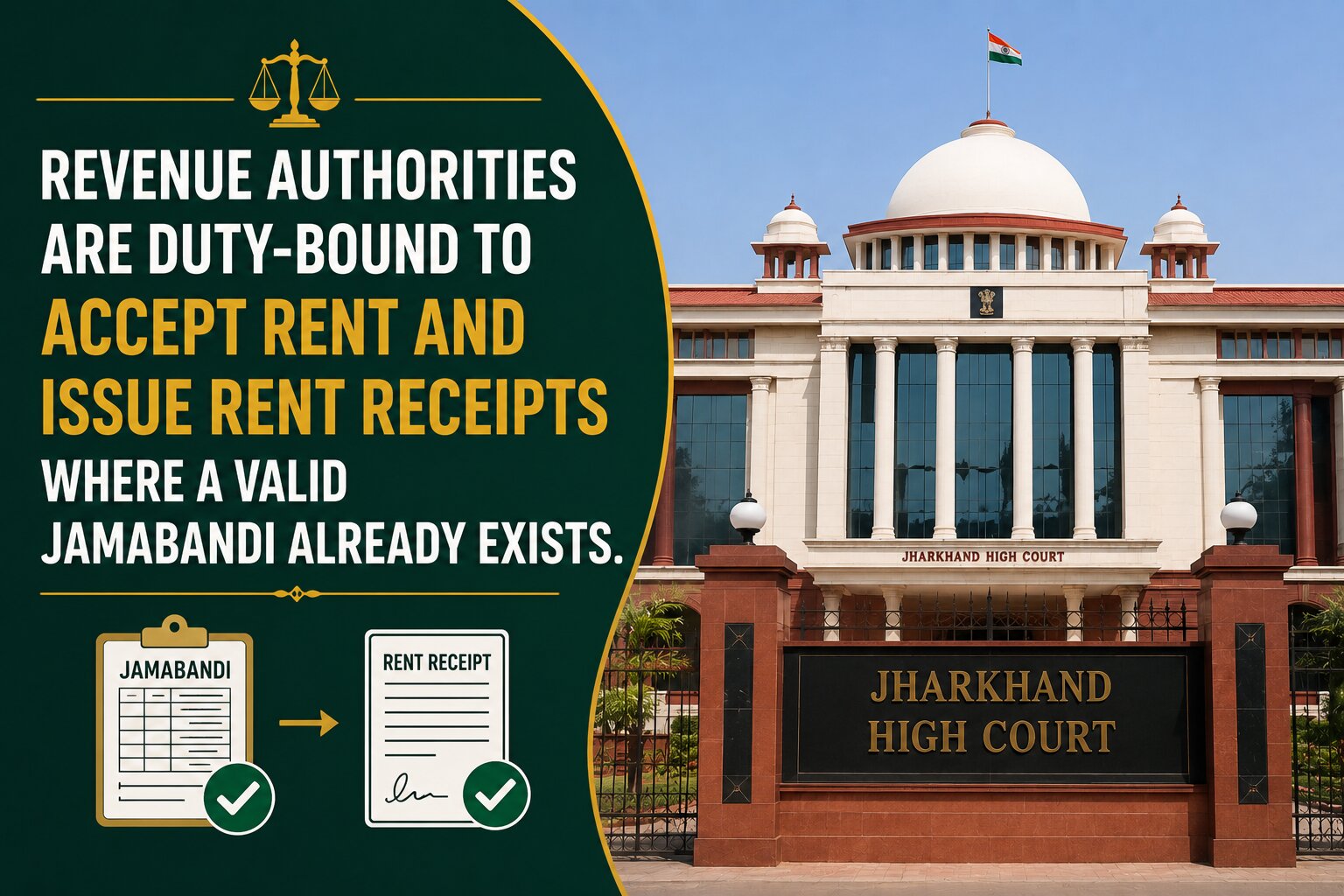
Revenue authorities are duty-bound to accept rent and issue rent receipts where a valid jamabandi already exists.
-
Third parties are not entitled to prior notice before issuance of rent receipts in favour of the recorded raiyat.
-
The Letters Patent Appeal was dismissed with liberty to seek appropriate civil remedies.
Analysis
-
The judgment reinforces the long-settled distinction between revenue administration and adjudication of civil rights, holding that revenue authorities cannot decide questions affecting title by cancelling an existing jamabandi.
-
By emphasizing the absence of statutory power under the Bihar Tenants' Holdings (Maintenance of Records) Act, 1973, the Court reaffirmed that administrative authorities must act strictly within the limits of powers conferred by legislation.
-
The decision protects long-standing entries in revenue records from arbitrary administrative interference while preserving the jurisdiction of civil courts to adjudicate disputes relating to ownership and title.
-
The Court also clarified that issuance of rent receipts is merely a ministerial or consequential act flowing from an existing jamabandi and does not determine proprietary rights.
-
The ruling draws an important distinction between administrative recognition of an existing revenue record and adjudication of competing ownership claims.
-
By rejecting the plea for a hearing before issuance of rent receipts, the Court observed that where no adjudicatory decision is being taken and the authority merely acts upon an existing jamabandi, principles of natural justice are not attracted.
-
Overall, the judgment strengthens certainty in land administration by preventing revenue authorities from exercising powers not expressly conferred by statute while ensuring that disputes regarding title are decided exclusively by competent civil courts.