
Kharak Singh Dhapola v. State of Uttarakhand & Another, 2026
Saptapadi, being an essential ceremony of Hindu marriage in the circumstances discussed, can be examined by the Trial Court during the trial.
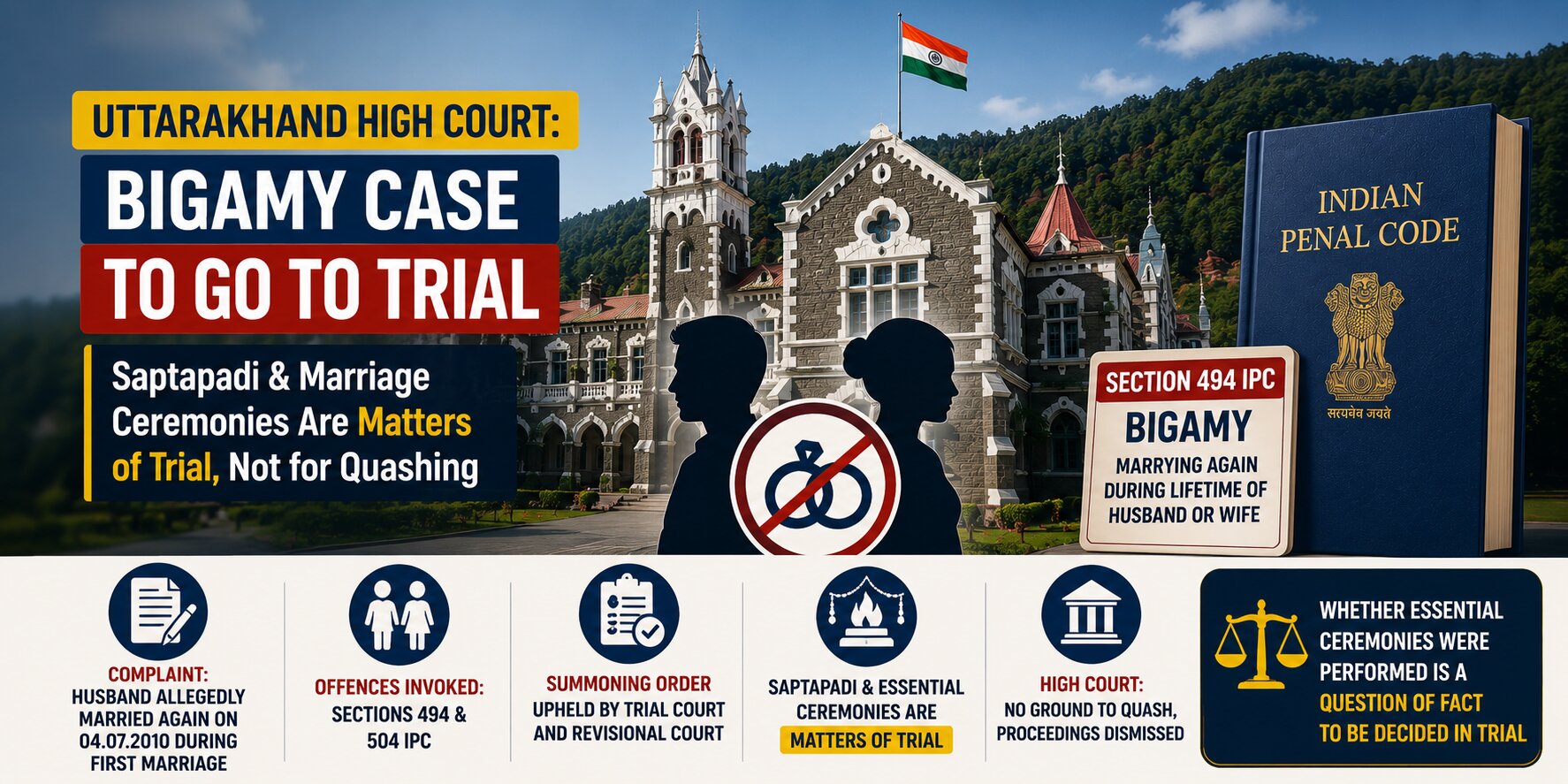
Judgement Details
Court
Uttarakhand High Court
Date of Decision
8 August 2026
Judges
Justice Siddhartha Sah
Citation
Acts / Provisions
Facts of the Case
-
The complainant-wife alleged that she had married the applicant-husband on 7 March 1988.
-
According to the complaint, their marriage continued to subsist and had not been dissolved.
-
The complainant alleged that during the subsistence of the first marriage, the applicant contracted a second marriage on 4 July 2010.
-
A complaint was filed alleging offences under Sections 494 and 504 IPC.
-
The complainant's statement was recorded under Section 200 CrPC.
-
The Trial Court also called for a police report.
-
On the basis of the material before it, the Judicial Magistrate First, Haldwani, summoned the applicant to face trial under Sections 494 and 504 IPC.
-
The applicant challenged the summoning order before the revisional court.
-
The 2nd Additional Sessions Judge, Nainital, dismissed the criminal revision.
-
The applicant thereafter approached the Uttarakhand High Court under Section 482 CrPC, seeking quashing of the summoning order, revisional order and consequential criminal proceedings.
-
The applicant primarily argued that no prima facie offence under Section 494 IPC was established.
-
He contended that there was no material showing that the alleged second marriage had been performed with the essential ceremonies required under Hindu law.
-
Particular emphasis was placed on the absence of evidence regarding Saptapadi.
-
The applicant relied upon the Allahabad High Court decision in Nisha v. State of U.P., arguing that Saptapadi was an essential ceremony for a valid Hindu marriage.
-
The complainant opposed the quashing application and argued that she should not be required to prove every essential ceremony of the alleged second marriage at the preliminary stage.
-
The complainant relied upon Pooja Sharma Bajaj v. Kunal Bajaj and the Supreme Court decision in K. Neelaveni v. State.
-
It was argued that whether the essential ceremonies of the alleged second marriage had actually been performed was a matter for trial.
-
The complainant also contended that requiring the first wife to establish all ceremonies before issuance of summons would impose an onerous burden, since she would ordinarily not have witnessed or been able to collect evidence concerning the husband's alleged second marriage.
-
The High Court considered the conflicting approaches reflected in the authorities cited by both sides.
-
The Court ultimately followed the principle stated in K. Neelaveni, as relied upon by the Delhi High Court.
-
The Court held that the question whether the essential ceremonies of the alleged second marriage were performed should be determined during the trial, rather than at the initial stage of taking cognizance.
Issues
-
Whether the absence of evidence regarding the performance of Saptapadi at the stage of summoning is sufficient to conclude that no offence under Section 494 IPC is made out?
-
Whether the complainant is required to prove the performance of all essential ceremonies of the alleged second marriage at the initial stage of taking cognizance?
-
Whether the question of whether Saptapadi and other essential ceremonies of the alleged second Hindu marriage were performed is a matter to be determined during trial?
-
Whether the High Court should exercise its inherent jurisdiction under Section 482 CrPC to quash the summoning order merely because the material at the preliminary stage does not establish performance of the essential marriage ceremonies?
-
Whether the summoning order and revisional order suffered from any legal error warranting interference under Section 482 CrPC?
Judgement
-
The Uttarakhand High Court dismissed the application under Section 482 CrPC.
-
The Court declined to quash the summoning order passed by the Judicial Magistrate First, Haldwani.
-
The Court also declined to interfere with the revisional order passed by the 2nd Additional Sessions Judge, Nainital.
-
The Court held that the question concerning whether the essential ceremonies of the alleged second marriage were actually performed is a matter of trial.
-
The Court specifically considered Saptapadi as one of the essential ceremonies relevant to the validity of a Hindu marriage.
-
However, the Court held that the absence of material proving Saptapadi at the initial stage did not justify quashing the proceedings.
-
The Court relied upon the principle from the Supreme Court's decision in K. Neelaveni, according to which the performance of essential marriage ceremonies is to be examined during trial.
-
The Court rejected the applicant's contention that the absence of evidence regarding Saptapadi meant that the basic ingredients of Section 494 IPC were absent at the cognizance stage.
-
The Court observed that the issue could not properly be determined at the primary stage of taking cognizance.
-
The Court consequently found no error in the summoning order or revisional order warranting exercise of its inherent jurisdiction.
-
The criminal proceedings were therefore permitted to continue before the Trial Court.
Held
-
The issue of whether the essential ceremonies of an alleged second Hindu marriage were performed is generally a matter for trial.
-
The absence of evidence regarding Saptapadi at the initial stage does not automatically establish that no offence under Section 494 IPC is made out.
-
The complainant is not required to conclusively prove every essential marriage ceremony merely at the stage of taking cognizance or issuing summons.
-
The High Court should not ordinarily quash proceedings under Section 482 CrPC merely because evidence concerning the ceremonies of the alleged second marriage has not yet been fully established.
-
The question of whether the second marriage was legally solemnized must be determined on the basis of evidence during trial.
-
The summoning order and revisional order did not suffer from an error warranting interference.
-
The application under Section 482 CrPC was dismissed.
Analysis
-
Trial versus cognizance stage: The principal significance of the judgment lies in distinguishing between what must be established at the stage of taking cognizance and what must ultimately be proved during trial.
-
Saptapadi issue: The Court accepted that Saptapadi is an important ceremony relevant to determining the validity of the alleged Hindu marriage. However, it held that determining whether the ceremony actually took place requires consideration of evidence and therefore belongs to the trial stage.
-
Section 494 IPC: For an allegation of bigamy to succeed, the prosecution ultimately has to establish the existence of a valid second marriage in accordance with the applicable law. The judgment does not remove that requirement; rather, it holds that the requirement need not be conclusively established before summons are issued.
-
Prima facie threshold: At the cognizance stage, the Court was concerned with whether the proceedings disclosed sufficient material to justify continuation. It did not conduct a mini-trial regarding the validity of the second marriage.
-
Avoiding premature adjudication: Requiring the complainant to prove every ceremony before the proceedings even reach trial could effectively require the High Court to assess evidence prematurely. The judgment avoids such a mini-trial at the Section 482 stage.
-
Position of the first wife: The complainant's argument concerning the practical difficulty faced by the first wife was significant. A first wife may not ordinarily have been present when the alleged second marriage took place and may therefore have limited access to evidence concerning its ceremonies.
-
Reliance on Supreme Court precedent: The High Court followed the principle attributed to K. Neelaveni v. State, as provided in the supplied information, that whether essential marriage ceremonies were performed is a matter for trial.
-
Conflict between precedents: The Court acknowledged the different approach reflected in Nisha v. State of U.P., where absence of cogent evidence regarding Saptapadi was treated as significant at the summoning stage. The Uttarakhand High Court preferred the approach supported by the Supreme Court precedent.
-
Limited Section 482 jurisdiction: The judgment illustrates that inherent powers under Section 482 CrPC are not ordinarily to be used to conduct an evidentiary assessment that properly belongs to the Trial Court.
-
No finding of guilt: The Court's refusal to quash the proceedings does not mean that the applicant was held guilty of bigamy. The validity and solemnization of the alleged second marriage remain matters to be established through evidence.
-
Overall significance: The judgment reinforces that the absence of proof of a particular marriage ceremony at the preliminary stage is not necessarily a ground to terminate a Section 494 IPC prosecution when the question can properly be determined through evidence at trial.