
Khalil Pasha & Ors. v. Abdul Rasheed & Anr., 2026
A recovered weapon or article must be connected with the crime through independent and reliable evidence.
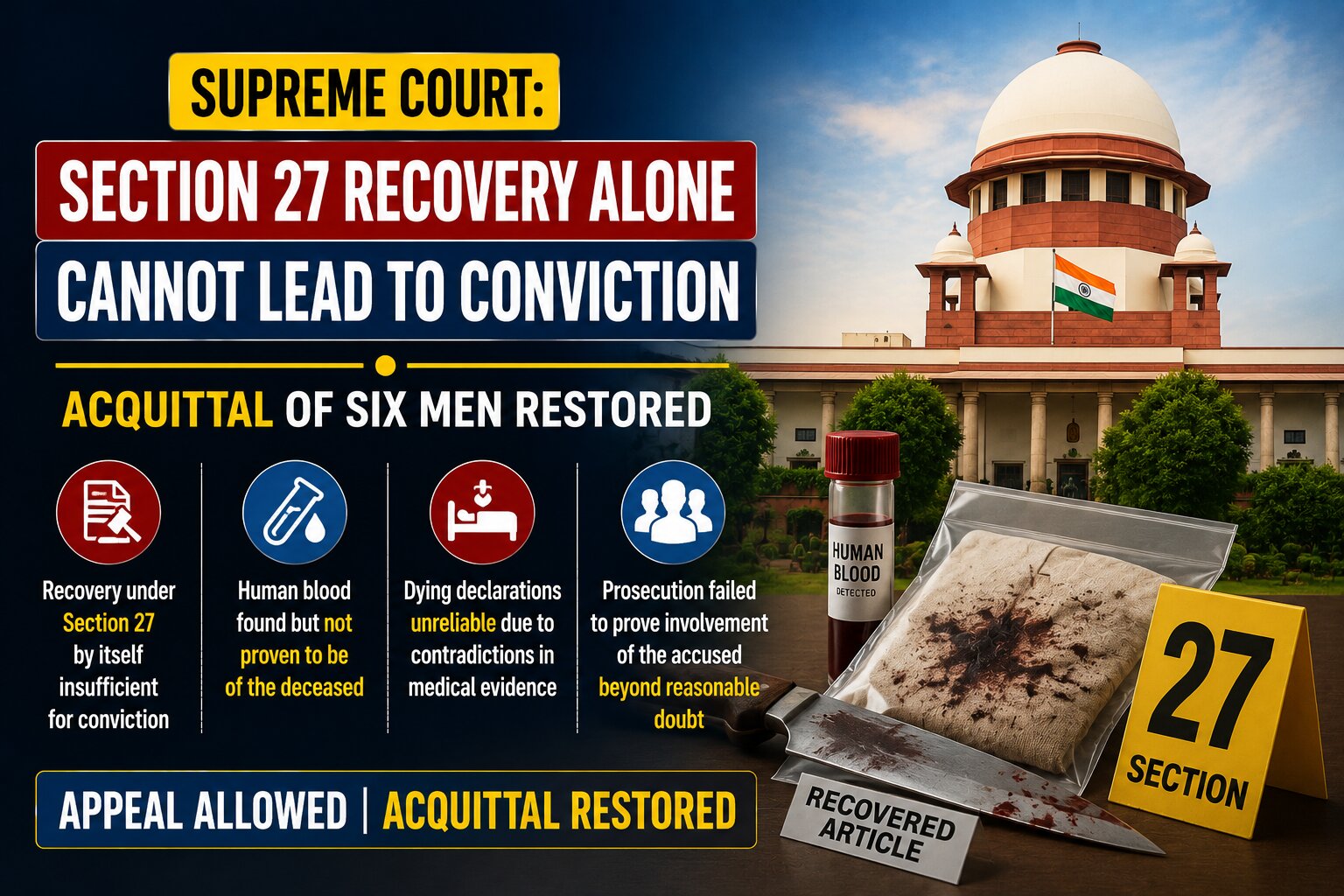
Judgement Details
Court
Supreme Court of India
Date of Decision
5 August 2026
Judges
Justice J.B. Pardiwala and Justice K. Vinod Chandran
Citation
Acts / Provisions
Facts of the Case
-
The case concerned the murder of Qavi on 14 February 1988.
-
Six accused persons had ultimately been acquitted by the Trial Court.
-
The deceased's brother challenged the acquittal before the Bombay High Court through a criminal revision petition.
-
The matter had previously reached the Supreme Court and was remanded on procedural grounds.
-
Following remand, the High Court directed reconsideration of the evidence concerning:
-
eyewitness testimony;
-
recoveries allegedly made under Section 27 of the Evidence Act; and
-
the chemical analysis report.
-
-
The Trial Court had rejected the alleged dying declarations.
-
The prosecution relied substantially upon the recovery of a weapon at the instance of Accused No. 4.
-
Clothes allegedly belonging to Accused No. 2 were also seized.
-
Forensic examination detected human blood on the recovered articles.
-
However, the prosecution failed to establish that the blood was that of the deceased.
-
The prosecution also failed to establish an independent connection between the recovered articles and the murder.
-
The Supreme Court noted that Accused No. 4 had allegedly suffered several cut injuries.
-
This raised the possibility that the human blood found on the recovered weapon could have been the accused's own blood.
-
The Court also questioned why, if the deceased had suffered several bleeding injuries at the place of occurrence, the prosecution had not established corresponding bloodstains or other signs of the assault at the scene.
-
The alleged dying declarations were also found unreliable.
-
The evidence of the doctors contained contradictions regarding whether the deceased was conscious after reaching the hospital.
-
There were also inconsistencies concerning who accompanied the injured person to the hospital and when the alleged declarations were made.
-
The Supreme Court concluded that although the prosecution successfully established that the death was homicidal, it failed to establish that the accused were responsible for the murder beyond reasonable doubt.
-
The Court therefore restored the Trial Court's acquittal.
Issues
-
Whether a recovery made under Section 27 of the Indian Evidence Act, 1872 can by itself form the basis of a conviction when there is no independent evidence connecting the recovered article with the offence?
-
Whether the discovery of human blood on a weapon recovered under Section 27 is sufficient to establish the accused's involvement when the prosecution fails to prove whose blood it was?
-
Whether the alleged dying declarations can be relied upon when the medical evidence contains material contradictions regarding the deceased's consciousness and the circumstances in which the declarations were allegedly made?
-
Whether the absence of corresponding bloodstains or other physical evidence at the alleged place of assault creates reasonable doubt regarding the prosecution's version of the occurrence?
-
Whether an acquittal can be overturned merely because another view of the evidence is possible when the Trial Court's view is a plausible one?
-
Whether the prosecution proved the involvement of the accused in the homicidal death beyond reasonable doubt?
Judgement
-
The Supreme Court allowed the appeal.
-
The Court restored the Trial Court's order acquitting the accused.
-
The Court held that a recovery under Section 27 of the Evidence Act cannot, by itself, justify conviction.
-
The recovered material must be connected with the offence through other reliable and independent circumstances.
-
The mere discovery of human blood on a recovered weapon was insufficient because the prosecution did not establish that the blood belonged to the deceased.
-
The Court also considered the possibility that the blood could have originated from Accused No. 4, who allegedly had several cut injuries.
-
The Court found the alleged dying declarations unreliable because of contradictions in the medical evidence.
-
The doctors differed concerning the deceased's consciousness after he was brought to hospital.
-
There were also inconsistencies regarding the person who accompanied the injured person and the timing and circumstances of the alleged declarations.
-
The Court found the absence of corresponding blood evidence at the alleged scene of assault significant.
-
Although the prosecution proved that the death was homicidal, it failed to complete the chain of circumstances necessary to establish the accused's guilt.
-
The Court emphasized that criminal courts cannot convict merely on assumptions or suspicion, particularly where the prosecution evidence fails to satisfy the judicial conscience regarding guilt.
-
The Court further held that an acquittal strengthens the presumption of innocence.
-
A plausible view adopted by the Trial Court cannot be displaced merely because another possible view of the evidence exists.
-
The Supreme Court therefore restored the acquittal of the accused.
Held
-
Section 27 recovery alone cannot establish guilt.
-
The presence of human blood on a recovered weapon is insufficient where the prosecution fails to establish whose blood it was.
-
The prosecution must establish a complete chain of circumstances leading to the hypothesis of the accused's guilt.
-
Contradictory medical evidence concerning the deceased's consciousness can substantially undermine alleged dying declarations.
-
The absence of corresponding physical evidence at the alleged crime scene may create reasonable doubt regarding the prosecution's version.
-
The prosecution proved that the death was homicidal, but failed to prove the involvement of the accused beyond reasonable doubt.
-
An acquittal strengthens the accused's presumption of innocence.
-
A plausible view adopted by the Trial Court should not be overturned merely because another view is possible.
-
The Supreme Court therefore restored the Trial Court's acquittal.
Analysis
-
Section 27 is a limited evidentiary rule: The judgment reinforces that discovery evidence obtained under Section 27 is not automatically proof of guilt. Its evidentiary value depends upon what fact was actually discovered and how that fact connects the accused to the offence.
-
Recovery is not equivalent to conviction: Finding a weapon at the instance of an accused may be an incriminating circumstance, but it does not independently establish that the accused committed the murder.
-
Independent corroboration is crucial: The recovered material must form part of a larger chain of circumstances. Other evidence must establish the connection between the article, the offence and the accused.
-
Human blood is not enough: The forensic finding that an article contains human blood has limited significance unless the prosecution establishes whose blood it is and how that blood connects the article with the deceased and the crime.
-
Alternative source of blood: The Court's observation regarding Accused No. 4's injuries was particularly important. If the accused himself had suffered numerous bleeding injuries, the prosecution had to exclude the reasonable possibility that the blood on the recovered weapon belonged to him.
-
Broken chain of circumstances: A conviction based on circumstantial evidence requires a chain of circumstances that points towards guilt and excludes reasonable alternative explanations. Here, the chain remained incomplete.
-
Importance of crime-scene evidence: The Court questioned the absence of bloodstains at the alleged scene even though the deceased was said to have suffered multiple bleeding injuries. This created further doubt about the prosecution's reconstruction of the incident.
-
Dying declaration must be reliable: A dying declaration can be powerful evidence, but its reliability must first be established. Contradictions regarding the deceased's consciousness and the circumstances in which the statement was allegedly made can undermine its evidentiary value.
-
Medical evidence matters: The conflicting accounts of the doctors regarding the deceased's condition weakened the prosecution's claim that he was capable of making reliable declarations.
-
Homicidal death is different from proof of guilt: The Court made an important distinction: establishing that a person died due to homicidal violence does not automatically establish who committed the homicide.
-
Presumption of innocence after acquittal: Once the Trial Court acquits an accused, the presumption of innocence receives additional reinforcement. An appellate court therefore exercises caution before interfering with an acquittal.
-
Plausible view principle: If the Trial Court's interpretation of the evidence is reasonably possible, an appellate court should not substitute another view merely because it considers that view preferable.
-
Suspicion cannot replace proof: The Court's reasoning emphasizes the fundamental criminal-law principle that even a brutal or disturbing crime cannot justify conviction where the evidence does not establish guilt beyond reasonable doubt.
-
Burden remains with prosecution: The accused does not have to prove innocence. The prosecution must establish the complete chain of evidence connecting the accused with the offence.
-
Significance for recovery cases: The judgment is particularly important in cases where the prosecution relies heavily on recoveries under Section 27. Investigators must establish the evidentiary connection between the recovered article and the crime rather than relying on the mere fact of recovery.
-
Impact of BSA: The principle continues under the Bharatiya Sakshya Adhiniyam, with Section 23 corresponding to the relevant discovery principle under the former Section 27 Evidence Act framework.