
Khalid and Another v. State of U.P., 2026
An FIR is not automatically substantive evidence merely because it was formally registered.
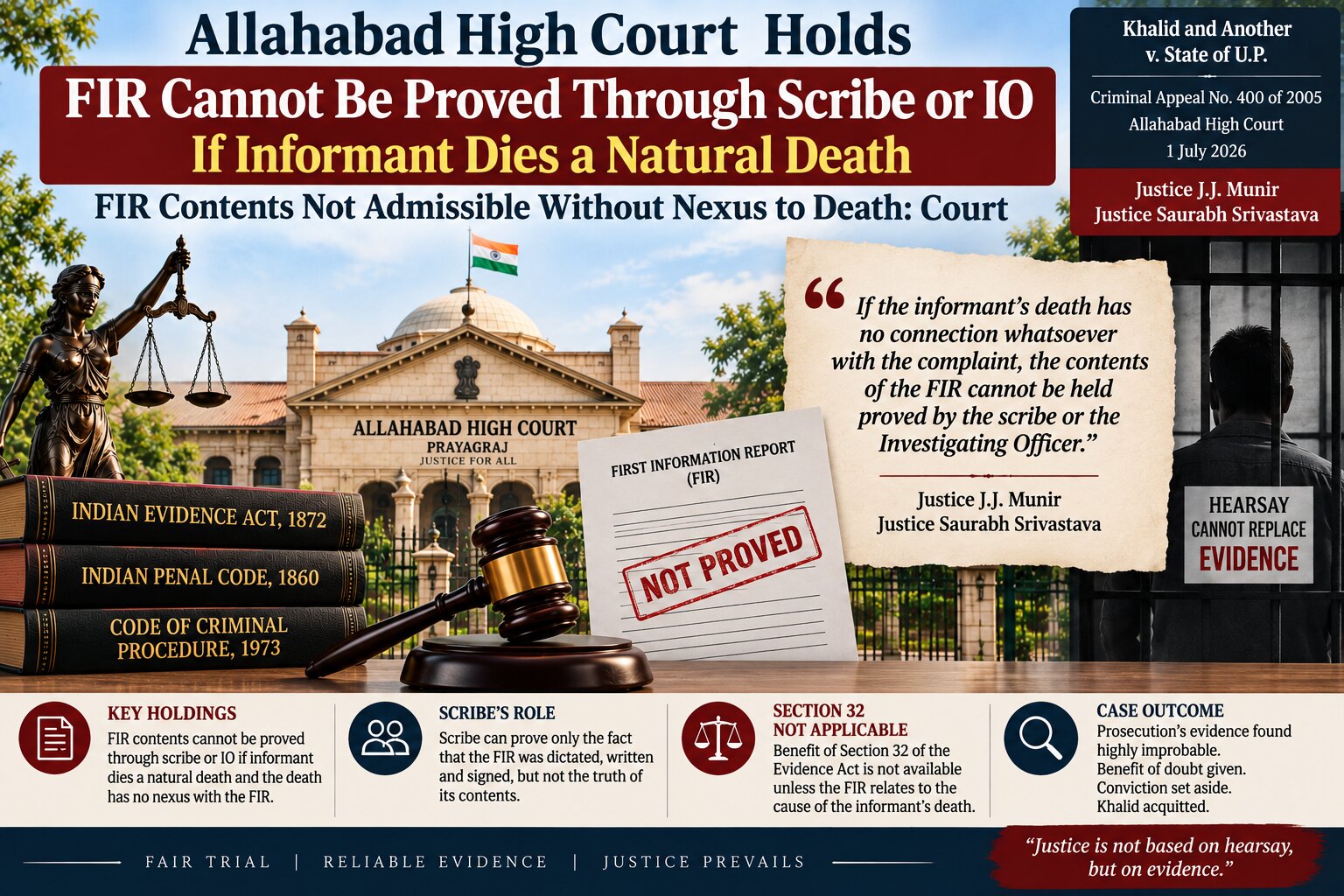
Judgement Details
Court
Allahabad High Court
Date of Decision
1 August 2026
Judges
Justice J.J. Munir and Justice Saurabh Srivastava
Citation
Acts / Provisions
Facts of the Case
- The case arose from the murder of Sarafraz alias Pappu on 7 January 1990 following a dispute concerning the use of a tractor-trolley.
-
The prosecution alleged that Khalid ordered his servant Nannu to restrain Sarafraz while Khalid fired at him.
-
The prosecution claimed that after the first gunshot was deflected by the informant, the pellets injured Nannu, following which Khalid allegedly shot Sarafraz in the head with a pistol.
-
Sarafraz's father, Wahiuddin, lodged the FIR but died a natural death before the commencement of the trial.
-
The prosecution examined the scribe of the FIR to prove its contents.
-
The Trial Court convicted Khalid and Nannu under Sections 302/34 IPC and sentenced both to life imprisonment.
-
During the pendency of the appeal, Nannu died and the proceedings abated against him.
-
Khalid continued the appeal before the High Court.
Issues
-
Whether the contents of an FIR lodged by an informant who subsequently dies a natural death can be proved through the scribe or Investigating Officer?
-
Whether Section 32 of the Evidence Act makes the FIR substantive evidence when the informant's death has no nexus with the offence reported in the FIR?
-
Whether the prosecution evidence was sufficiently reliable to sustain Khalid's conviction for murder?
Judgement
-
The High Court held that the contents of the FIR could not be proved through the scribe because the informant had died a natural death unrelated to the occurrence.
-
The Court clarified that the scribe could prove only the fact that the FIR was dictated, written and signed, along with its registration, but could not prove the truth of its contents.
-
Section 32 could not be invoked because the informant's death had no connection with the incident described in the FIR.
-
The Court nevertheless clarified that non-proof of the FIR does not prevent the prosecution from establishing the case through independent evidence properly proved at trial.
-
On examining the remaining evidence, the Court found the prosecution version highly improbable and unreliable.
-
The alleged manner in which Nannu was said to have restrained Sarafraz while Khalid fired at him was considered almost unbelievable.
-
The medical evidence concerning the shotgun pellets also created serious doubt about the prosecution version.
-
The Court therefore extended the benefit of doubt to Khalid.
-
The Trial Court's conviction and sentence were set aside, and Khalid was acquitted.
Held
-
Where the informant dies a natural death unrelated to the offence, Section 32(1) of the Evidence Act cannot be invoked to prove the contents of the FIR.
-
The scribe may establish the factum of the FIR, including its preparation and signatures, but cannot establish the truth of the statements contained in it.
-
The Investigating Officer likewise cannot reproduce the contents of such an FIR in evidence and thereby convert it into substantive evidence.
-
An FIR may operate as a dying declaration only where the informant's death has the necessary nexus with the facts reported.
-
Failure to prove the FIR does not by itself destroy the prosecution case if other cogent evidence independently establishes the offence.
-
In the present case, however, the other prosecution evidence contained serious inconsistencies and improbabilities.
-
The prosecution failed to establish Khalid's guilt beyond reasonable doubt.
-
Khalid was acquitted by giving him the benefit of doubt.
Analysis
-
The judgment reinforces an important distinction between the fact of making an FIR and the truth of its contents.
-
An FIR primarily sets the criminal law in motion; it does not ordinarily constitute substantive evidence of the facts stated in it.
-
The Court correctly emphasised that the person who actually made the statement must ordinarily be available for examination and cross-examination if the contents are sought to be relied upon substantively.
-
Section 32 creates an important exception where the statement has a nexus with the maker's death, such as an FIR functioning as a dying declaration. That exception cannot be extended to an informant who subsequently dies from unrelated natural causes.
-
The ruling prevents the prosecution from circumventing the hearsay rule simply by examining the person who wrote down the FIR or the police officer who registered it.
-
At the same time, the Court carefully clarified that exclusion of the FIR's contents does not automatically result in acquittal. The prosecution can still prove the case through witnesses, medical evidence and other admissible material.
-
In Khalid's case, the prosecution suffered a significant evidentiary disadvantage because the earliest account of the occurrence could not be substantively relied upon.
-
The Court then independently assessed the eyewitness and medical evidence and found the alleged sequence of events inherently improbable.
-
The alleged shotgun attack created particular difficulty because the prosecution's version required the pellets to strike Nannu while leaving Sarafraz's lower body completely unaffected.
-
The existence of a cross-version concerning the shooting further strengthened the reasonable doubt surrounding the prosecution's account.
-
The judgment therefore combines an important evidence-law principle regarding FIRs with the fundamental criminal-law principle that conviction cannot rest on evidence generating reasonable doubt.