
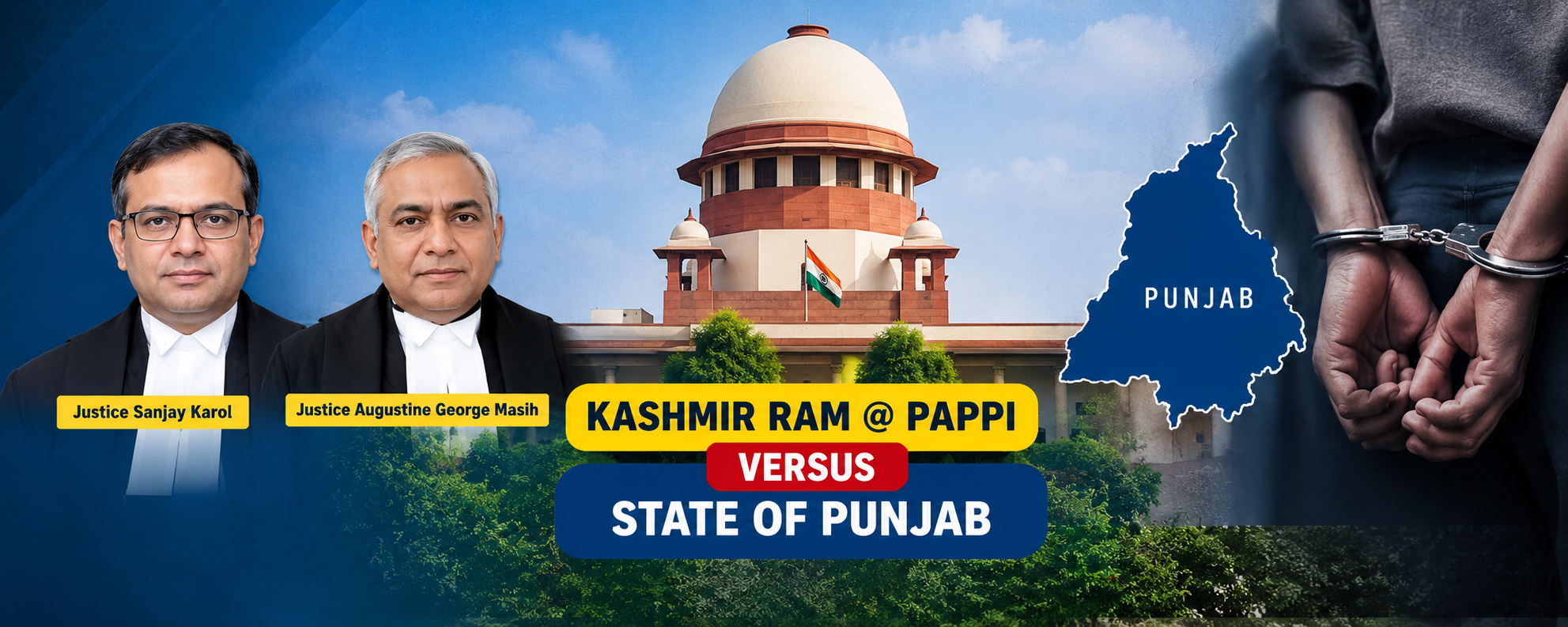
Kashmir Ram @ Pappi v. State of Punjab,
SC Upholds Kashmir Ram’s NDPS Conviction
Judgement Details
Court
Supreme Court of India
Date of Decision
17 September 2026
Judges
Justice Sanjay Karol and Justice Augustine George Masih
Citation
Acts / Provisions
Facts of the Case
-
On 4 May 2014, police officials were conducting checking at a naka near Canal Bridge, Village Tehang, District Jalandhar. According to the prosecution, a secret informer stated that Kashmir Ram @ Pappi and his brother Dharam Pal @ Bobby were transporting poppy husk in a Tata Safari vehicle.
-
The vehicle was intercepted and ten bags containing approximately 200 kg of poppy husk were allegedly recovered from beneath a tarpaulin in the rear portion of the vehicle.
-
The accused were also alleged to have disclosed the location of another eight bags, approximately 160 kg, kept in a room in their house. However, the Special Court did not accept the house recovery, principally because the requirements concerning independent witnesses under Section 100(4) CrPC had not been complied with.
-
The Special Court, Jalandhar, nevertheless convicted Kashmir Ram under Section 15(c) NDPS Act on the basis of the vehicle recovery and imposed 10 years' rigorous imprisonment and a ₹1,00,000 fine, with one additional year of rigorous imprisonment in default of payment.
-
The Punjab & Haryana High Court dismissed his appeal on 30 October 2019. Kashmir Ram then approached the Supreme Court.
Issues
-
Whether there was compliance with Section 42 NDPS Act regarding the secret information received by the investigating officer.
-
Whether Section 50 NDPS Act was attracted because personal searches of the accused were also conducted.
-
Whether the delay in sending the samples to the Chemical Examiner violated Standing Order 1/88 and Section 52A NDPS Act.
-
Whether the Chemical Examiner's report could be relied upon without examining the Chemical Analyst, particularly in light of Section 293 CrPC.
-
Whether absence of independent witnesses affected the prosecution case concerning recovery from the vehicle.
-
Whether accepting the vehicle recovery while rejecting the house recovery was legally inconsistent.
-
Whether discrepancies in the testimony of certain police witnesses destroyed the prosecution case.
-
Whether the prosecution sufficiently established the appellant's possession of the contraband, despite the vehicle being registered in the name of a third party.
-
Whether the presumption under Section 54 NDPS Act was rebutted by the defence.
-
Whether the concurrent findings of the Special Court and High Court warranted interference under Article 136 of the Constitution.
Judgement
-
The Supreme Court dismissed the appeal and upheld the conviction and sentence.
-
On Section 42, the Court distinguished between complete non-compliance and substantial compliance. Although the secret information was not entered separately in the prescribed register and separately forwarded to the superior officer, the investigating officer had received the information while conducting a naka on a public road concerning a vehicle expected imminently. He prepared the ruqa and sent it to the police station before interception and also informed the Deputy Superintendent of Police, who reached the spot and supervised the search. The Court therefore found substantial compliance with Section 42.
-
On Section 50, the Court held that the provision concerns the personal search of an individual and does not extend to searches of a vehicle, bag or container. Since the conviction was based on the recovery from the Tata Safari and nothing incriminating was recovered from the personal searches, Section 50 did not invalidate the vehicle recovery.
-
Regarding the delay in sending samples, the Court found that the integrity of the samples was sufficiently protected because the seized material was produced before the Magistrate the following day, the seals were recorded as intact, and the Chemical Examiner also found the seals intact and tallying with the specimen impressions. Thus, the delay amounted to a procedural irregularity but did not establish tampering or prejudice.
-
The Court further held that the Chemical Examiner's report was admissible under Section 293 CrPC. The defence had not sought examination of the Chemical Analyst during trial and had not established any reason to doubt the report.
-
The Court also distinguished the vehicle recovery from the house recovery. Section 100(4) CrPC applied to the search of the house, whereas the same requirement did not apply to the vehicle intercepted on a public road. The Court therefore found no inconsistency in accepting one recovery while rejecting the other.
-
Finally, the Court held that possession, rather than ownership of the vehicle, was material under Section 15 NDPS Act. The evidence established that the appellant was inside the vehicle and that the poppy husk was concealed immediately behind him. The presumption under Section 54 was therefore attracted and had not been rebutted.
Held
The appeal was dismissed.
The Supreme Court upheld:
-
Conviction under Section 15(c) NDPS Act;
-
10 years' rigorous imprisonment;
-
₹1,00,000 fine; and
-
One additional year of rigorous imprisonment in default of payment of fine.
The Court held that there was substantial compliance with Section 42, Section 50 was not attracted to the vehicle search, the sample-delay objection did not establish prejudice or tampering, and the Section 54 presumption remained unrebutted.
Analysis
-
The Court emphasised that the NDPS Act gives investigators extensive powers but also imposes safeguards because the consequences of conviction are severe. These safeguards cannot be treated as mere formalities. At the same time, the Court examined whether the purpose of the safeguard was actually served, rather than applying every procedural requirement mechanically.
-
A major aspect of the judgment is the distinction between total non-compliance and delayed or substantial compliance.
-
The Court reaffirmed that where secret information is received while an officer is on patrol and immediate action is necessary, strict prior recording may not always be practically possible. However, the information must subsequently be recorded and communicated as soon as practicable.
-
Importantly, the Court also clarified that registration of an FIR by itself cannot be treated as compliance with Section 42. In this case, however, the ruqa, communication to the superior officer and presence of the superior officer at the search, taken together, supported the finding of substantial compliance.
-
The judgment reinforces the distinction between personal search and search of a vehicle. A personal search conducted incidentally during investigation does not automatically invalidate an otherwise independent vehicle recovery when no contraband is recovered from the person's body.
-
The Court treated the delay in sending samples as a procedural irregularity because the evidence showed intact seals and judicial verification of the seized material. The reasoning focuses on whether the alleged procedural defect actually created a reasonable possibility of tampering, substitution or adulteration.
-
An important evidentiary principle applied by the Court was the ability to “sift the chaff from the grain.” The fact that one portion of the prosecution evidence is rejected does not necessarily require rejection of every other portion.
-
Here, the house recovery was rejected, but the vehicle recovery had independent documentary, forensic and judicial support.
-
The fact that the Tata Safari was registered in the name of a third party did not by itself exonerate the appellant. The Court focused on possession and control of the contraband, rather than title to the vehicle. The Section 54 presumption further placed an evidentiary burden on the appellant to satisfactorily account for the contraband.
-
The Supreme Court additionally noted that the Special Court and High Court had reached concurrent factual findings. Under Article 136, such findings are ordinarily not interfered with unless prima facie perversity or absurdity is demonstrated. The Court found no such basis here.