
Kartika @ Kirtan @ Kirtan Charan Jena & Anr. Etc. v. The State of Odisha, 2026
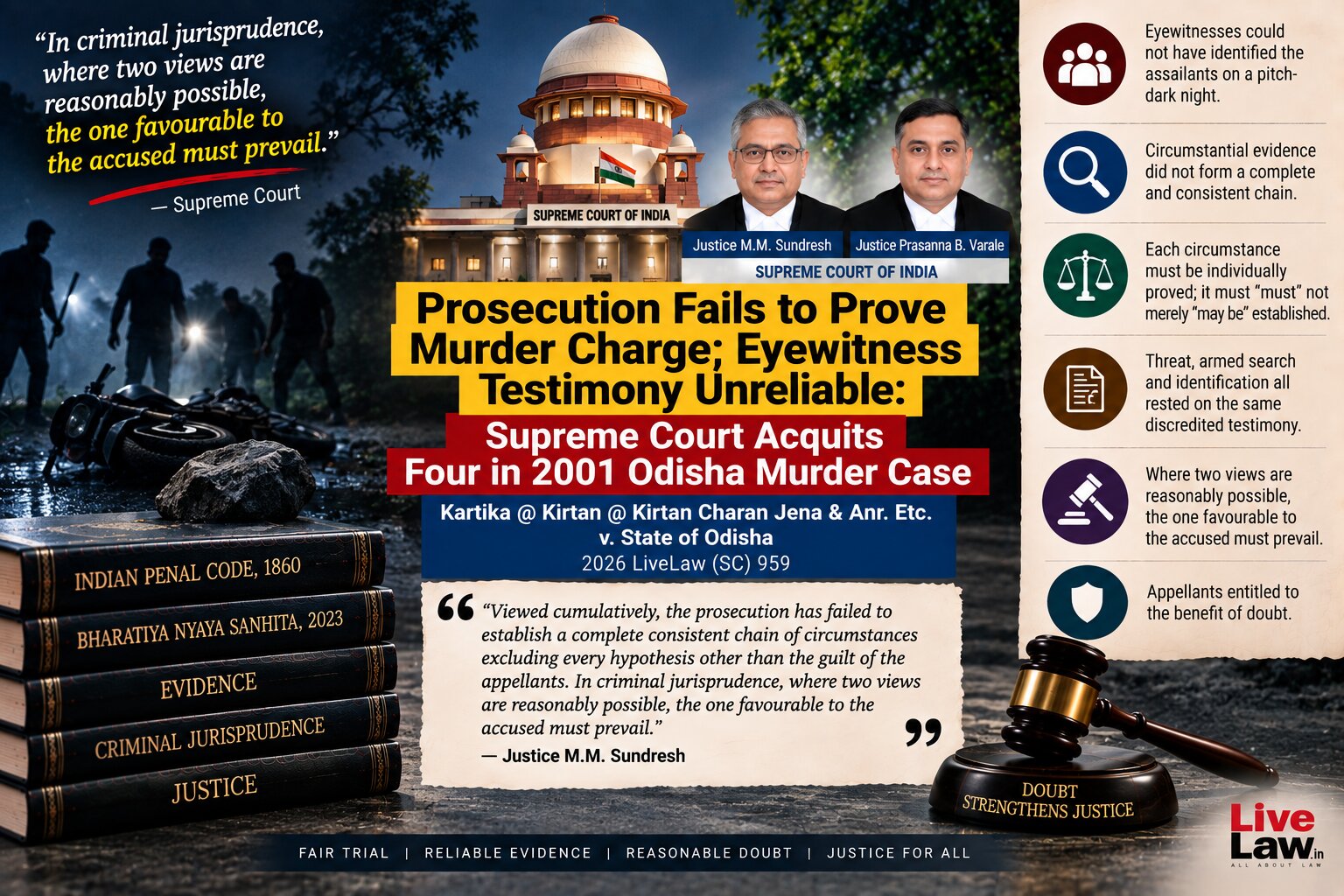
Judgement Details
Court
Supreme Court of India
Date of Decision
17 September 2026
Judges
Justice M.M. Sundresh and Justice Prasanna B. Varale
Citation
Acts / Provisions
Facts of the Case
-
The case concerned the alleged 2001 murder of Dhruba Pradhan in Odisha.
-
According to the prosecution, one accused had earlier visited the informant's house and threatened to kill the deceased.
-
Later that evening, a group of accused persons allegedly armed with weapons searched for the deceased.
-
The prosecution alleged that the accused intercepted the deceased while he was travelling on a motorcycle, assaulted him with stones and weapons and subsequently threw his motorcycle into a pond.
-
Out of 18 charge-sheeted persons, 14 were tried before the Trial Court.
-
The Trial Court convicted six accused under Sections 148, 506 and 302 read with Section 149 IPC and sentenced them to life imprisonment, while eight accused were acquitted.
-
The High Court found that the alleged eyewitnesses could not have identified the assailants on a pitch-dark night and therefore discarded the eyewitness testimony.
-
Despite rejecting the eyewitness account, the High Court upheld the convictions on the basis of circumstantial evidence.
-
Two of the six convicted persons died during the pendency of the appeals before the Supreme Court, leaving four appellants.
-
Before the Supreme Court, the appellants argued that the prosecution evidence was contradictory and that there was no reliable independent evidence connecting them with the murder.
-
The prosecution contended that the circumstances formed an unbroken chain and were supported by medical and recovery evidence.
Issues
-
Whether the prosecution established the identity of the assailants through reliable eyewitness testimony despite the incident having occurred on a pitch-dark night?
-
Whether the High Court was justified in relying upon circumstantial evidence after discarding the eyewitness testimony as unreliable?
-
Whether the prosecution established a complete and consistent chain of circumstances pointing exclusively towards the guilt of the appellants?
-
Whether the appellants were entitled to the benefit of doubt in the absence of reliable direct or circumstantial evidence connecting them with the murder?
Judgement
-
The Supreme Court allowed the appeals and set aside the judgments of both the Trial Court and the High Court.
-
The Court found considerable merit in the appellants' submissions and held that the prosecution had failed to establish their guilt beyond reasonable doubt.
-
The Court found material inconsistencies in the testimony of the alleged eyewitnesses regarding who was actually present at the scene.
-
The Court noted that the incident occurred on a pitch-dark night and that the only source of light was allegedly a torch carried by the accused themselves.
-
The Court agreed that the circumstances made identification of the assailants highly doubtful.
-
The Court also found that the circumstances relied upon by the High Court substantially depended upon the same discredited eyewitness testimony.
-
There was no satisfactory evidence regarding the alleged heavy stone used in the assault; it was neither recovered nor sent for medical examination.
-
The prosecution therefore failed to establish a complete chain of circumstances excluding every reasonable hypothesis consistent with innocence.
-
The appellants were consequently acquitted by extending the benefit of doubt.
Held
-
Eyewitness testimony cannot be relied upon where the surrounding circumstances make identification of the assailants inherently doubtful, particularly where the incident occurred in pitch darkness.
-
Once the eyewitness account is found unreliable, circumstantial evidence must independently satisfy the strict requirements applicable to a circumstantial-evidence case.
-
Every individual circumstance relied upon by the prosecution must be proved independently.
-
The circumstances must form a complete chain that points only towards the guilt of the accused and excludes every reasonable alternative hypothesis.
-
In the present case, the alleged threat, armed search and identification of the accused were substantially based on the same unreliable testimony.
-
The prosecution failed to establish a complete and consistent chain of circumstances.
-
Where two views are reasonably possible, the view favourable to the accused must prevail.
-
The appellants were therefore entitled to the benefit of doubt.
Analysis
-
The judgment reinforces the strict standard applicable to convictions based on circumstantial evidence.
-
The Supreme Court applied the principles commonly referred to as the “panchsutra” from Sharad Birdhichand Sarda v. State of Maharashtra, requiring the circumstances to be firmly established and to form a complete chain pointing towards guilt.
-
The Court emphasized that circumstances cannot merely be probable; they must be proved so as to exclude reasonable hypotheses consistent with innocence.
-
A significant aspect of the judgment was the treatment of the eyewitness evidence. The High Court had itself concluded that the witnesses could not have properly observed or identified the assailants on a pitch-dark night.
-
The Supreme Court found a further inconsistency between the prosecution witnesses concerning the presence of persons at the scene, weakening the reliability of the prosecution's narrative.
-
The Court also rejected an approach whereby circumstances dependent upon an unreliable eyewitness account could subsequently be treated as independent corroborative circumstances.
-
The absence of recovery or forensic examination of the alleged laterite stone further weakened the prosecution case.
-
The ruling demonstrates that a conviction cannot be sustained merely by accumulating circumstances unless each circumstance is independently proved and all of them collectively form an unbroken chain.
-
The judgment also reiterates the fundamental criminal-law principle that reasonable doubt must operate in favour of the accused.
-
The acquittal was therefore based not on a finding that the prosecution's version was impossible, but on the failure to establish guilt to the required standard of proof.