
Kartik Rabidas and 2 Others v. State of Assam and 4 Others, 2026
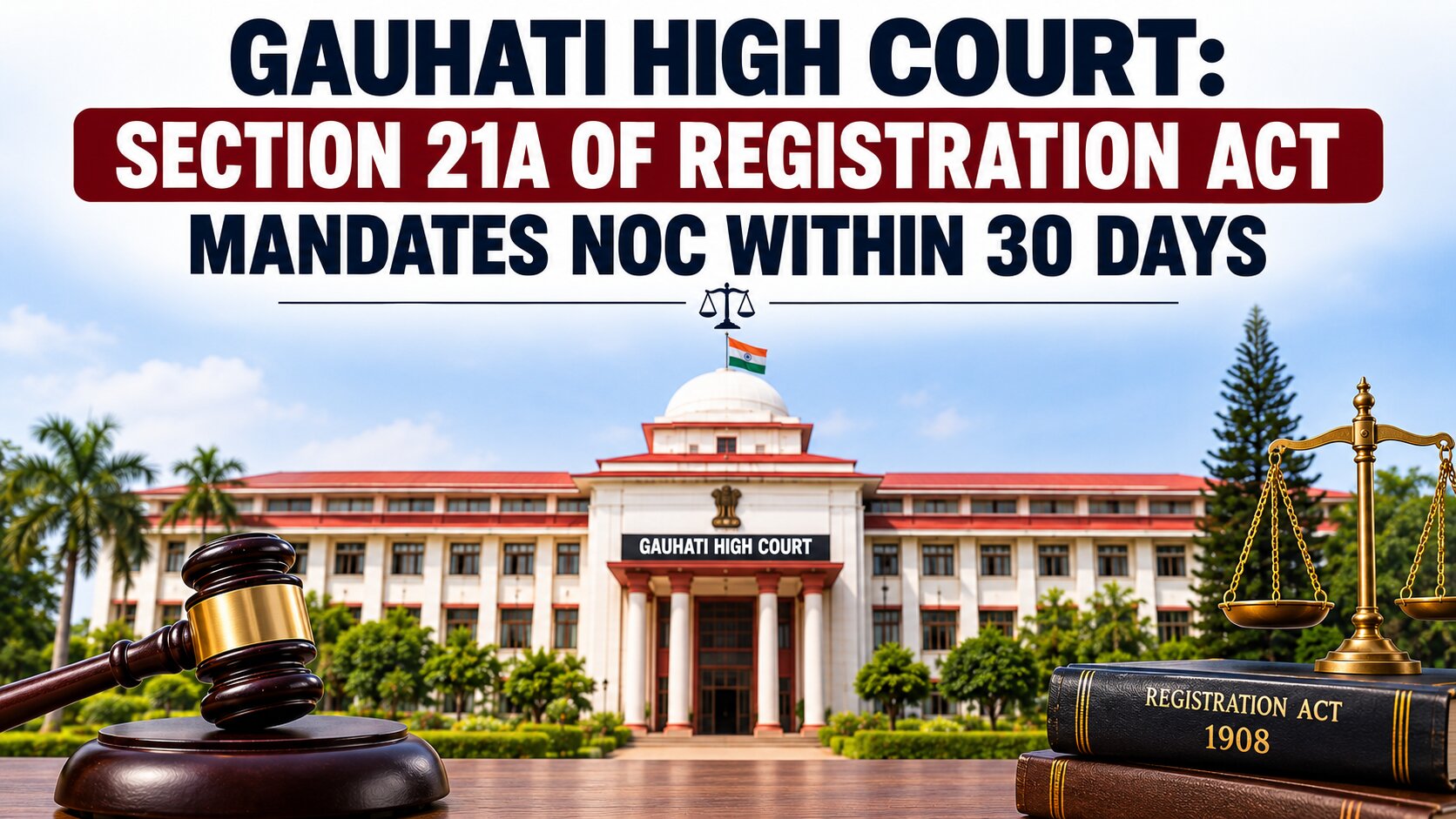
The Court held that Section 21A imposes a statutory mandate upon the jurisdictional Deputy Commissioner concerning the NOC process.
Judgement Details
Court
Gauhati High Court
Date of Decision
4 August 2026
Judges
Justice Manish Choudhury
Citation
Acts / Provisions
Facts of the Case
-
The petitioners were owners of a parcel of land situated at Mouza Rajabari in Sribhumi district.
-
The first and second petitioners entered into an agreement with the third petitioner for sale of a portion of the land measuring eight kathas.
-
The agreed sale consideration was ₹42 lakh.
-
The petitioners thereafter applied for a No Objection Certificate (NOC) under Section 21A of the Registration Act for the proposed transfer.
-
The relevant area had not completed its official survey operation.
-
Consequently, the online facility for submitting an NOC application was unavailable.
-
The petitioners therefore submitted the application through offline mode.
-
The State authorities acknowledged that, because the online facility was unavailable in the concerned area, the application could properly be submitted offline.
-
The authorities stated that the application was required to be processed in accordance with the applicable Standard Operating Procedure.
-
More than five months passed without the NOC application reaching its final conclusion.
-
The petitioners therefore approached the Gauhati High Court seeking a direction to the competent authority, particularly the District Commissioner, to conclude the NOC process.
-
The Court examined Section 21A of the Registration Act as amended and the SOP issued by the State Government.
-
Section 21A requires an NOC before certain non-testamentary instruments concerning immovable property can be accepted for registration.
-
The provision requires the NOC to be issued within 30 days from receipt of the application.
-
If an NOC is not issued within that period, the authority is required to pass a speaking order containing reasons within the prescribed period.
-
The SOP provides a procedure involving reports from the Circle Officer and, in applicable cases, the Nodal Officer and Special Branch of the Assam Police.
-
The Special Branch report may examine issues including threat, coercion, fraudulent means, communal harmony, national security and the character and antecedents of the parties.
-
The District Commissioner may seek additional information, reject the proposal or issue the NOC after considering the relevant reports.
-
The Court noted that the statutory period and SOP both prescribed a 30-day framework for processing the application.
-
Since the petitioners' application had remained pending for more than five months, the Court found that the prescribed timeline had not been followed.
Issues
-
Whether Section 21A of the Registration Act, 1908 requires the jurisdictional Deputy Commissioner to decide an NOC application within thirty days of its receipt?
-
Whether failure to issue an NOC within the prescribed thirty-day period requires the authority to pass a speaking order containing reasons for such non-issuance?
-
Whether an NOC application submitted through offline mode can be processed when the online application facility is unavailable in the concerned area?
-
Whether the authorities could keep the petitioners' NOC application pending for more than five months without bringing the process to its statutory conclusion?
-
Whether the Standard Operating Procedure dated 09.09.2025 also requires the authorities to process and conclude an NOC application within the prescribed thirty-day period?
-
Whether the District Commissioner was required to inform the petitioners in writing of any deficiency in their application within the prescribed period?
-
Whether the High Court should issue a direction requiring the competent authority to conclude the NOC process within the statutory time limit?
Judgement
-
The Gauhati High Court disposed of the writ petition with directions to the authorities.
-
The authority must either issue an NOC containing the description of the immovable property proposed to be transferred or pass a speaking order with reasons where the NOC is not issued.
-
The Court emphasized the 30-day statutory period prescribed under Section 21A.
-
The Court also considered the SOP notified by the State Government on 09 September 2025.
-
The SOP similarly prescribes a framework requiring timely processing of NOC applications.
-
The Court noted that the petitioners' application had remained pending for more than five months.
-
Such prolonged pendency was inconsistent with the statutory prescription.
-
The Court directed the respondent authorities, particularly the District Commissioner, to bring the entire NOC process to its conclusion.
-
The process was directed to be completed within an outer limit of 30 days from the date the petitioners submitted a certified copy of the High Court's order.
-
The Court directed the authorities to comply strictly with Section 21A and the applicable SOP.
-
If any additional document or information was required, the District Commissioner was directed to inform the petitioners in writing within 15 days of receiving the order.
-
Where deficiencies were communicated and subsequently cured, the 30-day period would be calculated from the date on which the deficiencies were cured.
-
The Court therefore ensured that the application could not remain indefinitely pending without either a decision or a reasoned order.
-
The writ petition was disposed of without any order as to costs.
Held
-
Section 21A creates a statutory obligation concerning disposal of NOC applications for covered immovable-property transfers.
-
The competent authority must act within the prescribed 30-day period.
-
The authority must either:
-
issue the NOC containing the required property particulars; or
-
pass a speaking order with reasons where the NOC is not issued.
-
-
Administrative authorities cannot keep an NOC application pending indefinitely.
-
The SOP dated 09.09.2025 also prescribes a 30-day processing framework.
-
Where the online facility is unavailable, submission through the permitted offline mode can be processed in accordance with the applicable procedure.
-
If an application contains deficiencies requiring additional documents, the applicant must be informed in writing within 15 days.
-
Once the deficiencies are cured, the statutory processing period runs from the date of curing the deficiencies.
-
The District Commissioner was directed to conclude the petitioners' NOC process within 30 days from submission of the certified copy of the Court's order.
-
The writ petition was disposed of without costs.
Analysis
-
Statutory mandate: The key principle is that Section 21A does not leave the authority with unlimited discretion regarding the time within which an NOC application must be processed.
-
Thirty-day deadline: The Court treated the 30-day period as a statutory prescription rather than an open-ended administrative target.
-
Speaking order requirement: If an NOC is not granted, the authority cannot simply remain silent. A reasoned or speaking order is required.
-
Administrative accountability: The judgment promotes accountability by requiring the authority to communicate the basis for refusal or non-issuance.
-
No indefinite pendency: The decision prevents applicants from being left in administrative uncertainty for months without knowing whether their property transfer will be permitted.
-
Offline applications: The Court recognized the practical problem created by the absence of an online facility. Where the State itself accepts that offline submission is permissible, the applicant cannot be prejudiced merely because the online system is unavailable.
-
Role of the SOP: The judgment gives importance to the State's own procedural framework for implementing Section 21A. Administrative authorities must follow the prescribed procedure as well as the statutory mandate.
-
Additional documents: The direction requiring deficiencies to be communicated within 15 days ensures that applicants are given a meaningful opportunity to correct defects rather than having applications remain dormant.
-
Fresh computation after curing defects: The Court clarified that once deficiencies are communicated and cured, the applicable 30-day period can run from the date of curing, providing a workable mechanism for the authority and applicant.
-
Reasoned administrative decisions: The requirement of a speaking order reflects the broader principle that administrative decisions affecting legal or property interests should disclose the reasons supporting the decision.
-
Balance between regulation and property transactions: Section 21A imposes regulatory safeguards on certain land transfers, but those safeguards must still be administered within the statutory framework.
-
Writ jurisdiction: Rather than itself deciding whether the NOC should ultimately be granted, the High Court directed the competent administrative authority to perform its statutory function within the prescribed period.
-
Limited judicial intervention: The Court did not substitute its own decision for that of the District Commissioner. It required the statutory authority to make the decision according to law.
-
Practical significance for landowners: Applicants seeking an NOC under Section 21A can rely upon the statutory timeline and seek appropriate legal relief where an application remains pending without decision.
-
Overall significance: The judgment reinforces that administrative authorities must act within statutory timelines and cannot indefinitely delay decisions concerning statutory applications.