
Kareti Venkata Vahini v. State of Andhra Pradesh & Ors., 2026
An order rejecting an application to adduce additional evidence at the appellate stage is interlocutory in nature where it does not determine substantive rights.
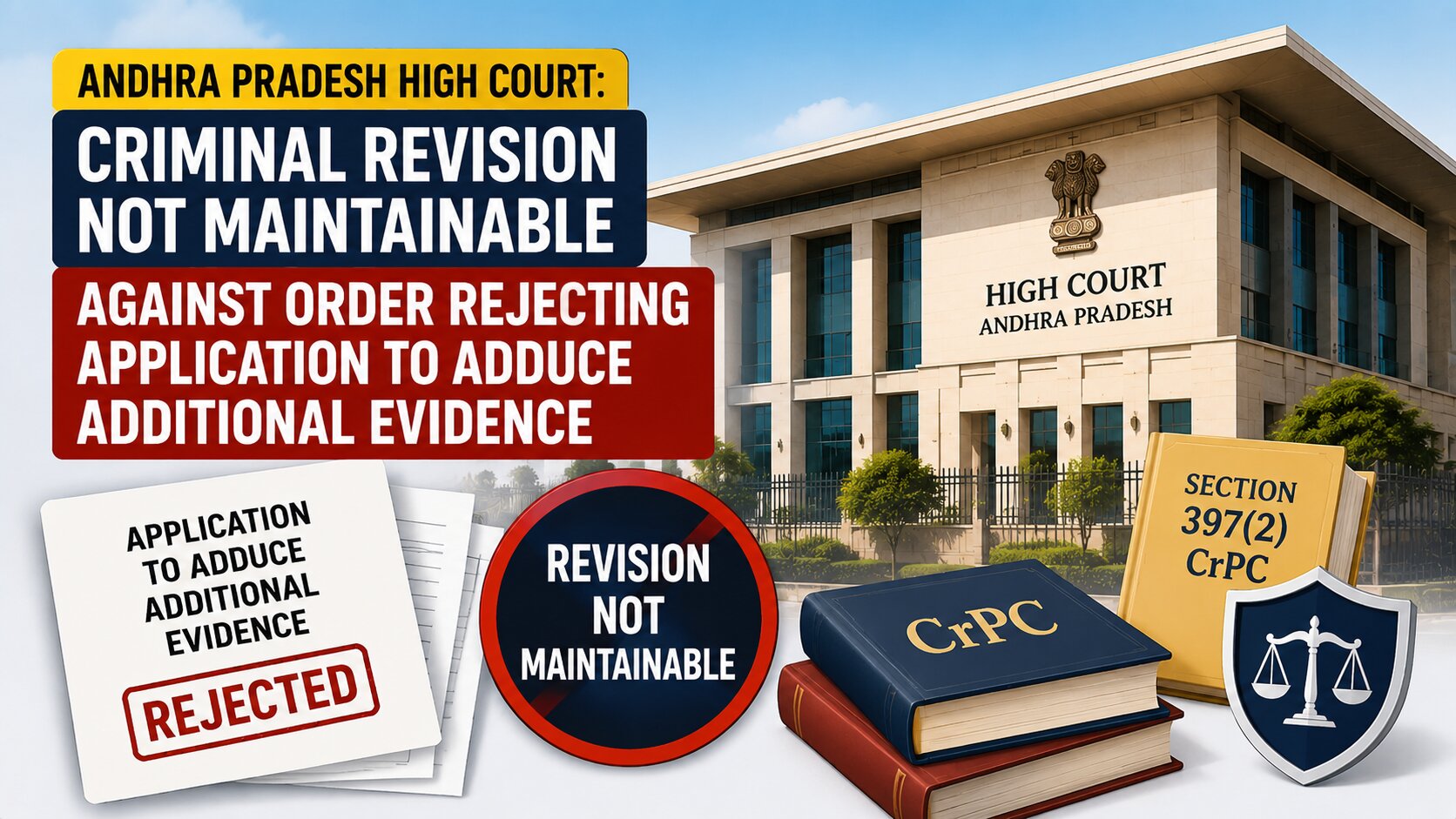
Judgement Details
Court
Andhra Pradesh High Court
Date of Decision
3 August 2026
Judges
Justice Dr. Y. Lakshmana Rao
Citation
Acts / Provisions
Facts of the Case
-
The petitioner was involved in a pending criminal appeal before the appellate court.
-
During the appellate proceedings, the petitioner sought permission to adduce additional evidence.
-
The petitioner proposed to produce certified copies of certain documents as additional evidence.
-
The appellate court rejected the application.
-
The appellate court observed that a proper application under Section 391 CrPC had not been filed.
-
According to the appellate court, the petitioner had not demonstrated that the proposed additional evidence was essential for a just decision.
-
The petitioner also failed to establish that the evidence could not have been produced earlier despite due diligence.
-
The appellate court further considered whether the proposed evidence was merely intended to fill gaps in the case.
-
Aggrieved by the rejection, the petitioner approached the Andhra Pradesh High Court by filing a criminal revision petition.
-
Before the High Court, the petitioner argued that rejection of the application deprived her of a valuable opportunity to place relevant material before the appellate court.
-
The petitioner contended that the impugned order was an intermediate order and therefore capable of being challenged in revision.
-
The petitioner relied upon judicial precedents to support the maintainability of the revision.
-
The High Court examined whether an order rejecting an application to adduce additional evidence at the appellate stage could be challenged under the revisional jurisdiction.
-
The Court held that the impugned order did not determine or affect any substantive rights of the parties.
-
The Court characterized the order as purely interlocutory.
-
Consequently, the statutory bar contained in Section 397(2) CrPC applied.
-
The High Court therefore held that the criminal revision petition was not maintainable.
-
The revision petition was dismissed, while the petitioner was granted liberty to pursue an appropriate remedy before the competent forum.
Issues
-
Whether a criminal revision petition is maintainable against an interlocutory order rejecting an application to adduce additional evidence at the appellate stage?
-
Whether an order rejecting an application under Section 391 CrPC to produce additional evidence determines or affects any substantive right of the parties?
-
Whether the statutory bar under Section 397(2) CrPC applies to an order refusing permission to adduce additional evidence during an appeal?
-
Whether an order relating to the reception of additional documents at the appellate stage is an interlocutory order for the purposes of Section 397(2) CrPC?
-
Whether the petitioner could challenge the rejection of the application through the revisional jurisdiction of the High Court?
Judgement
-
The Andhra Pradesh High Court dismissed the criminal revision petition.
-
The Court held that the order rejecting the application to adduce additional evidence was interlocutory in nature.
-
The Court found that the impugned order did not determine or affect any substantive right of the parties.
-
Consequently, the Court held that Section 397(2) CrPC operated as a statutory bar against the revision petition.
-
The Court observed that Section 397(2) unequivocally provides that no revision shall lie against an interlocutory order.
-
The Court distinguished the precedents relied upon by the petitioner because those cases involved orders that substantially affected the rights of the parties.
-
In the present matter, the order merely concerned the reception of additional evidence.
-
The Court therefore concluded that the petitioner could not invoke revisional jurisdiction against the impugned order.
-
The revision petition was consequently dismissed.
-
However, the Court granted the petitioner liberty to pursue an appropriate remedy before the competent forum.
-
The Court did not determine the merits of the proposed additional evidence or finally decide whether the documents should be admitted during the appeal.
Held
- Such an order is covered by the bar under Section 397(2) CrPC.
-
A criminal revision petition therefore does not lie against such an interlocutory order.
-
The mere rejection of an application to produce additional documents does not, by itself, make the order an intermediate or revisable order.
-
Orders concerning the reception of documents or additional evidence ordinarily remain interlocutory unless they substantially affect or determine the rights of the parties.
-
The petitioner's reliance on precedents concerning orders substantially affecting rights was distinguishable on the facts.
-
The High Court therefore declined to exercise revisional jurisdiction.
-
The petitioner was nevertheless granted liberty to approach the appropriate forum through an appropriate remedy.
Analysis
-
Interlocutory order: The central issue was the character of the appellate court's order. The High Court treated the rejection of additional evidence as an interlocutory procedural order because it did not finally determine any substantive right.
-
Section 397(2) bar: Once an order is classified as interlocutory, Section 397(2) creates an express statutory prohibition against entertaining a criminal revision petition against it.
-
Additional evidence under Section 391: The appellate court's power to receive additional evidence is governed by Section 391 CrPC. The petitioner was required to demonstrate why the additional evidence was necessary for a just decision and why it could not have been produced earlier despite due diligence.
-
No determination of substantive rights: The High Court emphasized that rejection of the application did not finally determine the petitioner's criminal liability or any substantive entitlement. It only concerned the procedural question of whether additional material could be introduced at that stage.
-
Intermediate versus interlocutory orders: The petitioner attempted to characterize the order as an intermediate order capable of revision. The High Court rejected this argument because the precedents relied upon involved orders having a substantial impact on the rights of the parties.
-
Distinction from substantive orders: The judgment demonstrates that not every order passed during criminal proceedings is automatically revisable. The nature and consequences of the particular order must be examined.
-
Procedural safeguards: Section 397(2) prevents criminal proceedings from being interrupted by repeated revisions against routine procedural orders. This promotes efficiency and prevents unnecessary fragmentation of criminal trials and appeals.
-
Liberty to seek appropriate remedy: Although the revision was dismissed as not maintainable, the Court did not foreclose all possible remedies. The petitioner was expressly given liberty to approach the competent forum through an appropriate application.
-
Practical significance: Parties seeking to challenge an appellate court's refusal to admit additional evidence must first determine whether the impugned order substantially affects their rights or merely regulates the procedure of the appeal.
-
Overall significance: The judgment reinforces the principle that revisional jurisdiction under Section 397 CrPC cannot ordinarily be invoked against an interlocutory order merely because the order is adverse to a party. The decisive consideration is whether the order determines or substantially affects substantive rights.