
Kannan Bala v. State of Tamil Nadu, 2026
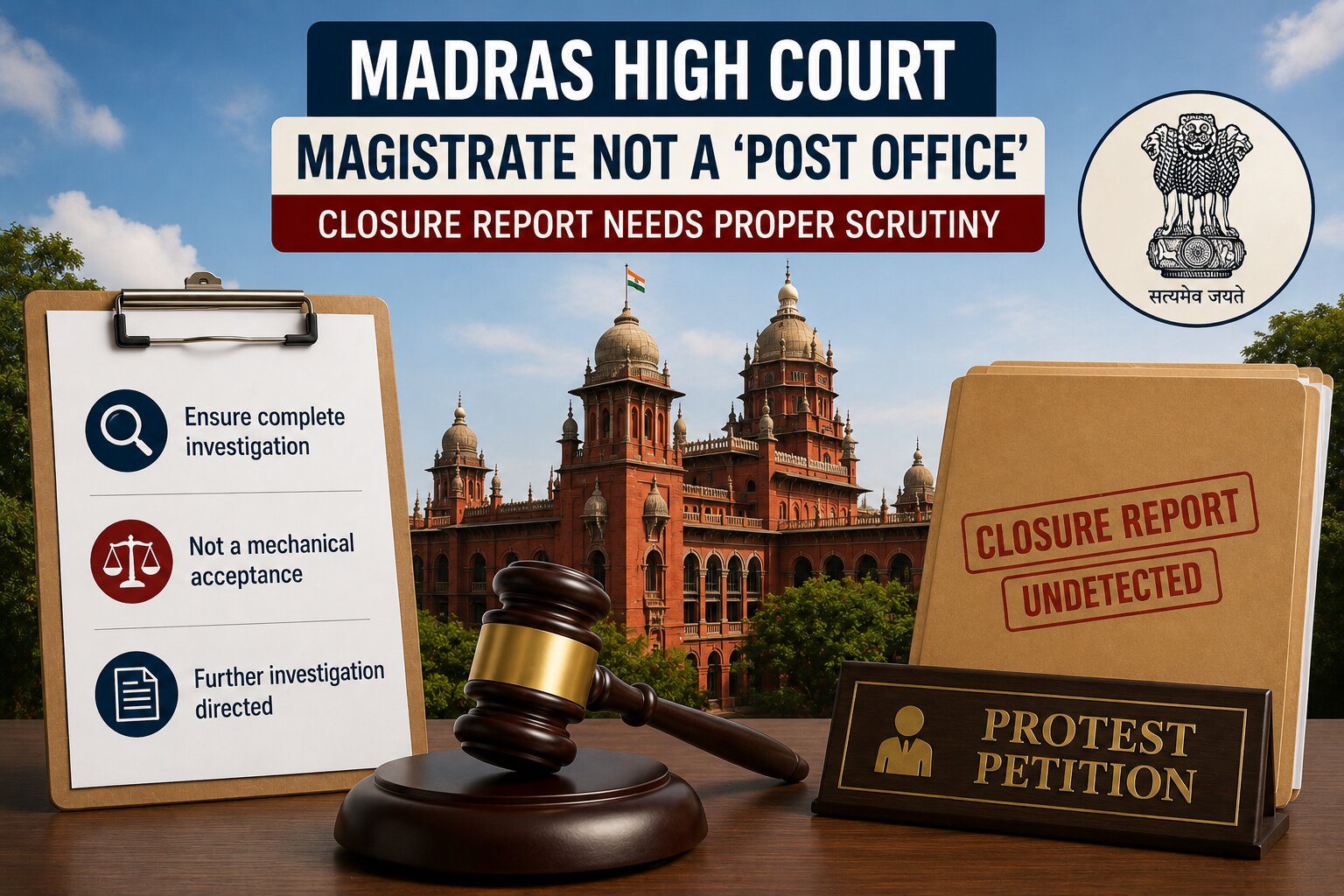
A closure report marked as "undetected" is valid only after a complete and meaningful investigation.
Judgement Details
Court
Madras High Court
Date of Decision
21 July 2026
Judges
Justice Victoria Gowri
Citation
Acts / Provisions
Facts of the Case
-
The petitioner was an Associate Professor and Senior Warden of the Men's Hostel at Tirunelveli Medical College.
-
As Senior Warden, he was responsible for monitoring and preventing ragging within the hostel.
-
After receiving complaints from parents of two first-year students regarding ragging, he conducted an inquiry.
-
The inquiry identified two final-year students as responsible, following which disciplinary action was initiated and one student was permanently debarred from the hostel.
-
A few days after the disciplinary action, unknown persons allegedly threw a paver block from the hostel terrace onto the windshield of the petitioner's car.
-
The petitioner alleged that the act was not merely intended to damage the vehicle but was aimed at causing him grievous injury or even death in retaliation for his anti-ragging action.
-
Based on his complaint, the police registered a case under Section 427 IPC and Section 3 of the Tamil Nadu Public Property (Prevention of Damage and Loss) Act.
-
After investigation, the police filed a closure report describing the case as "undetected", stating that no accused could be identified.
-
The Judicial Magistrate accepted the closure report despite the petitioner's protest petition.
-
Challenging the Magistrate's order, the petitioner approached the Madras High Court seeking further investigatio
Issues
-
Whether a Magistrate can mechanically accept a police closure report describing a case as "undetected" without examining the completeness and fairness of the investigation?
-
Whether the Magistrate is required to independently consider the objections raised in a protest petition before accepting a closure report?
-
Whether the police conducted a complete, fair, and meaningful investigation before filing the "undetected" closure report?
-
Whether further investigation by a different investigating officer was warranted in the facts of the case?
-
Whether the institutional background, including the petitioner's anti-ragging action and possible motive, required deeper investigation before closure of the case?
Judgement
-
The Madras High Court allowed the Criminal Revision Petition.
-
The Court held that a Magistrate cannot function as a "post office" by mechanically accepting a closure report filed by the police.
-
It observed that before accepting an "undetected" closure report, the Magistrate must satisfy himself that the investigation was complete, fair, and meaningful.
-
The Court emphasized that a closure report as "undetected" is legally sustainable only after all reasonable investigative avenues have been exhausted.
-
The Bench found that the investigating agency had failed to examine several important aspects, including access to the hostel terrace, hostel attendance registers, duty registers, CCTV footage, and the possible motive arising from the anti-ragging disciplinary action.
-
The Court observed that the institutional background and sequence of events could not be dismissed as a mere coincidence without proper investigation.
-
It noted that the Magistrate's order was cryptic and failed to demonstrate consideration of the objections raised in the protest petition.
-
The Court reiterated that while considering a protest petition, the Magistrate must independently examine whether the closure report adequately addresses all material aspects of the case.
-
Considering the limited scope of revisional jurisdiction, the Court directed further investigation rather than ordering reinvestigation.
-
The Court directed the Commissioner of Police to appoint a competent investigating officer not below the rank of Deputy Superintendent of Police/Assistant Commissioner of Police to conduct further investigation.
-
It further directed that the investigation be supervised by a senior police officer nominated by the Commissioner of Police.
Held
-
A Magistrate cannot mechanically accept a police closure report.
-
The Magistrate must independently consider the protest petition and examine whether the investigation addressed all material aspects.
-
The investigation in the present case was found to be incomplete.
-
The order accepting the closure report was set aside.
-
Further investigation by a senior officer under supervisory control was directed.
Analysis
-
The judgment reinforces the independent judicial role of Magistrates in scrutinizing police closure reports rather than acting as mere endorsing authorities.
-
The Court emphasized that judicial oversight is an essential safeguard against incomplete or superficial investigations.
-
By insisting that every reasonable investigative avenue must first be exhausted, the judgment strengthens the standards governing "undetected" closure reports.
-
The decision recognizes that institutional contexts, such as alleged retaliation following anti-ragging action, may constitute an important investigative lead that cannot be ignored.
-
The Court highlighted that the purpose of a protest petition is to enable judicial review of police conclusions, requiring active application of mind by the Magistrate.
-
The ruling strikes a balance between judicial restraint and the need to ensure fair investigation by directing further investigation instead of ordering a fresh investigation.
-
The judgment also underscores that criminal investigations must not end merely because the accused are initially unidentifiable where additional investigative methods remain available.
-
The decision strengthens accountability of both investigating agencies and Magistrates in ensuring that justice is not defeated through premature closure of criminal cases.