
Kanchan Devi v. Amit Sharma, 2026
Reconciliation must be attempted before a matrimonial court proceeds with adjudication of a divorce petition.
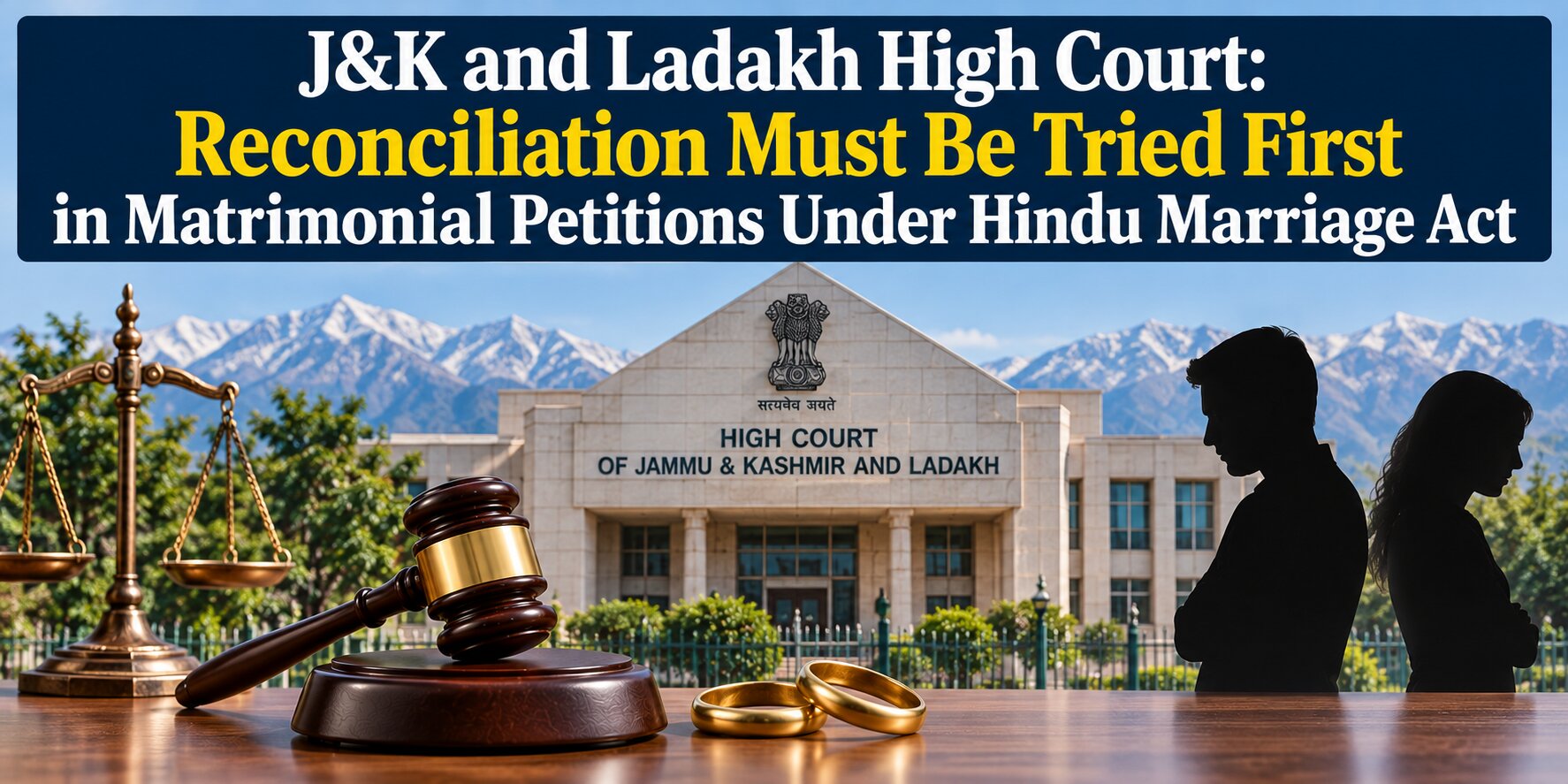
Judgement Details
Court
High Court of Jammu & Kashmir and Ladakh
Date of Decision
3 September 2026
Judges
Justice Rahul Bharti
Citation
Acts / Provisions
Facts of the Case
-
The petitioner-wife and respondent-husband were married, but their matrimonial relationship subsequently became strained.
-
The respondent-husband instituted a divorce petition under Section 13 of the Hindu Marriage Act, 1955 before the Principal District Judge, Samba.
-
The petitioner-wife appeared before the court through counsel after being summoned in the divorce proceedings.
-
Instead of first undertaking an exercise for reconciliation or mediation, the court proceeded to call upon the petitioner to file her reply/objections to the divorce petition.
-
The subordinate court even granted the petitioner a last opportunity to file her reply and indicated that failure to do so would result in closure of her right to file the reply-cum-objections.
-
Aggrieved by the procedure adopted by the subordinate court, the petitioner approached the High Court under Article 227 of the Constitution.
-
The petitioner contended that the matrimonial proceedings were being treated like an ordinary civil proceeding without giving effect to the special reconciliation-oriented procedure contemplated by the Hindu Marriage Act.
-
The High Court examined Section 23(2) of the Hindu Marriage Act, which requires the court to make every endeavour to bring about reconciliation between the parties before proceeding with adjudication.
-
The High Court also considered the spirit and requirements of Order XXXII-A CPC, which requires courts dealing with family-related disputes to endeavour to assist parties in arriving at a settlement.
-
The High Court found that the orders passed by the court below did not indicate that any meaningful reconciliation exercise had been undertaken.
-
The Court further noticed an issue concerning the designation of the subordinate court in the order, observing that a matrimonial petition under the Hindu Marriage Act falls within the jurisdiction of the Principal District Judge and not the Principal Sessions Judge.
-
The High Court accordingly exercised its supervisory jurisdiction and directed the Principal District Judge, Samba, to first undertake reconciliation or mediation.
-
Only if that exercise failed could the divorce petition proceed to adjudication, at which stage the petitioner would be given an opportunity to file her reply/objections.
Issues
-
Whether a court dealing with a divorce petition under the Hindu Marriage Act, 1955 is required to undertake reconciliation before proceeding with the filing of replies or objections?
-
Whether Section 23(2) of the Hindu Marriage Act, 1955 mandates the court to make an endeavour for reconciliation before proceeding with adjudication of a matrimonial dispute?
-
Whether the spirit of Order XXXII-A CPC requires courts dealing with matrimonial disputes to explore settlement or mediation at the first instance?
-
Whether the Principal District Judge, Samba, erred in directing the petitioner to file her reply and threatening closure of her right to reply without first undertaking reconciliation or mediation?
-
Whether the High Court could exercise its supervisory jurisdiction under Article 227 to correct the procedure adopted by the subordinate court in the matrimonial proceedings?
Judgement
-
The High Court disposed of the petition by exercising its supervisory jurisdiction under Article 227 of the Constitution.
-
The Court held that the subordinate court was required to first undertake an exercise aimed at reconciliation or mediation between the matrimonial parties.
-
The Court relied upon Section 23(2) of the Hindu Marriage Act, 1955, which requires the court to make every endeavour to bring about reconciliation before proceeding with the divorce matter.
-
The Court also referred to Order XXXII-A CPC, which reflects the legislative policy of encouraging settlement in family-related disputes.
-
The High Court found that the orders of the Principal District Judge, Samba, did not demonstrate that any reconciliation exercise had been undertaken.
-
The Court held that immediately insisting upon a reply or objections from the wife did not fulfil the reconciliation-oriented obligation imposed upon the matrimonial court.
-
The High Court observed that requiring the respondent-wife to immediately respond to allegations in the divorce petition could potentially result in further formalisation of the matrimonial dispute rather than first exploring an amicable resolution.
-
The Principal District Judge, Samba, was directed to first undertake reconciliation or mediation.
-
Only if reconciliation or mediation failed was the court directed to proceed with the divorce petition on its merits.
-
Following failure of reconciliation or mediation, the petitioner was to be given an opportunity to file her reply/objections.
-
The High Court also directed the Registrar General to communicate with subordinate courts regarding the proper designation of courts according to the jurisdiction being exercised.
-
The Court clarified that a matrimonial proceeding under the Hindu Marriage Act should be referred to by the designation of the Principal District Judge, rather than the Principal Sessions Judge.
-
A copy of the order was directed to be forwarded to the Principal District Judge, Samba, and the Registrar General for circulation among judicial officers.
Held
-
Section 23(2) of the Hindu Marriage Act imposes a duty upon the court to make an endeavour to bring about reconciliation between the parties.
-
The reconciliation exercise should take place before mechanically proceeding with pleadings and objections.
-
Order XXXII-A CPC reinforces the judicial responsibility to explore settlement in family-related disputes.
-
A matrimonial proceeding should not be treated merely as an ordinary civil dispute without regard to its special nature.
-
Where reconciliation or mediation has not been attempted, the court should first undertake that exercise before proceeding further with the divorce petition.
-
If reconciliation or mediation fails, the respondent should then be given an opportunity to file a reply or objections and the matter can proceed to adjudication.
-
The High Court can exercise its Article 227 supervisory jurisdiction where the subordinate court adopts a procedure inconsistent with the statutory scheme governing matrimonial proceedings.
-
The court exercising matrimonial jurisdiction must use the correct designation corresponding to its jurisdiction.
Analysis
-
The judgment emphasises that matrimonial litigation has a distinctive character. A divorce petition is not simply an ordinary adversarial civil dispute because the relationship between the parties and the possibility of preserving the marriage remain relevant at the procedural stage.
-
Section 23(2) HMA places reconciliation within the statutory framework of matrimonial adjudication. The provision requires the court to make an endeavour to reconcile the parties before proceeding with the matter.
-
The Court's reference to Order XXXII-A CPC reinforces the broader procedural policy that courts dealing with family disputes should explore settlement rather than immediately move into purely adversarial litigation.
-
The judgment makes clear that reconciliation is not merely a theoretical or optional consideration to be ignored while the court proceeds directly with pleadings. The court must actually give consideration to whether an amicable resolution is possible.
-
The Court specifically criticised the approach of first insisting upon a reply and even threatening closure of the right to file objections without any prior reconciliation exercise.
-
The reasoning recognises that pleadings in matrimonial litigation frequently contain allegations concerning the conduct of one spouse. Immediately requiring the opposing spouse to answer those allegations may deepen the adversarial character of the dispute.
-
The judgment therefore establishes a procedural sequence: first explore reconciliation or mediation; if that fails, proceed with the ordinary adjudicatory process, including filing of the respondent's reply.
-
Importantly, the Court did not hold that the respondent can permanently avoid filing a reply. The opportunity to file objections remains available after the reconciliation or mediation exercise fails.
-
The decision therefore balances two objectives: preservation of the possibility of settlement and, if settlement fails, the parties' right to have the matrimonial dispute adjudicated according to law.
-
The judgment also highlights the importance of procedural sensitivity in family litigation. Courts dealing with matrimonial disputes are expected to recognise the nature of the relationship involved rather than mechanically apply the procedure followed in ordinary civil litigation.
-
The Court's direction concerning the designation of the subordinate court is also significant. Judicial orders should correctly identify the jurisdiction being exercised, particularly where the same judicial establishment may deal with both civil and criminal matters.
-
The circulation of the order among judicial officers indicates that the Court intended the procedural principle concerning reconciliation to receive broader attention in matrimonial proceedings.
-
Overall, the decision reinforces reconciliation-first adjudication in proceedings under the Hindu Marriage Act, while preserving the normal adjudicatory process if an amicable settlement cannot be achieved.