
K. Surya v. The State of Tamil Nadu, 2026
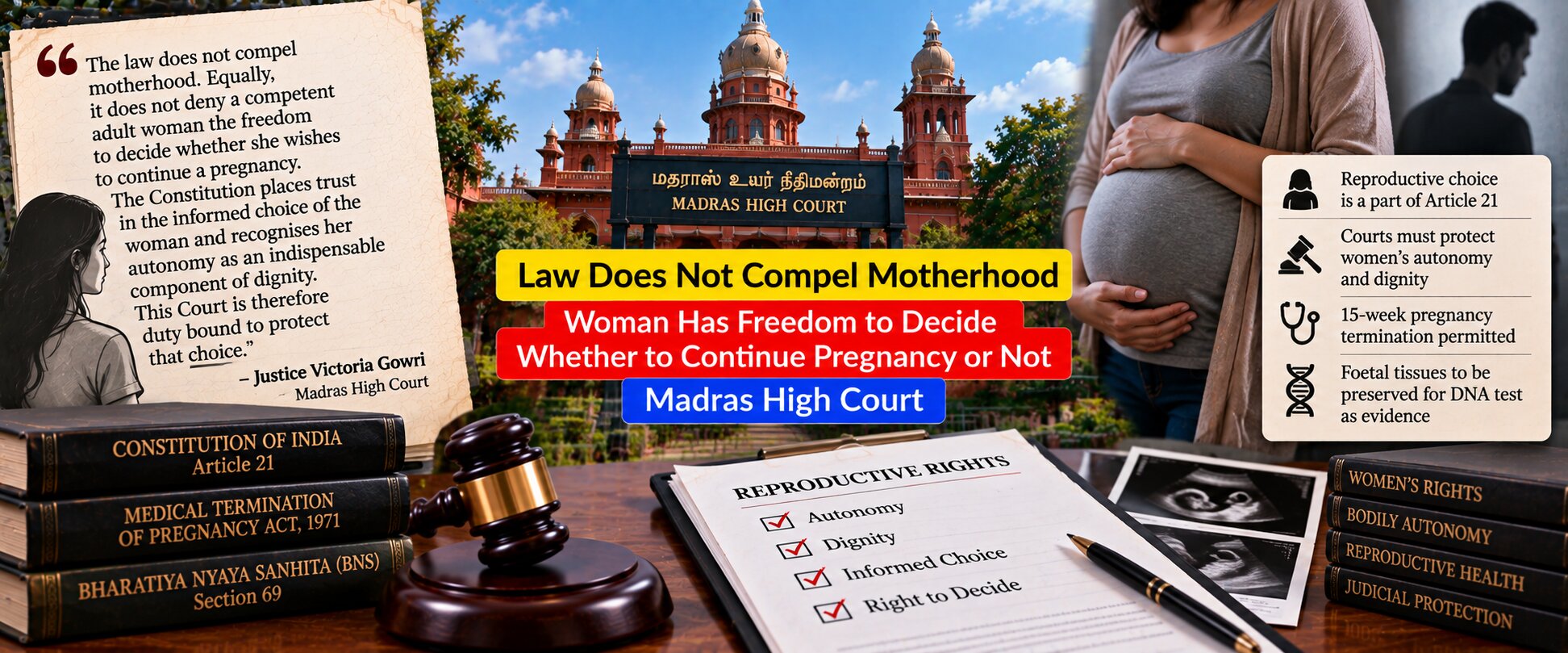
A competent adult woman's reproductive choice is protected by Article 21.
Judgement Details
Court
Madras High Court
Date of Decision
3 September 2026
Judges
Justice L. Victoria Gowri
Citation
Acts / Provisions
Facts of the Case
-
The petitioner, K. Surya, was a final-year B.Tech student.
-
He approached the Madras High Court seeking protection from alleged police harassment arising out of a dispute with a woman with whom he had been in a relationship.
-
The woman had allegedly complained to the police that the petitioner had promised to marry her but subsequently refused to marry her.
-
The petitioner alleged that the police had compelled him and the woman to appear before them and had made them stand before a temple, garland each other and pose for photographs, allegedly creating an impression that they had married.
-
The petitioner approached the High Court apprehending further police interference and pressure to establish a matrimonial relationship with the woman.
-
During the proceedings, the woman appeared before the Court and informed it that she was pregnant.
-
She stated that the pregnancy had been conceived during her consensual relationship with the petitioner.
-
The petitioner continued to maintain that he was unwilling to marry her or establish a matrimonial relationship with her.
-
The woman consequently filed an application seeking permission to terminate the pregnancy.
-
The High Court suo motu impleaded the Dean of Tirunelveli Medical College Hospital and directed that the woman be medically examined.
-
The medical examination revealed that the woman was suffering from severe anaemia. Following blood transfusion, her haemoglobin levels were brought to the required level.
-
The woman clearly informed the Court that she did not wish to continue the pregnancy.
-
She submitted that compelling her to continue an unwanted pregnancy would cause serious emotional, psychological and social trauma.
-
The Court considered the woman's age, her informed decision, her medical condition and the circumstances surrounding the pregnancy.
-
The Court also noted that the petitioner himself had consistently refused to marry the woman or establish a family unit with her.
-
The Court therefore considered whether compelling the woman to continue the pregnancy would amount to an impermissible interference with her bodily autonomy and decisional freedom under Article 21.
-
The Court ultimately permitted termination of the pregnancy.
-
At the same time, the Court noted that a criminal case had been registered against the petitioner under Section 69 BNS, and that he had already been arrested and remanded to judicial custody.
-
Since biological material arising from the termination could potentially constitute relevant evidence in the criminal investigation, the Court directed preservation of the foetal tissues and other biological samples in accordance with medical protocols.
-
The Investigating Officer was also directed to take appropriate steps for a DNA examination in accordance with law.
Issues
-
Whether a competent adult woman has the constitutional autonomy under Article 21 to decide whether she wishes to continue or terminate her pregnancy?
-
Whether compelling an adult woman to continue an unwanted pregnancy against her informed decision amounts to an infringement of her bodily autonomy and decisional freedom?
-
Whether the refusal of the biological father to marry the woman or establish a family unit can justify compelling the woman to continue the pregnancy?
-
Whether the woman's request for termination could be permitted in the circumstances of the case having regard to the Medical Termination of Pregnancy Act and her medical condition?
-
Whether the biological material arising from the lawful termination of pregnancy should be preserved where it may constitute relevant evidence in an ongoing criminal investigation?
-
Whether the petitioner's apprehension regarding police harassment required further protection when he had already been arrested and remanded to judicial custody?
Judgement
-
The Madras High Court allowed the woman's request for termination of pregnancy.
-
The Court held that the law does not compel an adult woman to assume motherhood against her informed decision.
-
Justice Victoria Gowri emphasised that reproductive choice is closely connected with bodily autonomy, dignity and decisional freedom protected under Article 21.
-
The Court observed that the Constitution places trust in the informed choice of a competent adult woman.
-
The Court rejected the notion that the petitioner's refusal to marry the woman could result in an obligation upon her to continue an unwanted pregnancy.
-
The Court found that forcing the woman to continue the pregnancy despite her informed decision would constitute a direct intrusion into her bodily autonomy and freedom of decision.
-
The Court consequently permitted the termination in the circumstances of the case.
-
The Court's order was based upon the particular facts before it, including the woman's informed decision, her age, medical assessment and the circumstances surrounding the pregnancy.
-
The Court also addressed the petitioner's original grievance concerning alleged police harassment.
-
It noted that the police had already registered a criminal case against him under Section 69 BNS and that he had been arrested and remanded to judicial custody.
-
Consequently, the Court observed that his apprehension of continuing police excess had lost much of its immediate significance.
-
However, the petitioner was granted liberty to pursue appropriate remedies challenging the FIR, arrest and other aspects of the criminal proceedings in accordance with law.
-
The Court separately considered the evidentiary consequences of termination.
-
Since biological material generated from the termination could potentially be relevant to the criminal case, the Court directed that the foetal tissues and other biological samples be preserved according to established medical protocols.
-
The Investigating Officer was directed to take appropriate steps for conducting a DNA test in accordance with law.
Held
-
Bodily autonomy and decisional freedom form an important part of constitutional dignity.
-
The law does not compel a competent adult woman to continue an unwanted pregnancy merely because another person, including the biological father, does not consent to termination or refuses to marry her.
-
Compelling a woman to continue an unwanted pregnancy despite her informed decision can amount to an impermissible intrusion into her bodily autonomy and decisional freedom.
-
The Court is duty-bound to protect constitutionally recognised reproductive autonomy in appropriate cases.
-
The permission for termination in this case did not depend upon compelling the petitioner to marry the woman.
-
The petitioner's refusal to marry did not diminish the woman's independent constitutional right to make decisions concerning her own pregnancy.
Analysis
-
The termination was permitted after the Court obtained and considered a medical assessment of the woman.
-
The biological material resulting from the termination could still have evidentiary relevance to the criminal investigation.
-
Accordingly, preservation of foetal tissues and other biological samples and lawful DNA testing were directed to ensure that the termination did not unnecessarily interfere with the investigation.
-
The petitioner remained free to challenge the FIR, arrest and related criminal proceedings through appropriate legal remedies.