
K. Rashik v. National Insurance Company Ltd. & Another, 2026
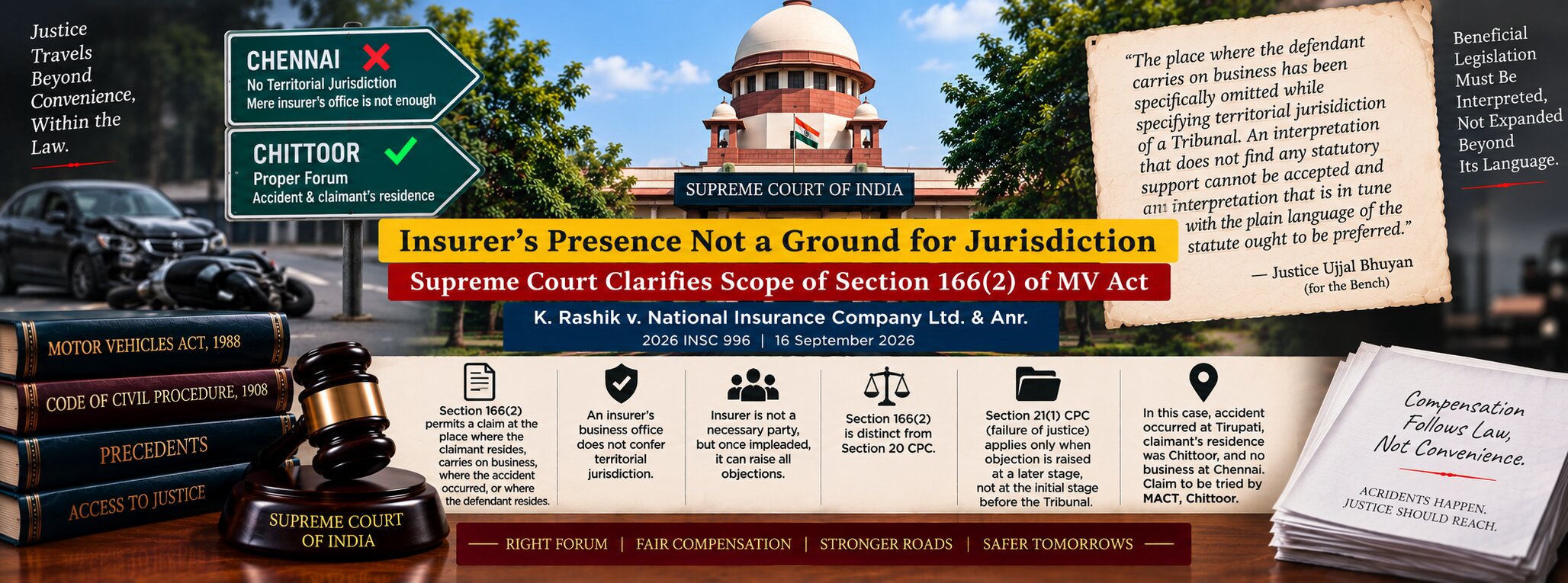
An insurer's business office does not by itself confer territorial jurisdiction on an MACT under Section 166(2) of the Motor Vehicles Act.
Judgement Details
Court
Supreme Court of India
Date of Decision
16 September 2026
Judges
Justice Ujjal Bhuyan and Justice Atul S. Chandurkar
Citation
Acts / Provisions
Facts of the Case
-
On 25 October 2022, the appellant K. Rashik was travelling on a two-wheeler with his brother when a mini truck driven by the second respondent hit their vehicle.
-
The accident occurred in District Tirupati, Andhra Pradesh.
-
The claimant filed a compensation application under Section 166 of the Motor Vehicles Act, 1988 before the Motor Accidents Claims Tribunal, Chennai.
-
The National Insurance Company Ltd., which was impleaded as the insurer, objected to the territorial jurisdiction of the Chennai Tribunal.
-
The insurer argued that no part of the cause of action arose in Chennai and therefore Section 166(2) did not confer jurisdiction on the Chennai Tribunal.
-
The MACT, Chennai rejected the objection, reasoning that the insurer had a business office in Chennai and therefore the Tribunal could entertain the claim.
-
The insurer challenged this decision before the Madras High Court under Article 227 of the Constitution.
-
The Madras High Court held that the Chittoor Tribunal had jurisdiction because the accident occurred in the Chittoor/Tirupati area and the claimant's pleaded residence was also in Chittoor.
-
The claimant approached the Supreme Court, arguing that he resided and worked at Chennai and that the beneficial nature of the Motor Vehicles Act required a liberal interpretation in favour of accident victims.
-
The claimant also argued that the insurer itself carried on business at Chennai and therefore its presence there should permit the Chennai Tribunal to exercise jurisdiction.
-
The Supreme Court examined the precise wording of Section 166(2) and the distinction between the jurisdictional options available in relation to the claimant and the defendant.
-
The Court found that the claimant's own pleadings showed his address as Chittoor, the accident occurred in Tirupati, and there was no pleading that he carried on business in Chennai.
-
The Court therefore concluded that no jurisdictional connection existed between the claim and Chennai.
Issues
-
Whether an MACT can assume territorial jurisdiction merely because the insurer carries on business or maintains an office within that territory?
-
Whether the expression “where the claimant resides or carries on business” in Section 166(2) of the Motor Vehicles Act can be extended to the place where the insurer carries on business?
-
Whether the expression “defendant resides” in Section 166(2) includes an insurer who has been impleaded as a party-respondent?
-
Whether Section 20 of the CPC, which recognises the place where a defendant carries on business as a jurisdictional ground, can be applied to expand the jurisdiction under Section 166(2) of the Motor Vehicles Act?
-
Whether the requirement of showing “failure of justice” under Section 21(1) of the CPC applies when an objection to territorial jurisdiction is raised before the MACT at the initial stage?
-
Whether the MACT at Chennai had territorial jurisdiction when the accident occurred in Tirupati, the claimant's pleaded residence was Chittoor, and there was no pleading that he carried on business in Chennai?
Judgement
-
The Supreme Court dismissed the appeal filed by the claimant and upheld the Madras High Court's order.
-
The Court held that Section 166(2) does not confer territorial jurisdiction merely because the insurer carries on business at a particular place.
-
The Court identified the jurisdictional options available to a claimant under Section 166(2): the place where the claimant resides, where the claimant carries on business, where the accident occurred, or the place within whose jurisdiction the defendant resides.
-
The Court emphasized that the legislature deliberately used different expressions for the claimant and defendant.
-
For the claimant, the statute expressly uses “resides or carries on business.”
-
For the defendant, the statute uses only “resides” and does not add the words “or carries on business.”
-
Therefore, the place where a defendant merely carries on business cannot independently confer jurisdiction under Section 166(2).
-
The Court held that the word “defendant” in Section 166(2) is not intended to include the insurer merely because the insurer has been impleaded.
-
The insurer's impleadment in a Section 166 claim is not mandatory; the Tribunal can independently issue notice to the insurer under Section 168(1).
-
However, once the insurer is impleaded as a party-respondent, it can raise all legally permissible grounds to contest the claim.
-
The Court distinguished Section 166(2) from Section 20 CPC, because Section 20 expressly recognises the place where a defendant carries on business, whereas Section 166(2) does not.
-
The Court also clarified that earlier decisions such as Mantoo Sarkar, Malati Sardar, and Balveer Batra concerned objections raised at a later or appellate stage.
-
Where territorial jurisdiction is challenged at the initial stage, Section 166(2) must be directly applied.
-
The Section 21(1) CPC requirement of demonstrating failure of justice becomes relevant when the objection is raised at a later stage after adjudication.
-
Since the insurer raised its objection before the MACT itself and before adjudication on merits, Section 21(1) CPC did not protect the claimant.
-
The claim was therefore directed to be tried by the MACT at Chittoor.
Held
-
Section 166(2) expressly permits filing where the claimant resides or carries on business, but does not similarly provide jurisdiction merely because the defendant carries on business there.
-
The expression “defendant resides” in Section 166(2) does not include an insurer merely because the insurer has been impleaded.
-
Section 166(2) is distinct from Section 20 CPC, and the broader jurisdictional rule contained in Section 20 cannot be imported into the Motor Vehicles Act.
-
An insurer that has been impleaded as a party-respondent can raise all permissible objections, including territorial jurisdiction.
-
The requirement under Section 21(1) CPC of demonstrating failure of justice applies to territorial-jurisdiction objections raised at a later/appellate stage, not to an objection raised at the initial stage before the Tribunal.
-
Since the claimant's own pleadings placed his residence in Chittoor, the accident occurred in Tirupati, and there was no assertion that he carried on business in Chennai, the Chennai MACT lacked territorial jurisdiction.
-
The claim was correctly transferred to and directed to be tried by the MACT at Chittoor.
Analysis
-
The judgment gives importance to the plain statutory language of Section 166(2).
-
The Court recognised that the Motor Vehicles Act is beneficial legislation, intended to provide effective remedies to victims of motor accidents.
-
However, the beneficial-objective principle cannot be used to introduce a jurisdictional ground that the legislature did not provide.
-
The key distinction is between “claimant resides or carries on business” and “defendant resides.”
-
The deliberate omission of “carries on business” in relation to the defendant indicates that an insurer's office cannot independently create MACT jurisdiction.
-
The judgment also clarifies the legal position of an insurer in motor accident claims.
-
An insurer is not necessarily a defendant from the moment a claim is filed; it may initially only receive notice under the statutory scheme.
-
Once the insurer is impleaded as a party, however, it is entitled to contest the claim on all permissible grounds.
-
The decision prevents a claimant from selecting a Tribunal solely on the basis of the geographical presence of an insurance company.
-
The Court distinguished jurisdiction at the beginning of proceedings from an objection raised after the Tribunal has already delivered an award.
-
At the initial stage, the Tribunal must strictly satisfy itself that one of the jurisdictional conditions under Section 166(2) exists.
-
At the appellate or post-award stage, Section 21(1) CPC introduces the additional requirement of showing failure of justice.
-
The judgment therefore provides an important clarification on the interaction between the Motor Vehicles Act and the CPC.
-
The ruling also demonstrates that purposive interpretation cannot override clear statutory wording.
-
The practical consequence is that claimants must carefully identify the proper MACT based on residence, business, accident location, or legally relevant defendant residence, rather than merely relying on the location of an insurer's office.