
Jittu Yadav v. State of Chhattisgarh & Others, 2026
The absence of an outer limit for condonation under Section 9 supports the continued applicability of Section 5 of the Limitation Act.
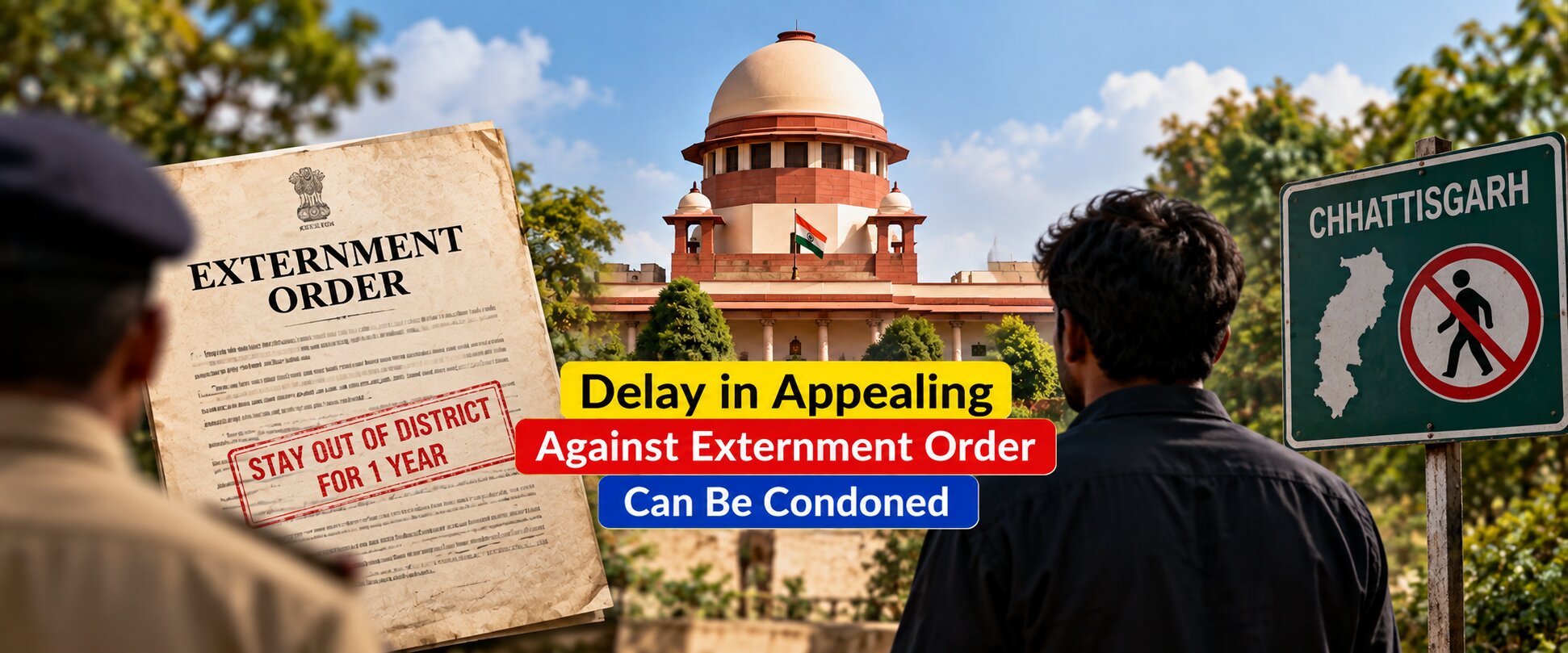
Judgement Details
Court
Supreme Court of India
Date of Decision
4 September 2026
Judges
Justice B.V. Nagarathna and Justice Ujjal Bhuyan
Citation
Acts / Provisions
Facts of the Case
-
The appellant, Jittu Yadav, was proceeded against under the Chhattisgarh Rajya Suraksha Adhiniyam, 1990.
-
The District Magistrate, Balodabazar-Bhatapara, issued a show-cause notice dated 24 April 2025 to the appellant.
-
The notice called upon the appellant to explain why an externment order should not be passed against him under the Adhiniyam.
-
The appellant submitted his reply to the show-cause notice on 5 May 2025.
-
After considering the material available on record, the District Magistrate passed an externment order dated 18 June 2025.
-
By the externment order, the appellant was directed to remain outside District Balodabazar-Bhatapara for a period of one year.
-
The appellant challenged the externment order by filing an appeal before the State Government under Section 9 of the Adhiniyam.
-
Section 9 prescribes a period of 30 days for filing such an appeal.
-
The appellant filed his appeal on 12 September 2025, which was approximately 50 days after the externment order.
-
The State Government dismissed the appeal on 3 October 2025, holding that it was barred by limitation.
-
The appellant thereafter approached the High Court of Chhattisgarh at Bilaspur under Article 226 of the Constitution.
-
The High Court dismissed the petition on 16 October 2025 and upheld the rejection of the appeal on the ground of limitation.
-
The appellant then approached the Supreme Court.
-
Before the Supreme Court, the principal question was whether the 30-day limitation prescribed under Section 9 of the Adhiniyam excluded the application of Section 5 of the Limitation Act.
-
The appellant contended that the Adhiniyam did not expressly exclude Section 5 and did not prescribe any maximum outer limit beyond which delay could not be condoned.
-
The State argued, among other things, that the appeal had been filed beyond the statutory period and that no application seeking condonation of delay had originally been filed before the State Government.
Issues
-
Whether Section 5 of the Limitation Act, 1963 applies to an appeal filed under Section 9 of the Chhattisgarh Rajya Suraksha Adhiniyam, 1990?
-
Whether the 30-day limitation period prescribed under Section 9 of the Chhattisgarh Rajya Suraksha Adhiniyam, 1990 expressly excludes the application of Section 5 of the Limitation Act, 1963?
-
Whether the applicability of Section 5 of the Limitation Act can be excluded by necessary implication even when the special statute does not expressly prohibit condonation of delay?
-
Whether the absence of an outer limit for condonation of delay under Section 9 of the Chhattisgarh Rajya Suraksha Adhiniyam indicates that Section 5 of the Limitation Act continues to apply?
-
Whether the appellant's delayed appeal against the externment order could be restored and considered on merits upon sufficient cause being shown for the delay?
-
Whether an interpretation preserving the statutory appellate remedy should be preferred where an externment order carries serious consequences for the appellant's movement and livelihood?
Judgement
-
The Supreme Court allowed the appeal filed by Jittu Yadav.
-
The Court examined the relationship between Section 9 of the Chhattisgarh Rajya Suraksha Adhiniyam and Section 5 read with Section 29(2) of the Limitation Act.
-
The Court observed that Section 9 prescribes a period of 30 days for filing an appeal against an order passed by the District Magistrate or another specially empowered officer.
-
However, Section 9 does not expressly state that the delay beyond 30 days cannot be condoned.
-
The Court noted that the Adhiniyam does not prescribe any outer limit for condonation of delay.
-
The Court considered whether Section 5 of the Limitation Act was excluded either expressly or by necessary implication.
-
The Court explained that merely because a special statute prescribes a particular period of limitation does not automatically mean that Section 5 of the Limitation Act becomes inapplicable.
-
Under Section 29(2) of the Limitation Act, Sections 4 to 24 ordinarily apply to special and local laws unless their operation is expressly excluded or the scheme of the special law necessarily implies such exclusion.
-
The Court examined earlier decisions dealing with statutes containing restrictive expressions such as “but not thereafter” and “not exceeding”.
-
Such expressions demonstrate legislative intent to create an absolute outer limit and can exclude the operation of Section 5.
-
In the present case, however, the Chhattisgarh Rajya Suraksha Adhiniyam contained no comparable restrictive language.
-
The statute merely prescribed 30 days as the period for filing the appeal.
-
The Court therefore found no legislative indication that the appellate authority was completely prohibited from condoning delay.
-
The Court held that Section 9 of the Adhiniyam does not exclude Section 5 of the Limitation Act.
-
Consequently, delay in filing an appeal under Section 9 can be condoned where the appellant establishes sufficient cause.
-
The Court also emphasized the serious consequences of an externment order.
-
An externment order may restrict a person's ability to remain within his district and can consequently affect his movement, livelihood and other civil interests.
-
The Court held that an interpretation that unnecessarily destroys an appellate remedy merely because of a procedural delay should generally be avoided where the statute itself does not clearly require such a result.
-
The Court emphasized that limitation law is intended to regulate the exercise of remedies and promote diligence, rather than automatically extinguish substantive rights in the absence of a clear legislative command.
-
The Court therefore preferred an interpretation that preserves the right of appeal and advances substantial justice.
-
The Supreme Court set aside the High Court judgment dated 16 October 2025.
-
The Court condoned the delay in filing the appellant's appeal.
-
The appeal before the State Government under Section 9 of the Adhiniyam was restored.
-
The State Government was directed to decide the appeal on its own merits and in accordance with law.
-
The Supreme Court directed that the matter be decided expeditiously and, in any event, by 15 June 2026.
-
The appeal before the Supreme Court was accordingly disposed of.
Held
-
Delay in filing an appeal under Section 9 may therefore be condoned where sufficient cause is established.
-
An interpretation preserving an appellate remedy should be preferred where the statute does not clearly prohibit condonation of delay.
-
The serious consequences of an externment order make access to appellate scrutiny particularly significant.
-
The appellant's appeal before the State Government was restored and directed to be decided on merits.
Analysis
-
Section 9 of the Chhattisgarh Rajya Suraksha Adhiniyam, 1990 does not exclude the application of Section 5 of the Limitation Act, 1963.
-
A statutory period of 30 days for filing an appeal does not, by itself, create an absolute bar against condonation of delay.
-
Section 5 can apply to proceedings under a special statute unless its operation is expressly excluded or excluded by necessary implication.
-
The absence of restrictive expressions such as “but not thereafter” or “not exceeding” is relevant in determining whether the legislature intended to create an absolute limitation period.