
Jayesh Kanna v. The Assistant Commissioner Law and Order (West) & Ors., 2026
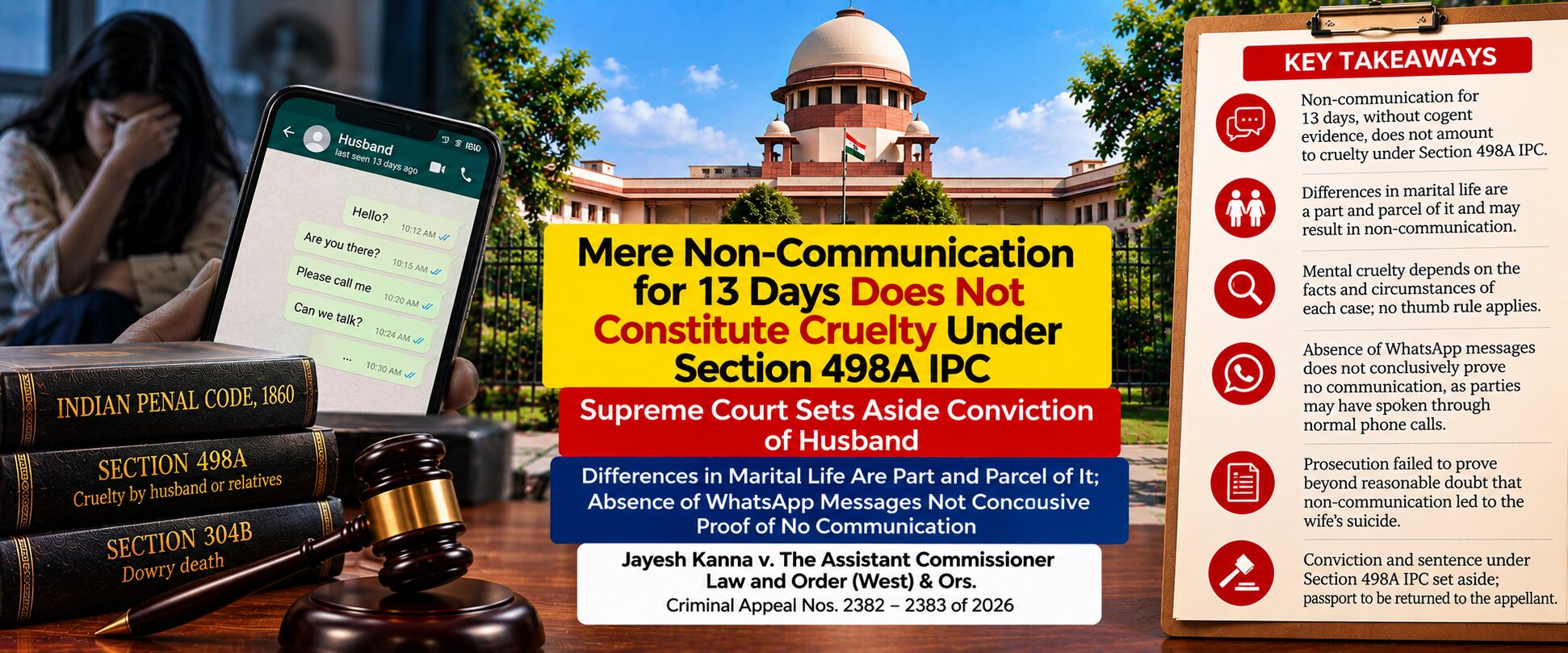
Mere non-communication for 13 days does not, by itself, constitute cruelty under Section 498A IPC.
Judgement Details
Court
Supreme Court of India
Date of Decision
5 September 2026
Judges
Justice J.K. Maheshwari and Justice Atul S. Chandurkar
Citation
Acts / Provisions
Facts of the Case
-
The case arose from the death of the appellant's wife, who died by suicide.
-
The appellant-husband was residing in Oman, while the deceased wife was staying at her parents' house.
-
The prosecution alleged that the husband had objections to the deceased visiting her parental home against the wishes of his family.
-
It was alleged that the husband subsequently refused to speak to his wife for 13 days.
-
According to the prosecution, this prolonged non-communication caused the deceased severe mental agony and emotional distress, ultimately compelling her to take the extreme step of suicide.
-
A criminal case was registered in 2015 against the husband and his family members under Sections 498A and 304B IPC.
-
During the trial, the allegations concerning dowry demand and harassment were not proved against the accused.
-
Consequently, the husband and his family members were acquitted of the charges under Section 304B and the other allegations relating to dowry harassment.
-
Despite the acquittal on those allegations, the Trial Court convicted the husband under Section 498A IPC.
-
The Trial Court reasoned that the husband's alleged conduct, particularly his refusal to communicate with his wife, amounted to wilful conduct of such a nature as to drive her to suicide.
-
The Madras High Court upheld the conviction.
-
The husband thereafter approached the Supreme Court challenging his conviction.
-
Before the Supreme Court, the defence argued that the conviction rested essentially upon the allegation that the husband had refused to speak to his wife for 13 days.
-
The prosecution, on the other hand, maintained that the husband's conduct constituted serious mental cruelty and contributed to the deceased taking her own life.
Issues
-
Whether mere non-communication by a husband with his wife for 13 days, without further cogent evidence of harassment or cruelty, constitutes cruelty within the meaning of Section 498A IPC?
-
Whether the prosecution established beyond reasonable doubt that the husband's alleged refusal to communicate with the deceased caused such mental cruelty as to attract Section 498A IPC?
-
Whether the absence of WhatsApp messages between the husband and deceased was sufficient to establish that there had been no communication between them?
-
Whether the conviction under Section 498A IPC could be sustained when the allegations of dowry demand and harassment had not been proved?
Judgement
-
The Supreme Court allowed the appeals filed by the husband.
-
The Court set aside the conviction and sentence imposed upon the appellant under Section 498A IPC.
-
The Court held that merely because the husband did not communicate with his wife for 13 days, such conduct, without supporting evidence, could not constitute cruelty within the meaning of Section 498A in the facts of the case.
-
The Court observed that differences in marital life are part and parcel of matrimonial relationships and that such differences can sometimes result in periods of non-communication.
-
The Court found that there was no sufficient evidence showing that the appellant's non-communication amounted to the kind of wilful conduct contemplated by Section 498A.
-
The prosecution had principally relied upon the oral testimony of the deceased's parents concerning the alleged lack of communication.
-
The prosecution also relied upon WhatsApp chats, arguing that the absence of messages from the husband demonstrated that there had been no communication.
-
The Supreme Court rejected that reasoning, observing that the absence of WhatsApp messages does not necessarily establish an absence of communication because the parties could have spoken through ordinary telephone calls.
-
The Court emphasized that mental cruelty is a fact-sensitive concept and there is no universal formula or thumb rule for determining whether particular conduct amounts to cruelty.
-
The prosecution failed to establish beyond reasonable doubt that the alleged lack of communication between the husband and wife resulted in or contributed to the wife's death in the manner alleged.
-
Accordingly, the Supreme Court set aside the orders of both the Trial Court and the Madras High Court.
-
The Court also permitted the appellant's passport to be returned.
Held
-
Mental cruelty must be assessed according to the facts and circumstances of each individual case.
-
There is no thumb rule for determining what constitutes mental cruelty.
-
The prosecution must establish the ingredients of Section 498A beyond reasonable doubt.
-
Absence of WhatsApp messages cannot, by itself, establish that the parties had no communication whatsoever, since communication could take place through ordinary telephone calls or other means.
-
In the present case, the evidence was insufficient to establish that the husband's alleged non-communication constituted cruelty or that it resulted in the wife's suicide.
-
The conviction under Section 498A IPC was therefore unsustainable.
Analysis
-
Cruelty is fact-specific: The Supreme Court reiterated that mental cruelty cannot be determined through a fixed formula. Conduct that may cause serious emotional distress in one factual setting may not necessarily satisfy the statutory threshold of cruelty in another.
-
Non-communication is not automatically cruelty: The Court specifically rejected the proposition that a 13-day period of non-communication, standing alone, could amount to cruelty. There must be additional material demonstrating that the conduct crossed the statutory threshold.
-
Evidence must establish the causal connection: An important aspect of the decision was the prosecution's inability to establish beyond reasonable doubt that the alleged lack of communication caused the deceased to take the extreme step of suicide.
-
WhatsApp evidence cannot be treated in isolation: The Court found that the absence of WhatsApp messages was insufficient to establish complete absence of communication. Communication could have taken place through ordinary phone calls, and therefore the digital evidence did not conclusively establish the prosecution's allegation.
-
Marital differences and criminal cruelty are distinct: The judgment recognizes that disagreements, periods of silence and differences can occur in matrimonial life. Such circumstances do not automatically become criminal cruelty unless the evidence establishes conduct falling within Section 498A.