
Jaspal Singh v. Ashwani Kumar, 2026
The Court distinguished between liquidated damages clauses and option clauses, holding that only an express contractual right permitting discharge by payment can exclude specific performance.
Judgement Details
Court
Supreme Court of India
Date of Decision
14 July 2026
Judges
Justice K.V. Viswanathan and Justice Alok Aradh
Citation
Acts / Provisions
Facts of the Case
-
On 22 June 2003, the parties entered into an Agreement to Sell under which the appellant agreed to purchase the respondent's half share in 12 marlas of land for ₹12.50 lakh.
-
The appellant paid ₹9 lakh as earnest money at the time of execution of the agreement.
-
Subsequently, the parties extended the time for execution of the sale deed on two occasions, during which the respondent also received an additional ₹60,000 from the appellant.
-
According to the appellant, despite his continuous readiness and willingness to perform his part of the contract, the respondent failed to execute the sale deed.
-
Consequently, the appellant instituted a suit for specific performance in the year 2006.
-
The respondent denied the execution of the agreement as a genuine sale transaction and contended that the signed documents had merely been furnished as security in connection with a separate financial arrangement relating to his proposed travel abroad.
-
The Trial Court declined specific performance and granted only refund of the earnest money.
-
The First Appellate Court reversed the Trial Court's decision and decreed the suit for specific performance.
-
The High Court, exercising jurisdiction under Section 100 CPC, restored the Trial Court's decree by holding that the contractual clause providing for refund of earnest money disentitled the purchaser from seeking specific performance.
-
Aggrieved, the purchaser approached the Supreme Court.
Issues
-
Whether a contractual clause providing for refund of earnest money upon non-execution of the sale deed bars a decree for specific performance?
-
Whether such a clause enables the vendor to discharge the contractual obligation merely by refunding the earnest money?
-
Whether the High Court exceeded the limited jurisdiction conferred under Section 100 of the Code of Civil Procedure by reappreciating evidence?
-
Whether the First Appellate Court rightly decreed the suit for specific performance?
Judgement
-
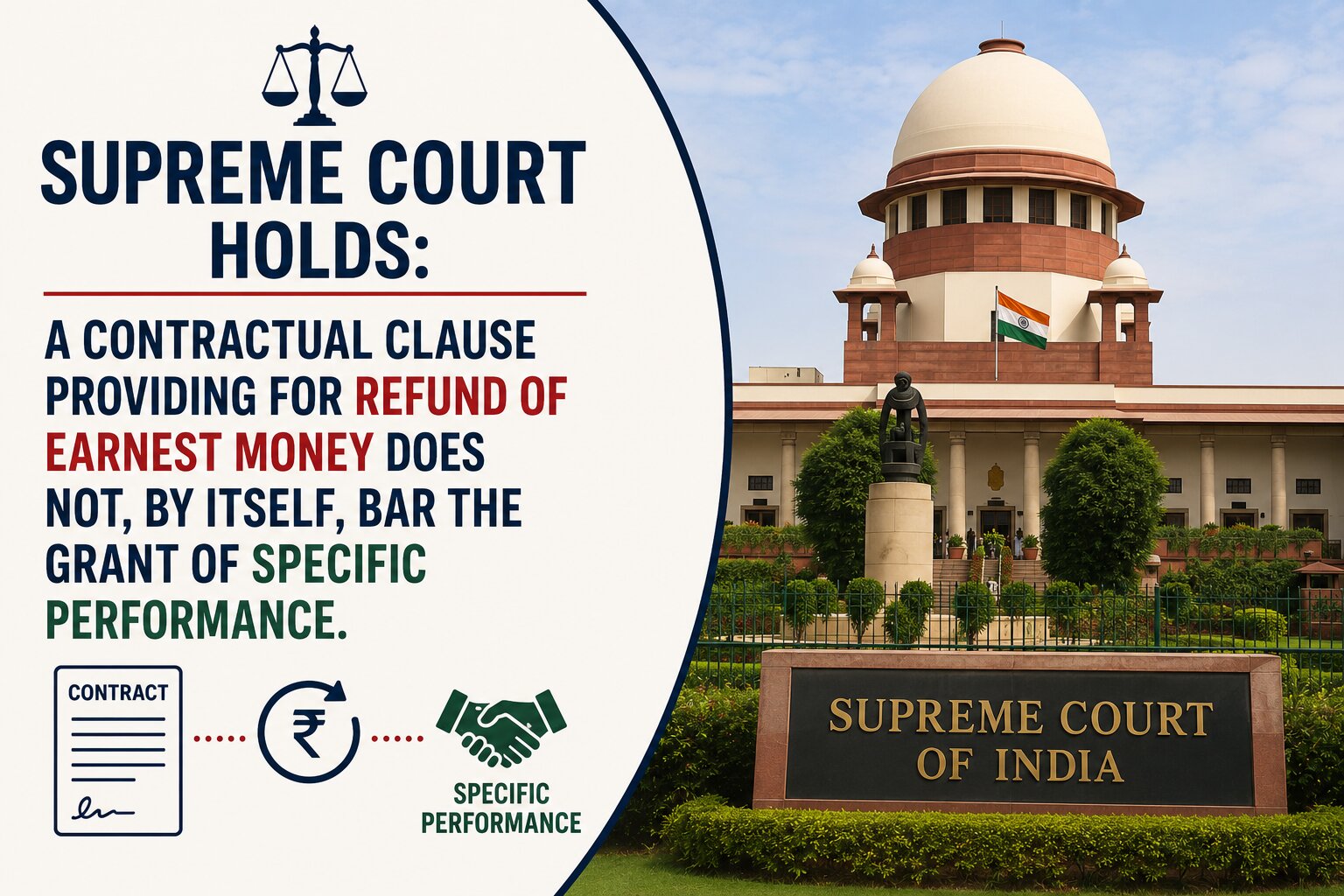
The Supreme Court held that a contractual clause providing for refund of earnest money does not, by itself, bar the grant of specific performance.
-
The Court observed that the clause merely protected the purchaser's minimum entitlement in the event of default and did not confer upon the vendor an option to avoid performance by refunding the earnest money.
-
The Court held that the clause neither contained language of election nor any stipulation permitting the respondent to substitute payment of money for performance of the contract.
-
The Court observed that such a clause reinforces the obligation to perform rather than substitutes it.
-
Referring to Section 23 of the Specific Relief Act, 1963, the Court reiterated that merely because a contract specifies a sum payable upon breach does not mean that specific performance is excluded where the contract is otherwise specifically enforceable.
-
The Court held that accepting the High Court's interpretation would unjustly reward a defaulting vendor who had received a substantial portion of the sale consideration and repeatedly extended the time for execution.
-
The Supreme Court further held that the High Court exceeded the limited scope of its jurisdiction under Section 100 CPC by reassessing factual findings that had already been concurrently recorded by the subordinate courts.
-
The Court observed that the High Court wrongly relied upon surrounding circumstances, including an alleged unpleaded financial transaction, the joint ownership of the property, and consensual extensions of time, none of which undermined the validity of the agreement.
-
The Court also rejected the respondent's allegation that the agreement had been fabricated from signed blank papers, noting that he had admitted his signatures on all three agreements and had produced no expert evidence to substantiate the plea of fraud.
-
The Court further held that the sale of an undivided share in jointly owned property is legally permissible and cannot by itself create suspicion regarding the genuineness of the agreement.
-
Accordingly, the Supreme Court allowed the appeal, set aside the High Court's judgment, and restored the decree of specific performance passed by the First Appellate Court.
Held
-
A clause providing for refund of earnest money does not by itself exclude the remedy of specific performance.
-
Such a clause does not confer an option upon the vendor to avoid contractual performance by merely refunding the earnest money.
-
Section 23 of the Specific Relief Act, 1963 permits specific performance notwithstanding a contractual stipulation regarding payment of damages or refund upon breach.
-
The High Court exceeded its jurisdiction under Section 100 CPC by reappreciating evidence and disturbing findings unsupported by any substantial question of law.
-
The decree for specific performance granted by the First Appellate Court was restored.
Analysis
-
The judgment clarifies the scope of Section 23 of the Specific Relief Act, 1963, reaffirming that clauses stipulating payment upon breach are ordinarily intended as security for performance rather than substitutes for contractual obligations.
-
By rejecting the High Court's interpretation, the Supreme Court prevented defaulting vendors from using refund clauses as a mechanism to escape binding agreements after receiving substantial consideration.
-
The decision also reinforces the limited nature of the High Court's jurisdiction under Section 100 CPC, emphasizing that second appeals are confined to substantial questions of law and do not permit reassessment of factual findings unless they are perverse.
-
The judgment recognizes that consensual extensions of time and sale of an undivided share are ordinary commercial incidents that do not cast doubt upon the genuineness of an agreement.
-
The Court also underscored that allegations of fraud must be supported by credible evidence and cannot succeed merely because signed documents were allegedly misused.
-
Overall, the ruling strengthens the equitable remedy of specific performance in contracts concerning immovable property and preserves the legislative intent underlying the Specific Relief Act by ensuring that contractual obligations are enforced according to their true legal character.