
Jasmer Singh v. Smt. Sunita, 2026
The Court held that the expression "insufficient funds" under Section 138 should not receive a narrow or literal interpretation.
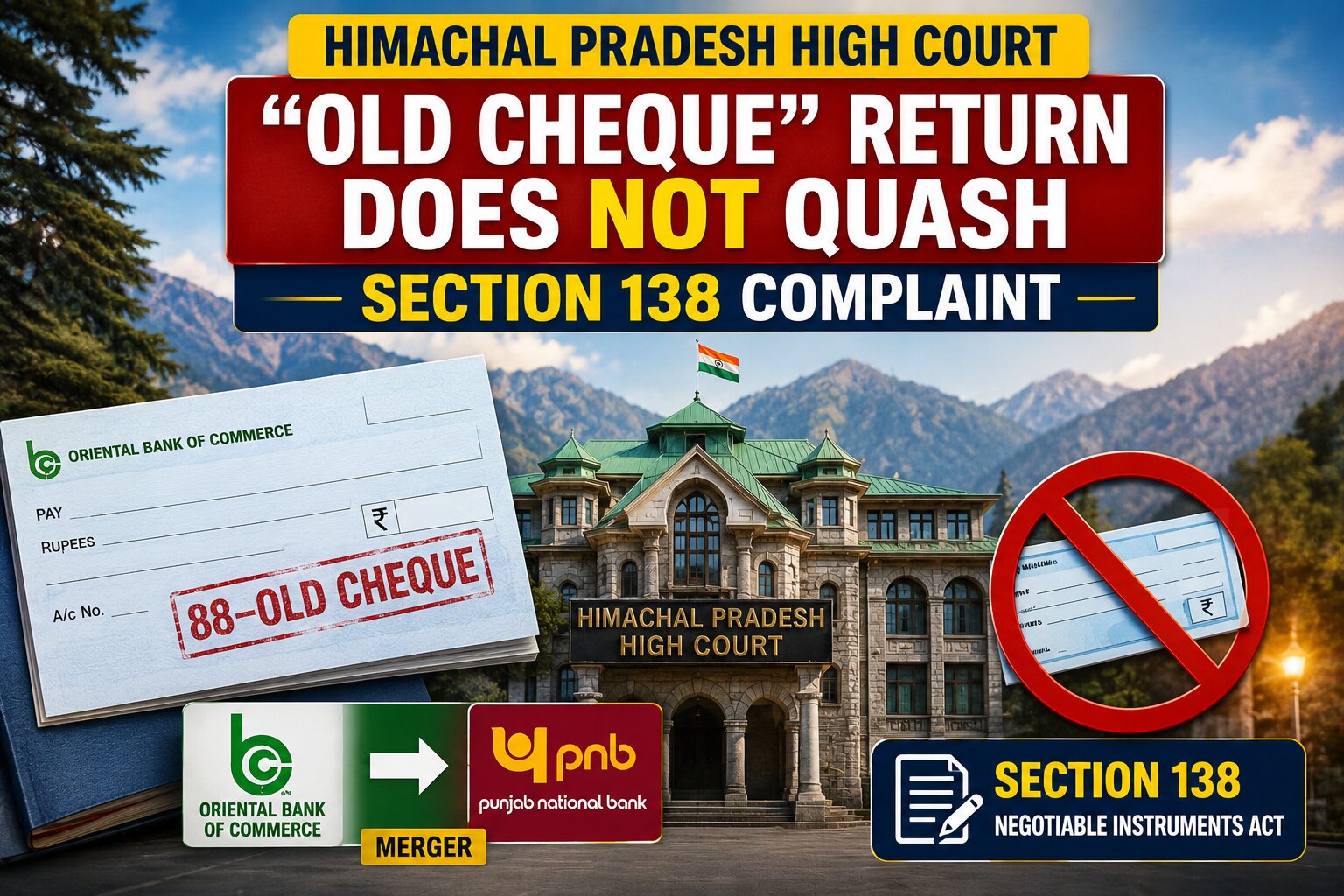
Judgement Details
Court
Himachal Pradesh High Court
Date of Decision
29 July 2026
Judges
Justice Sandeep Sharma
Citation
Acts / Provisions
Facts of the Case
-
The complainant alleged that she had advanced a loan of ₹1.30 lakh to the accused.
-
Towards repayment of the loan, the accused issued a cheque drawn on Oriental Bank of Commerce (OBC).
-
Before the cheque was presented for encashment, Oriental Bank of Commerce merged with Punjab National Bank (PNB).
-
Upon presentation, the cheque was dishonoured with the endorsement "88–Old Cheque."
-
The complainant served the statutory demand notice upon the accused demanding payment of the cheque amount.
-
Despite receipt of the statutory notice, the accused failed to make payment within the prescribed period.
-
Consequently, the complainant instituted proceedings under Section 138 of the Negotiable Instruments Act, 1881 before the competent court.
-
The accused approached the High Court seeking quashing of the complaint, contending that dishonour due to the endorsement "Old Cheque" did not fall within the ambit of Section 138.
-
It was argued that Section 138 applies only when a cheque is dishonoured because of insufficient funds or because it exceeds the arrangement made with the bank.
-
The complainant opposed the petition by contending that the accused's account continued with Punjab National Bank after the merger and that the endorsement could not automatically absolve him from criminal liability.
-
The High Court examined the scope of Section 138 and the effect of the bank merger in light of the principles laid down by the Supreme Court in M/s Laxmi Dyechem v. State of Gujarat.
Issues
-
Whether a cheque dishonoured with the endorsement "88–Old Cheque" is capable of attracting liability under Section 138 of the Negotiable Instruments Act?
-
Whether the expression "insufficient funds" under Section 138 should be interpreted narrowly or given a purposive interpretation?
-
Whether the merger of Oriental Bank of Commerce with Punjab National Bank absolves the drawer of criminal liability under Section 138 merely because an old cheque book was used?
-
Whether the existence of sufficient funds in the accused's account at the time of presentation of the cheque is a disputed question requiring trial?
-
Whether the complaint under Section 138 was liable to be quashed at the threshold by exercising the High Court's inherent jurisdiction?
Judgement
-
The High Court dismissed the petition seeking quashing of the cheque dishonour complaint.
-
Relying upon M/s Laxmi Dyechem v. State of Gujarat, the Court observed that dishonour of a cheque for reasons analogous to insufficient funds may also fall within the ambit of Section 138.
-
The Court held that the expression "insufficient funds" is a genus that includes several species of dishonour such as account closed, payment stopped, referred to drawer, and similar endorsements.
-
The Bench observed that the accused admittedly issued the cheque and never disputed either its issuance or his signatures.
-
The Court held that merely because the cheque belonged to the old cheque book of Oriental Bank of Commerce, which had merged into Punjab National Bank, the accused could not automatically escape liability.
-
The Court observed that the accused's bank account continued even after the merger, and therefore the bank merger alone could not extinguish his legal obligations.
-
The High Court held that the crucial issue was whether sufficient funds were available in the accused's account when the cheque was presented.
-
Since that issue required appreciation of evidence, the Court held that it could only be decided during the trial and not in proceedings seeking quashing of the complaint.
-
The Court further observed that the payee cannot reasonably be expected to know the legal consequences arising out of a bank merger or whether old cheque books remained valid after such merger.
-
Consequently, the High Court refused to interfere with the criminal proceedings and directed that the matter should proceed before the trial court.
Held
-
The petition seeking quashing of the complaint was dismissed.
-
The cheque dishonour complaint under Section 138 of the Negotiable Instruments Act was permitted to proceed.
-
The Court held that dishonour on the ground of "88–Old Cheque" does not automatically exclude the applicability of Section 138.
-
The Court held that the question regarding availability of sufficient funds in the accused's account is a matter for trial.
-
The accused cannot escape liability merely because the cheque belonged to a bank that subsequently merged with another bank.
Analysis
-
The judgment reinforces the purposive interpretation of Section 138 of the Negotiable Instruments Act rather than adopting a narrow or technical approach.
-
By relying on M/s Laxmi Dyechem v. State of Gujarat, the Court reaffirmed that the legislative object of enhancing the credibility of commercial transactions must be protected.
-
The ruling prevents dishonest drawers from taking advantage of technical changes arising out of bank mergers.
-
The Court correctly recognized that the continuation of the accused's bank account after the merger is a relevant circumstance in determining liability.
-
The decision emphasizes that disputed factual issues, particularly the existence of sufficient funds, should ordinarily be decided after evidence is led during trial.
-
The judgment limits the scope of the High Court's inherent jurisdiction by reiterating that criminal proceedings should not be quashed where disputed questions of fact require adjudication.
-
The ruling protects bona fide payees who may not possess technical knowledge regarding banking mergers and the operational status of old cheque books.
-
The decision strengthens the object of Chapter XVII of the Negotiable Instruments Act, which seeks to ensure the credibility and reliability of cheque transactions.
-
The judgment is likely to serve as persuasive authority in future cheque dishonour cases involving bank mergers, obsolete cheque books, or technical endorsements by banks.