
Jaskaran Jeet Singh Deol v. State of Punjab, 2026
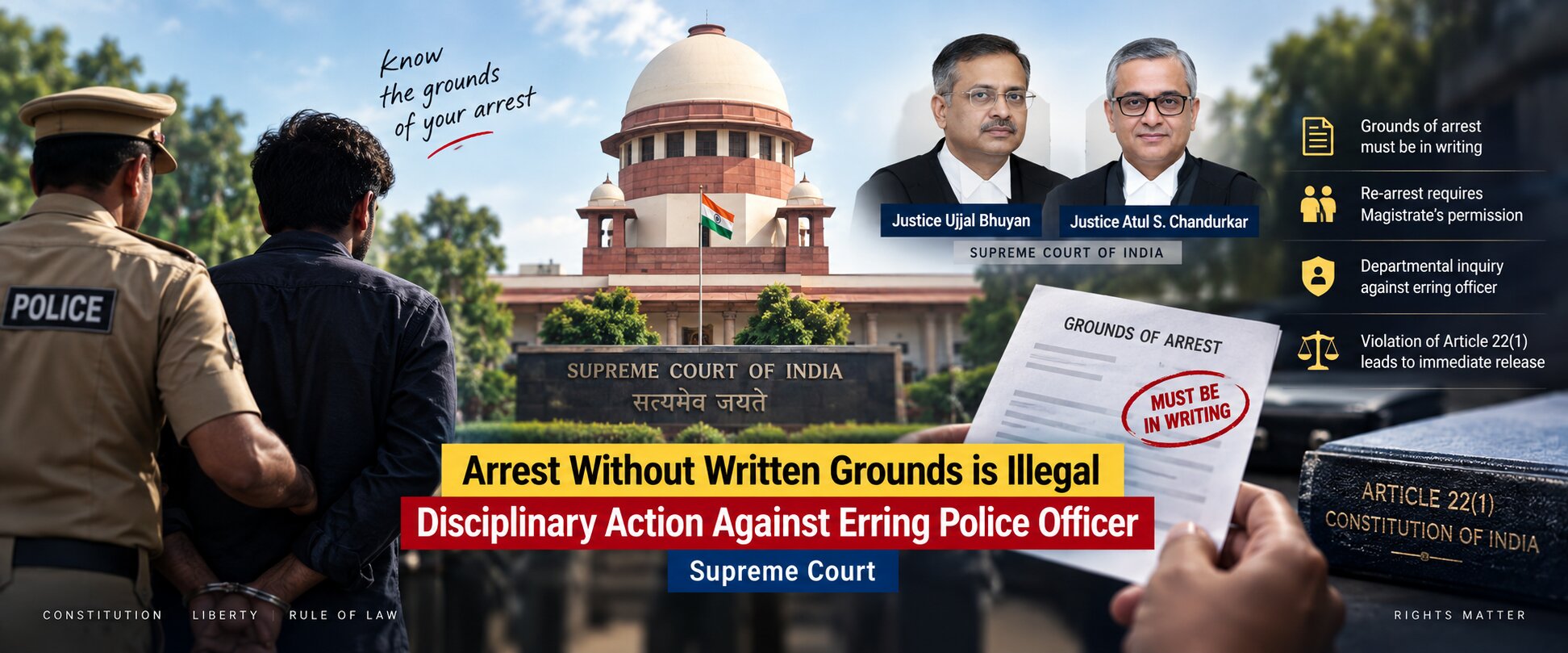
Failure to furnish written grounds of arrest as required by Article 22(1) renders the arrest unconstitutional.
Judgement Details
Court
Supreme Court of India
Date of Decision
21 September 2026
Judges
Justice Ujjal Bhuyan and Justice Atul S. Chandurkar
Citation
Acts / Provisions
Facts of the Case
-
The appellant, Jaskaran Jeet Singh Deol, was arrested in connection with allegations involving the sexual assault of a minor.
-
The appellant contended that the grounds of arrest were not furnished to him in writing at the time of his arrest.
-
The local court had declared his arrest illegal and directed his immediate release.
-
The Punjab and Haryana High Court subsequently stayed the order of the local court.
-
The matter therefore reached the Supreme Court.
-
Before the Supreme Court, the principal issue concerned the constitutional consequences of failure to furnish the grounds of arrest under Article 22(1).
-
The Court also considered whether a person whose initial arrest was declared unconstitutional could subsequently be re-arrested, and, if so, what safeguards the investigating agency and Magistrate were required to follow.
-
The Court considered the earlier decisions in Sri Darshan, Sonam Raghuvanshi, and particularly Mihir Rajesh Shah v. State of Maharashtra (2025).
-
The Court held that Mihir Rajesh Shah represents the correct and binding position of law on the issue.
Issues
-
Whether failure to furnish the grounds of arrest in writing to an arrested person constitutes a violation of the fundamental right guaranteed under Article 22(1) of the Constitution?
-
Whether an arrest made in breach of Article 22(1) becomes illegal and unconstitutional, thereby requiring the immediate release of the arrested person?
-
Whether an accused whose initial arrest has been declared illegal for non-compliance with Article 22(1) can subsequently be re-arrested by the investigating agency?
-
Whether the investigating agency must obtain permission of the concerned Magistrate before re-arresting a person whose earlier arrest was declared unconstitutional?
-
Whether the subsequent filing of a chargesheet and order of cognisance can validate an arrest that was unconstitutional because the grounds of arrest were not furnished?
-
Whether the requirement of furnishing the grounds of arrest under Article 22(1) applies equally to offences under special statutes and is not confined to offences under the general criminal law?
-
Whether violation of Article 22(1) requires proof of prejudice or demonstrable prejudice before the arrested person can claim release from unconstitutional detention?
-
Whether a police officer who fails to furnish the grounds of arrest is liable to face departmental inquiry and disciplinary action?
Judgement
-
The Supreme Court declared the arrest of Jaskaran Jeet Singh Deol illegal on account of non-furnishing of the grounds of arrest in accordance with Article 22(1) of the Constitution.
-
The Court held that the grounds of arrest must be furnished in writing and in a language understood by the accused.
-
A copy of the written grounds of arrest must ordinarily be supplied to the arrested person as a matter of course and without exception.
-
The Court characterized the protection under Article 22(1) as a fundamental constitutional safeguard, rather than a mere procedural formality.
-
The Court held that breach of this constitutional requirement vitiates the arrest and remand.
-
The Court clarified that when an accused is released because of violation of Article 22(1), the person is not being released on bail; rather, the person is being released from illegal and unconstitutional detention.
-
The subsequent filing of a chargesheet or taking of cognisance does not retrospectively validate an unconstitutional arrest.
-
The Court held that Article 22(1) operates across different categories of offences, including offences created under special enactments.
-
If the investigating agency considers custodial interrogation necessary after such release, it cannot simply re-arrest the accused on its own authority.
-
The investigating agency must first furnish the grounds of arrest and then approach the concerned Magistrate with an application seeking custody and explaining the necessity for re-arrest.
-
The application must explain why the grounds of arrest were not supplied at the first instance.
-
Such an application must carry the endorsement of the immediate superior authority.
-
The Magistrate must consider the application expeditiously and, as directed in Mihir Rajesh Shah, preferably within a week, while following the principles of natural justice.
-
If the Magistrate is satisfied that there were bona fide reasons for the initial failure and that re-arrest is necessary, the Magistrate may permit the investigating agency to re-arrest the accused.
-
On the administrative side, the superior authority must assign the investigation to another police officer and direct a departmental inquiry against the officer responsible for the constitutional violation.
-
If the inquiry results in adverse findings, the officer may face departmental action, including an entry in the officer's service book.
-
The Supreme Court directed that a copy of the judgment be sent to the Directors General of Police of all States and Union Territories.
-
The Court also reiterated that similar safeguards are required where there is a violation of Article 22(2).
-
Depending upon the facts, High Courts may also award compensation as a public law remedy for violation of Article 22(2), without preventing the accused from pursuing a private civil-law remedy.
Held
-
The Court held that furnishing the grounds of arrest in writing is a mandatory constitutional requirement under Article 22(1).
-
Failure to furnish the grounds of arrest makes the arrest unconstitutional and illegal.
-
The accused must be released from such unconstitutional detention; this release is not equivalent to bail.
-
The constitutional violation does not require the accused to additionally establish prejudice or demonstrable prejudice.
-
A subsequent chargesheet or order taking cognisance cannot cure or validate an unconstitutional arrest.
-
The requirement applies irrespective of the nature or gravity of the offence and is not restricted to any particular statute.
-
Re-arrest after release for violation of Article 22(1) requires judicial oversight.
-
The investigating agency must approach the concerned Magistrate after furnishing the grounds of arrest and explain the necessity and circumstances of the proposed re-arrest.
-
The concerned police officer's failure to comply with Article 22(1) must be subjected to departmental inquiry, with further disciplinary consequences where adverse findings are recorded.
-
The judgment emphasizes that constitutional safeguards cannot be diluted because of the seriousness of the alleged offence.
Analysis
-
Constitutional safeguard: The judgment treats Article 22(1) as a substantive constitutional protection designed to ensure that an arrested person understands the reasons for deprivation of liberty.
-
Written grounds are mandatory: The Court makes clear that merely informing an accused orally is insufficient where the constitutional requirement calls for written grounds.
-
Illegal arrest versus bail: One of the significant aspects of the judgment is the distinction between release on bail and release from unconstitutional detention. The latter flows from the constitutional invalidity of the arrest itself.
-
No prejudice requirement: The Court rejected the approach that an accused must separately demonstrate actual prejudice resulting from the failure to furnish the grounds of arrest. The constitutional safeguard is treated as independently enforceable.
-
Chargesheet cannot cure the defect: The judgment establishes that later investigative or judicial steps cannot retrospectively convert an unconstitutional arrest into a lawful one.
-
Re-arrest requires judicial control: The Court was particularly concerned that the same authority responsible for violating Article 22(1) should not have unrestricted power to re-arrest the accused. Judicial scrutiny by the Magistrate is therefore required.
-
Accountability of investigating officers: The judgment goes beyond the immediate liberty of the accused and establishes an administrative mechanism for dealing with the responsible police officer through superior-authority oversight and departmental inquiry.
-
Transfer of investigation: Requiring another officer to take over the investigation after such a serious constitutional lapse is intended to separate the officer responsible for the violation from the subsequent investigative process.
-
Applicability across statutes: The Court emphasized that Article 22(1) is a constitutional safeguard, not a protection dependent upon the particular criminal statute under which the accused is arrested.
-
Gravity of offence: The judgment reiterates that the seriousness of an allegation does not eliminate the requirement to comply with constitutional safeguards governing personal liberty.
-
Broader constitutional principle: Relying on the constitutional approach reflected in decisions such as Khatri and Prabhu Dayal Deorah, the Court emphasized that constitutional procedures governing deprivation of liberty must be strictly observed.