
Jagabandhu Barik v. State of Odisha & Ors., 2026
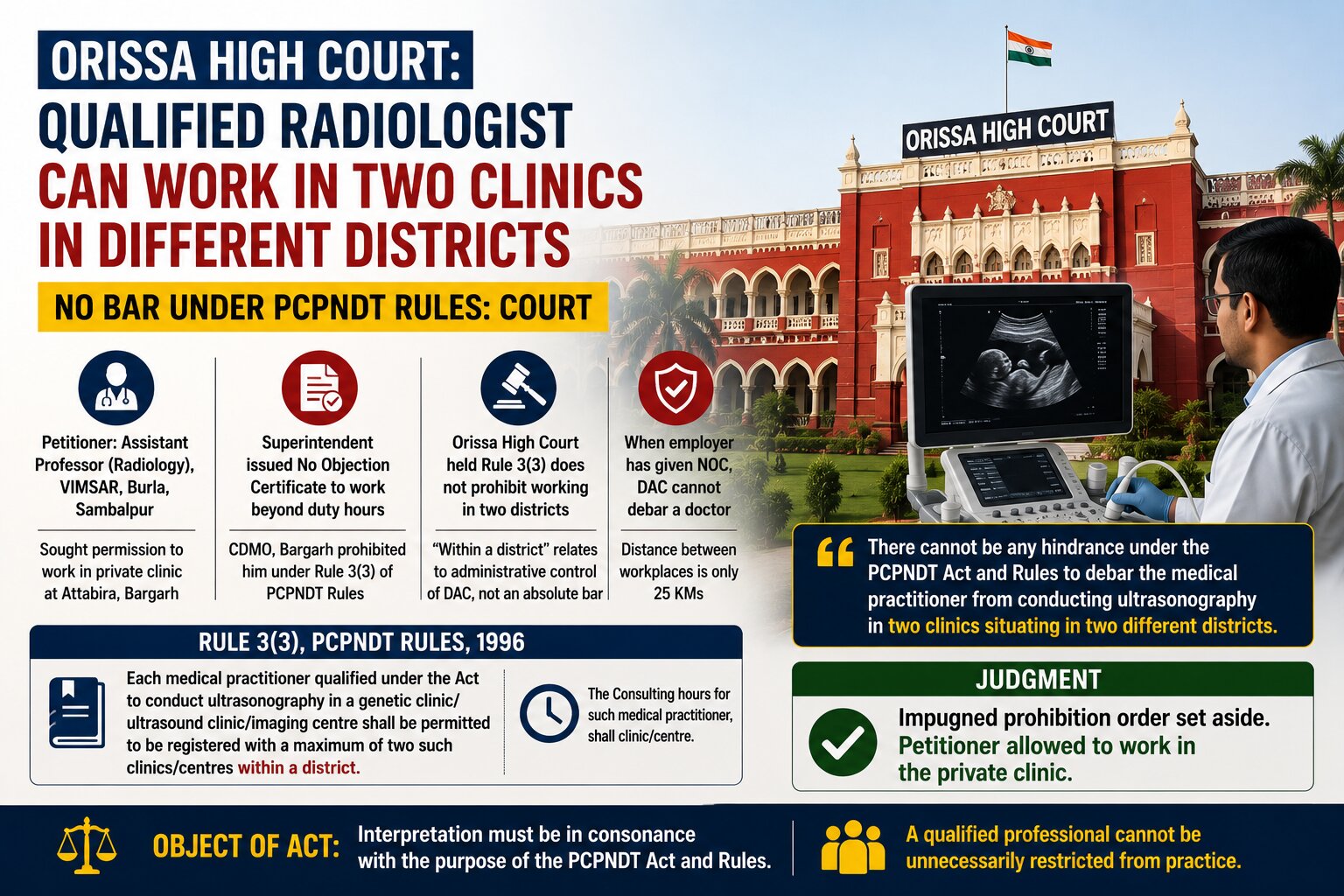
Rule 3(3) of the PCPNDT Rules does not by itself bar a qualified Radiologist from conducting ultrasonography at clinics located in two different districts.
Judgement Details
Court
Orissa High Court
Date of Decision
22 August 2026
Judges
Justice Bibhu Prasad Routray
Citation
Acts / Provisions
Facts of the Case
-
The petitioner was a qualified Radiologist and Assistant Professor at VIMSAR, Burla, Sambalpur.
-
His employer issued a No Objection Certificate permitting him to work at a private clinic beyond official working hours.
-
The private clinic was situated at Attabira, Bargarh, around 25 km from his workplace.
-
The Bargarh authorities prohibited him from conducting ultrasonography there, relying on Rule 3(3) of the PCPNDT Rules.
-
The State argued that the Rule permitted registration with two clinics only within one district.
-
The petitioner challenged the prohibition before the High Court.
Issues
-
Whether Rule 3(3) of the PCPNDT Rules prohibits a qualified Radiologist from conducting ultrasonography at two clinics situated in different districts?
-
Whether the District Advisory Committee of Bargarh could prohibit the petitioner from practising at a private clinic when his permanent employer had issued a No Objection Certificate for such practice?
Judgement
-
The High Court allowed the writ petition.
-
It held that Rule 3(3) does not expressly prohibit a qualified Radiologist from working at clinics situated in two different districts.
-
The phrase “within a district” primarily operates in relation to the administrative and disciplinary jurisdiction of the District Advisory Committee.
-
The Court found no justification for applying Rule 3(3) to prevent the petitioner from practising at the Bargarh clinic.
-
The prohibition order was therefore set aside.
Held
-
A qualified Radiologist may conduct ultrasonography at clinics in different districts, provided the statutory requirements are otherwise satisfied.
-
Rule 3(3) cannot be interpreted as creating an absolute prohibition against such practice.
-
A valid No Objection Certificate from the doctor's permanent employer was an important circumstance.
-
The Court emphasized that the PCPNDT Rules must be interpreted consistently with the object and purpose of the legislation.
Analysis
-
Purposive interpretation: The Court avoided an interpretation that would impose a restriction not expressly contained in the Rules.
-
Administrative jurisdiction: The two-clinic limitation within a district relates to supervision by the District Advisory Committee rather than an absolute geographical prohibition on professional practice.
-
Employer's permission: The NOC demonstrated that the petitioner's private practice was permitted outside his official working hours.
-
PCPNDT compliance remains essential: The judgment does not dilute the regulatory safeguards against sex selection or illegal prenatal diagnostic practices.
-
Balanced approach: The decision protects legitimate professional practice while preserving the regulatory framework of the PCPNDT Act.