
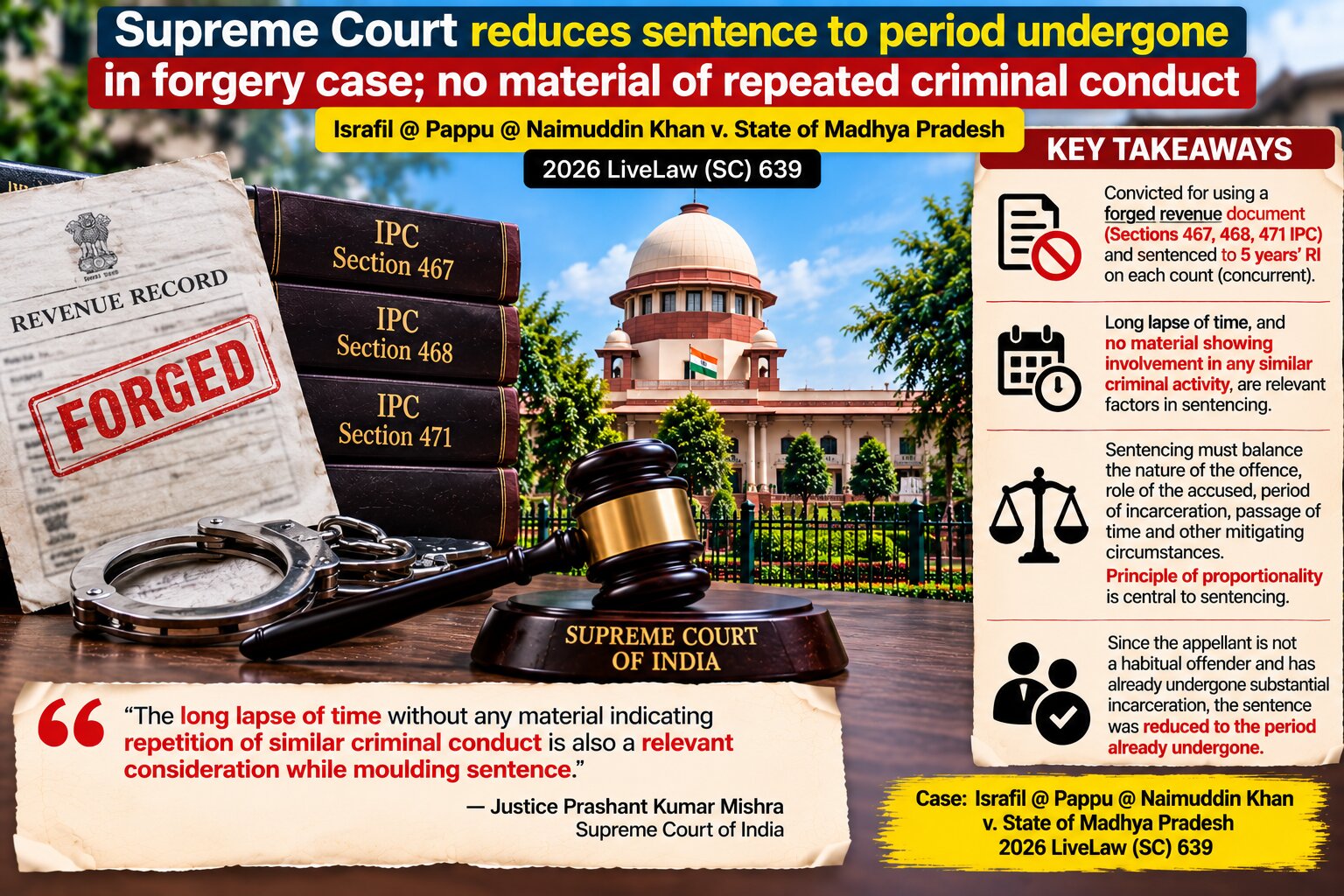
ISRAFIL @ PAPPU @ NAIMUDDIN KHAN v. STATE OF MADHYA PRADESH, 2026
The Court recognised that forgery and use of forged documents in judicial proceedings are serious offences.
Judgement Details
Court
Supreme Court of India
Date of Decision
3 September 2026
Judges
Justice Prashant Kumar Mishra and Justice N.V. Anjaria
Citation
Acts / Provisions
Facts of the Case
-
The prosecution case arose from an incident dated 15 September 2014 involving the appellant's appearance before the Judicial Magistrate First Class, Rewa.
-
The appellant appeared in connection with a criminal case for the purpose of furnishing surety/bail on behalf of another accused, Mukesh Dahiya.
-
In support of the surety, the appellant produced a document described as a Bhu Adhikar Rin Pustika (Land Rights and Loan Book).
-
The document purported to relate to agricultural land situated at Village Amirati, Tehsil Gurh, District Rewa, Madhya Pradesh.
-
The document allegedly showed agricultural land standing in the name of Naimuddin Khan along with other co-sharers.
-
During scrutiny of the document in the bail proceedings, the Judicial Magistrate noticed irregularities in its pagination and sequence.
-
One of the pages appeared in an unusual sequence, raising suspicion regarding the genuineness of the document.
-
The appellant was unable to satisfactorily explain the apparent anomaly.
-
The Magistrate consequently directed communication to the police for inquiry and appropriate action.
-
FIR No. 562 of 2014 was thereafter registered at Police Station Civil Lines, Rewa.
-
The FIR initially referred to offences under Sections 420, 466, 467, 468 and 471 IPC.
-
During investigation, the disputed revenue document was verified with the concerned revenue authorities.
-
The prosecution alleged that the document was forged and that the appellant knowingly used it as genuine during judicial proceedings.
-
The investigation also revealed variations in the description of the appellant's identity in different stages of the record.
-
The matter proceeded to trial before the Fifth Additional Sessions Judge, Rewa, in Sessions Case No. 200089 of 2015.
-
The Trial Court examined the prosecution evidence, including evidence from the concerned Patwari and investigating officials.
-
The Trial Court acquitted the co-accused, Ashish Garg.
-
The appellant, however, was convicted under Sections 420, 467, 468 and 471 IPC by judgment dated 6 January 2024.
-
The Trial Court imposed five years' rigorous imprisonment on each count, together with a fine of ₹1,000 under each count.
-
The substantive sentences were directed to run concurrently, meaning that the appellant was not required to serve five consecutive five-year terms.
-
The appellant challenged the conviction and sentence before the Madhya Pradesh High Court.
-
The High Court dismissed the criminal appeal on 30 April 2025 and affirmed the conviction and sentence.
-
The appellant then approached the Supreme Court.
-
On 21 November 2025, the Supreme Court issued notice specifically limited to the question of quantum of sentence.
-
Consequently, the Supreme Court did not reconsider the correctness of the conviction in the present judgment.
-
The appellant argued that the occurrence was from 2014, that he had faced criminal proceedings for more than a decade, and that there was no material showing that he was a habitual offender or had subsequently engaged in similar criminal activity.
-
The State opposed reduction of sentence, emphasising that the use of forged documents in judicial proceedings is serious because it affects the integrity of the administration of justice.
-
The Supreme Court accepted that the offence was serious but held that seriousness alone could not eliminate the requirement of proportional sentencing.
-
The Court noted that the disputed document had been detected at the threshold during the bail proceedings and that the alleged misuse had not resulted in an irreversible pecuniary or proprietary consequence.
-
The Court also noted that no material had been placed before it showing prior or subsequent similar criminal conduct.
-
The appellant had remained involved in criminal proceedings for more than ten years and had undergone more than two years of actual incarceration.
-
The Supreme Court ultimately maintained the conviction but reduced the substantive sentence to the period already undergone, while leaving the fines unchanged.
Issues
-
Whether the substantive sentence of five years' rigorous imprisonment imposed for each of the offences under Sections 420, 467, 468 and 471 IPC was proportionate to the facts and circumstances of the case?
-
Whether the long passage of time since the occurrence and the appellant's prolonged involvement in criminal proceedings constitute relevant mitigating circumstances while determining the quantum of sentence?
-
Whether the absence of material showing prior or subsequent similar criminal conduct is a relevant consideration while moulding the sentence?
-
Whether the fact that the forged document was detected at the threshold during bail proceedings and did not result in an irreversible pecuniary or proprietary consequence is relevant to the proportionality of sentence?
-
Whether the period of incarceration already undergone by the appellant could be taken into account while determining whether the substantive sentence required modification?
-
Whether the conviction could be maintained while reducing the substantive sentence to the period already undergone?
Judgement
-
The Supreme Court partly allowed the appeal.
-
The Court expressly maintained the appellant's conviction under Sections 420, 467, 468 and 471 IPC.
-
The Supreme Court clarified that the appeal before it was confined to the quantum of sentence and that the correctness of the conviction was not being reconsidered.
-
The Court acknowledged that forgery and use of forged documents in judicial proceedings are serious offences that undermine the authenticity and sanctity of public and legal documents.
-
At the same time, the Court held that sentencing must be based upon the principle of proportionality.
-
The Court considered the fact that the occurrence dated back to 2014 and that the appellant had remained under the shadow of criminal proceedings for more than a decade.
-
The Court found that there was no material before it indicating that the appellant was a habitual offender or had engaged in similar criminal activity either before or after the present occurrence.
-
The Court also considered that the forged document was detected during scrutiny at the threshold stage of the bail proceedings.
-
The Court noted that the alleged misuse did not ultimately result in an irreversible pecuniary or proprietary consequence.
-
The Court considered the period of actual incarceration already undergone by the appellant, which exceeded two years.
-
Relying upon the principle of proportionality and the overall circumstances, the Court concluded that the ends of justice would be adequately met by modifying the substantive sentence.
-
The five-year substantive sentence on each count was therefore reduced to the period already undergone.
-
The fines of ₹1,000 under each count remained unchanged.
-
The appellant was directed to be released forthwith if he was not required in any other case, subject to payment of the fine if it had not already been deposited.
-
The appeal was accordingly partly allowed.
Held
-
Conviction maintained: The Supreme Court did not disturb the conviction under Sections 420, 467, 468 and 471 IPC.
-
Sentence modified: The substantive sentence was reduced from five years' rigorous imprisonment to the period already undergone.
-
Proportionality is central: Sentencing must balance the seriousness of the offence with the surrounding facts, the role of the accused, incarceration already undergone, passage of time and other mitigating circumstances.
-
Long passage of time is relevant: A substantial lapse of time between the offence and final consideration of sentence can be taken into account while moulding the sentence.
-
Absence of repeated criminal conduct matters: Where there is no material indicating habitual offending or similar subsequent criminal activity, that circumstance can be relevant to sentencing.
-
Actual custody matters: The period of incarceration already undergone is a relevant consideration in determining whether the substantive sentence should be reduced.
-
Detection at the threshold is relevant: The fact that the forged document was detected during the initial scrutiny in the bail proceedings was considered while assessing proportionality.
-
No irreversible consequence: The Court considered that the alleged misuse of the forged document did not ultimately result in an irreversible pecuniary or proprietary consequence.
-
Seriousness does not eliminate proportionality: Although forgery affecting judicial proceedings is serious, punishment cannot be determined without considering the entire factual matrix.
-
Fine retained: The fine imposed by the Trial Court and affirmed by the High Court remained unchanged.
Analysis
- In Israfil @ Pappu @ Naimuddin Khan v. State of Madhya Pradesh, the Supreme Court maintained the conviction under Sections 420, 467, 468 and 471 IPC but reduced the substantive sentence to the period already undergone.
- However, it held that sentencing must remain governed by the principle of proportionality and cannot become a purely retributive exercise.
- The Court considered several mitigating circumstances, including the occurrence being more than a decade old, the appellant's prolonged exposure to criminal proceedings, absence of material showing habitual or similar criminal conduct, detection of the forged document at the threshold of the bail proceedings, absence of an irreversible pecuniary or proprietary consequence, and more than two years of actual incarceration.
- The judgment therefore establishes that the seriousness of an offence does not eliminate the duty of the sentencing court to consider the individual facts, actual consequences, passage of time and mitigating circumstances.