
Imtiyaz Nuruddin Chinchali v. State of Karnataka & Anr., 2026
Section 352 BNS requires intentional insult accompanied by the requisite intention or knowledge to provoke the person insulted into breaking the public peace or committing another offence.
Judgement Details
Court
Karnataka High Court
Date of Decision
24 September 2026
Judges
Justice Venkatesh Naik T
Citation
Acts / Provisions
Facts of the Case
-
The petitioner was a shopkeeper whose premises were situated in Athani, Karnataka.
-
According to the complaint, the petitioner had allegedly placed barricades in front of his shop and on the road, allegedly causing inconvenience to members of the public.
-
On 7 January 2026, the complainant, described as a social worker, questioned the petitioner regarding the barricades and the alleged obstruction.
-
The complainant and others had reportedly received information about a video circulating in a WhatsApp group concerning the incident near the petitioner's shop.
-
It was alleged that when the petitioner was questioned about the obstruction, he made certain remarks concerning the Prime Minister of India.
-
The complaint treated the alleged remarks as insulting and alleged offences under Sections 285 and 352 of the BNS.
-
The complaint was lodged on 11 January 2026, approximately four days after the alleged incident.
-
The petitioner approached the Karnataka High Court seeking quashing of the criminal proceedings by invoking the High Court's inherent jurisdiction.
-
The petitioner argued that there was no allegation that he had abused or intentionally insulted the complainant.
-
According to the petitioner, the complaint merely alleged that he had made statements concerning a third person, namely the Prime Minister, and therefore the essential ingredients of Section 352 BNS were absent.
-
The State and complainant opposed the petition, contending that the barricades had caused public inconvenience and that the alleged remarks were capable of provoking a breach of peace.
-
They further argued that the existence of intention and other factual circumstances should ordinarily be examined during trial rather than at the stage of exercising inherent jurisdiction.
-
The High Court examined whether the allegations, even if taken at face value, disclosed the essential ingredients of the offences alleged.
Issues
-
Whether the allegations in the complaint disclosed the essential ingredients of an offence under Section 352 of the BNS when there was no specific allegation that the petitioner intentionally insulted or abused the complainant?
-
Whether remarks allegedly directed against a third person can, without more, constitute intentional insult under Section 352 BNS against the person who lodged the complaint?
-
Whether the allegations concerning the barricades in front of the petitioner's shop disclosed the ingredients necessary to constitute an offence under Section 285 BNS?
-
Whether mere abuse, rudeness, discourtesy or insolence is sufficient to constitute intentional insult under Section 352 BNS without the requisite intention or knowledge to provoke a breach of peace?
-
Whether continuation of the criminal proceedings was justified when the complaint contained general and omnibus allegations and did not disclose the essential ingredients of the alleged offences?
Judgement
-
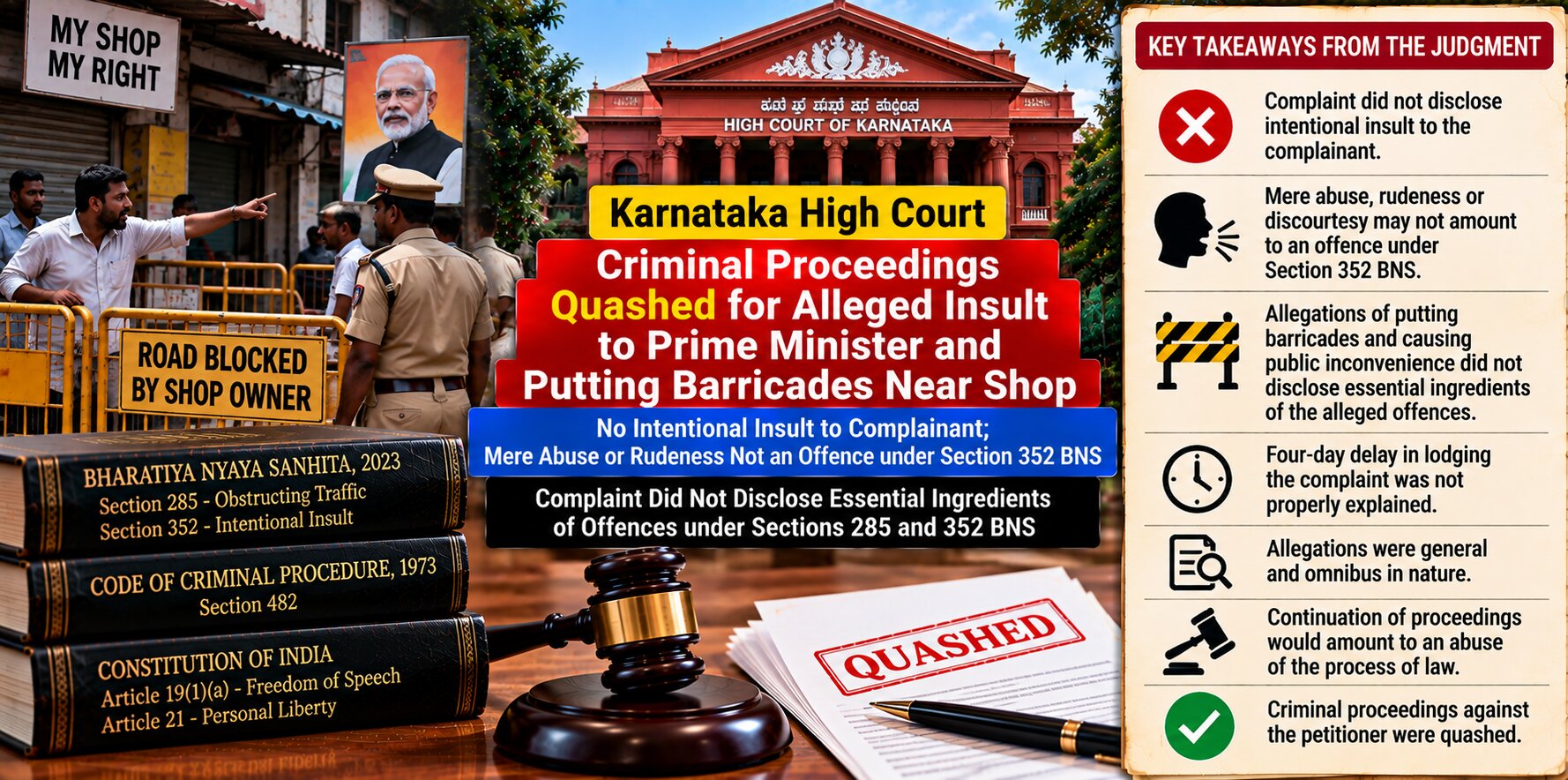
The Karnataka High Court allowed the criminal petition and quashed the criminal proceedings pending before the Principal Civil Judge and JMFC, Athani.
-
The Court found that the complaint did not contain a specific allegation that the petitioner had abused or intentionally insulted the complainant.
-
The Court noted that the principal allegation was that, when questioned regarding the barricades, the petitioner made certain statements concerning the Prime Minister.
-
The Court held that this allegation, by itself, did not establish the ingredients of Section 352 BNS, which requires intentional insult coupled with the requisite intention or knowledge concerning provocation of breach of peace.
-
The Court relied upon the Supreme Court's reasoning in Mohammad Wajid v. State of U.P., under which mere abuse, discourtesy, rudeness or insolence does not automatically amount to intentional insult unless the statutory requirement concerning intention or knowledge is established.
-
The Court also considered the allegation concerning the barricades and found that the essential ingredients of the alleged offence under Section 285 BNS were not sufficiently disclosed.
-
The Court took note of the four-day delay between the alleged incident on 7 January 2026 and the complaint lodged on 11 January 2026, observing that the delay had not been properly explained.
-
The Court found the allegations to be general and omnibus in nature.
-
Applying the settled principles governing exercise of inherent jurisdiction, the Court concluded that the allegations, taken at face value, did not disclose the essential ingredients of the alleged offences.
-
The Court held that allowing such proceedings to continue would amount to an abuse of the process of law.
-
Consequently, the FIR and the pending criminal proceedings against the petitioner were quashed.
Held
-
A complaint must disclose an insult directed towards the person whose provocation is alleged; a statement concerning a third person does not, without more, establish the offence against the complainant.
-
Mere abuse, rudeness, discourtesy or insolence is not automatically sufficient to constitute an offence under Section 352 BNS.
-
The complaint in the present case did not specifically allege that the petitioner had abused or intentionally insulted the complainant.
-
The allegation that the petitioner made remarks concerning the Prime Minister did not, on the complaint's own showing, establish the necessary ingredients of Section 352 BNS against the complainant.
-
The allegations concerning the barricades also failed to disclose the essential ingredients of the offence under Section 285 BNS, as assessed by the High Court.
-
The unexplained delay between the alleged incident and lodging of the complaint was an additional circumstance considered by the Court.
-
Where the allegations are general and omnibus and do not constitute the offences alleged even if accepted at face value, continuation of the prosecution can amount to abuse of the process of law.
-
The High Court consequently exercised its inherent jurisdiction and quashed the criminal proceedings.
Analysis
-
The central issue in the judgment is the precise statutory requirement of intentional insult under Section 352 BNS. The Court did not treat the provision as covering every offensive, rude or objectionable statement.
-
Section 352 requires more than the existence of an insulting expression. There must be an intentional insult accompanied by the requisite intention or knowledge that the provocation is likely to cause the person insulted to break the public peace or commit another offence.
-
The Court therefore focused on who was allegedly insulted. The complaint did not state that the petitioner had abused or intentionally insulted the complainant. Instead, the alleged remarks were directed towards the Prime Minister.
-
This distinction was important because Section 352 is concerned with the reaction of the person who is insulted and provoked. An individual cannot automatically establish the offence merely by claiming that he was offended by remarks concerning another person.
-
The judgment also illustrates the importance of pleadings and foundational allegations in a criminal complaint. At the quashing stage, the High Court does not conduct a full trial, but it can examine whether the allegations, assuming them to be true, satisfy the basic ingredients of the offences invoked.
-
The Court relied on Mohammad Wajid v. State of U.P., where the Supreme Court emphasised that mere abuse, discourtesy, rudeness or insolence does not by itself establish intentional insult unless the necessary statutory intention or knowledge is present.
-
The Court consequently distinguished between an offensive statement and a legally punishable act of intentional insult. Criminal liability under Section 352 requires the additional elements prescribed by the statute.
-
The decision also considered Section 285 BNS, relating to obstruction or danger in a public way. The existence of barricades or public inconvenience alone was not treated as automatically sufficient; the allegations had to disclose the ingredients of the statutory offence.
-
The Court's approach reflects the broader principle that criminal prosecution cannot continue merely because an allegation sounds objectionable or because a dispute exists. The factual allegations must correspond to the legal ingredients of the offence charged.
-
The four-day delay in lodging the complaint was not treated as an independent automatic ground for quashing. Rather, the Court considered the unexplained delay as an additional circumstance while examining the overall sustainability of the allegations.
-
The judgment is also significant for its application of the High Court's inherent jurisdiction. Section 482 Cr.P.C., now corresponding to Section 528 BNSS, can be exercised where continuation of proceedings would constitute an abuse of process.
-
The Court therefore did not decide whether the alleged remarks were politically appropriate, offensive or otherwise objectionable. Its analysis was confined to whether the criminal offences invoked were legally made out from the complaint.
-
The ruling also demonstrates the difference between freedom of expression and criminal liability. The Court's decision did not create a general immunity for statements about political figures; rather, it found that the particular complaint failed to establish the statutory ingredients of Sections 285 and 352 BNS.
-
Similarly, the judgment does not mean that barricading a public road can never attract criminal liability. Where the statutory ingredients are properly established through the allegations and evidence, prosecution may proceed.
-
The key procedural lesson is that the criminal process cannot be used to prosecute conduct that does not prima facie satisfy the offence charged.
-
Ultimately, the High Court concluded that the allegations were insufficiently specific and that continuing the proceedings would amount to an abuse of process. It therefore quashed the proceedings in exercise of its inherent jurisdiction.