
Husband of Victim Girl & Ors. v. State of West Bengal & Anr., 2026
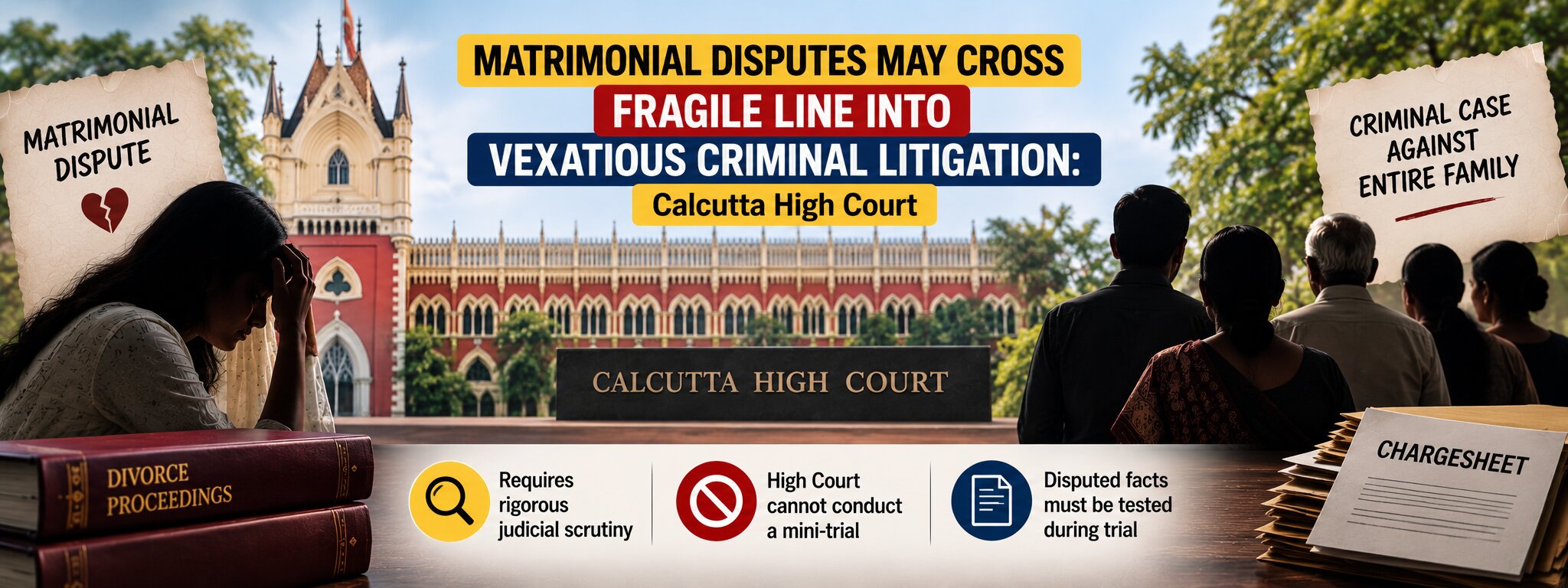
Matrimonial disputes that develop into criminal proceedings against an extended family require rigorous judicial scrutiny.
Judgement Details
Court
Calcutta High Court
Date of Decision
25 August 2026
Judges
Justice Uday Kumar
Citation
Acts / Provisions
Facts of the Case
- The petitioner-husband and the complainant-wife married on April 17, 2022, and registered the marriage on May 12, 2022.
-
The wife alleged physical and mental cruelty, dowry harassment and sexual assault by her brother-in-law.
-
The husband claimed that the wife left the matrimonial home and subsequently refused to return.
-
The husband instituted matrimonial proceedings for dissolution of marriage on May 30, 2023.
-
The wife lodged a criminal complaint on July 18, 2023, after receiving summons in the matrimonial proceedings.
-
Police investigated the allegations and filed a chargesheet against the husband and members of his extended family.
-
The accused approached the High Court alleging that the criminal case was a mala fide counterblast to the matrimonial proceedings.
Issues
-
Whether the High Court can quash criminal proceedings under Section 482 CrPC merely because the criminal complaint followed matrimonial proceedings?
-
Whether alleged timeline discrepancies between the sexual-assault allegation, marriage registration and criminal complaint justify quashing at the threshold?
-
Whether disputed questions concerning alibi, credibility and chronology can be adjudicated while exercising inherent jurisdiction?
-
Whether the proceedings were demonstrably mala fide within Category (7) of Bhajan Lal?
Judgement
-
The Calcutta High Court dismissed the petition seeking quashing of the criminal proceedings.
-
The Court held that the chronology relied upon by the petitioners involved matters of evidentiary appreciation.
-
The chargesheet was supported by the victim's Section 164 statement, witness statements, seizure materials and medical documentation.
-
The High Court held that Section 482 jurisdiction does not permit it to conduct a mini-trial or weigh competing factual versions.
-
The petitioners' factual defences and alibi were left open for consideration during trial.
-
The trial court was directed to remain uninfluenced by the observations made by the High Court.
Held
-
Such scrutiny does not permit the High Court to decide disputed facts at the quashing stage.
-
The alleged 48-hour gap between the alleged assault and marriage registration was a matter for evidence and cross-examination.
-
The timing of the criminal complaint after receipt of divorce summons did not, by itself, establish malicious prosecution.
-
Where investigation produces prima facie material, the proceedings should not ordinarily be quashed merely on the accused's factual defence.
-
The High Court cannot conduct a mini-trial while exercising Section 482 jurisdiction.
Analysis
-
The judgment balances the need to prevent vexatious criminal litigation with the principle that disputed allegations must ordinarily be tested at trial.
-
The Court recognised the possibility of criminal proceedings being used as a counterblast in matrimonial disputes.
-
However, the sequence of matrimonial and criminal proceedings was not considered sufficient, by itself, to establish mala fides.
-
The decision reinforces the exceptional nature of Bhajan Lal Category (7).
-
Questions concerning contradictions, alibi, chronology and credibility must ordinarily be tested through cross-examination.
-
Section 482 CrPC cannot become a substitute for a criminal trial where the chargesheet contains prima facie supporting material.
-
The judgment therefore adopts a cautious approach: scrutiny at the threshold, but no premature adjudication of disputed facts.