
Hirendra Kushwaha v. State of U.P. through Principal Secretary, Department of Home, Lucknow & Another, 2026
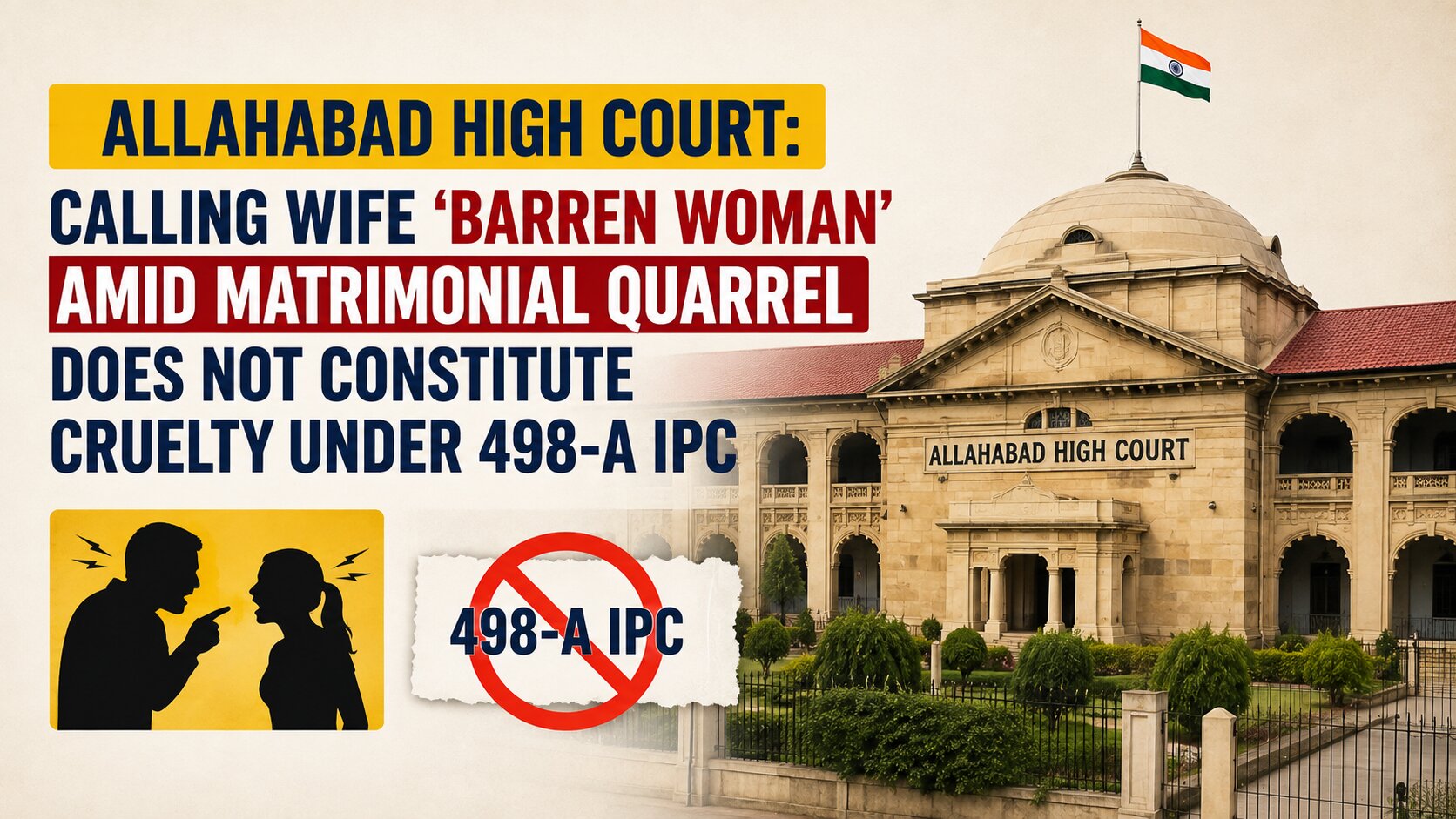
A reference to a wife as a “barren woman”, although insensitive and reprehensible, does not automatically constitute cruelty under Section 498-A IPC.
Judgement Details
Court
High Court of Allahabad
Date of Decision
14 August 2026
Judges
Justice Indrajeet Shukla
Citation
Acts / Provisions
Facts of the Case
-
The petitioner-husband was married to the complainant-wife in December 2015.
-
No child was born from the marriage for approximately three years.
-
According to the complainant, the absence of a child became a source of frequent matrimonial disputes between the spouses.
-
The wife alleged that she was taunted regarding her inability to conceive.
-
She alleged that during a quarrel on 23 November 2020, she was assaulted.
-
She further alleged that she was confined in a room following the incident.
-
Serious allegations were also made against the petitioner's father and brother.
-
The complainant approached the police in July 2021, alleging various matrimonial offences.
-
According to her, the police did not take appropriate action on her complaint.
-
She consequently approached the Magistrate under Section 156(3) CrPC.
-
The Magistrate directed proceedings against the husband but did not summon the other two persons named in the complaint.
-
The husband was summoned for offences under Sections 498-A, 323, 504 and 506 IPC and Sections 3/4 of the Dowry Prohibition Act.
-
The husband challenged the summoning order before the Allahabad High Court under Section 482 CrPC.
-
He contended that the allegations were primarily the result of a matrimonial dispute concerning childlessness.
-
He argued that the alleged exchange of abuses between the spouses was mutual rather than unilateral.
-
The complaint alleged that the husband referred to the wife as a “barren woman”.
-
The petitioner argued that, in the context of the matrimonial quarrel, the alleged words did not satisfy the statutory ingredients of cruelty under Section 498-A or intentional insult under Section 504 IPC.
-
The Court examined the original complaint and the statements recorded under Sections 200 and 202 CrPC.
-
It also examined the allegations concerning dowry demand, assault and intimidation.
Issues
-
Whether referring to the wife as a “barren woman” during a matrimonial quarrel over childlessness, in the circumstances of the case, constitutes cruelty under Section 498-A IPC?
-
Whether mere taunts concerning childlessness, refusal to undergo medical examination and verbal altercations between spouses are sufficient to constitute the offence of cruelty under Section 498-A IPC?
-
Whether the alleged use of insulting words during a mutual matrimonial quarrel satisfies the ingredients of intentional insult under Section 504 IPC?
-
Whether the prosecution was required to establish the requisite intention or knowledge that the alleged insult was likely to provoke the complainant to breach public peace or commit another offence under Section 504 IPC?
-
Whether the allegations concerning dowry demand contained sufficient material particulars to constitute offences under Sections 3 and 4 of the Dowry Prohibition Act?
-
Whether allegations subsequently introduced in a statement under Section 200 CrPC can cure the absence of a material allegation in the original complaint?
-
Whether the general allegations of assault, unsupported by medical material or specific attribution of individual roles, were sufficient to sustain criminal proceedings against the petitioner?
-
Whether continuation of the criminal proceedings against the petitioner would amount to an abuse of the process of law warranting exercise of the High Court's inherent jurisdiction under Section 482 CrPC?
Judgement
-
The Allahabad High Court allowed the petition under Section 482 CrPC.
-
The Court examined the allegations concerning the matrimonial dispute and found that the central conflict arose from childlessness within the marriage.
-
The Court observed that the allegations primarily disclosed a matrimonial quarrel involving offensive and insulting remarks exchanged between the spouses.
-
The Court found that the alleged verbal abuse was not a unilateral course of conduct attributable solely to the husband.
-
The allegation that the husband called the wife a “barren woman” was described as insensitive and reprehensible.
-
However, the Court held that, in the particular factual circumstances, the alleged remark by itself did not satisfy the legal requirements of Section 498-A IPC.
-
The Court further held that mere taunts regarding childlessness, refusal to undergo medical examination and verbal altercations do not automatically constitute statutory cruelty.
-
The Court separately considered Section 504 IPC.
-
It explained that merely exchanging abusive or insulting words does not automatically constitute intentional insult under Section 504.
-
The prosecution must prima facie show that the insult was intentional and of such a nature as to provide provocation, with the accused intending or knowing that the provocation was likely to cause a breach of public peace or commission of another offence.
-
The Court found no sufficient material demonstrating the required intention or knowledge.
-
The alleged words were uttered during a domestic quarrel and appeared to have arisen in the heat of matrimonial discord rather than pursuant to a premeditated intention.
-
The Court also examined the allegations relating to dowry.
-
It found that the original complaint did not contain a specific allegation of dowry demand.
-
A general allegation concerning dowry appeared subsequently in the complainant's statement under Section 200 CrPC.
-
The Court held that the subsequent statement could not be used simply to fill material omissions or lacunae in the original complaint.
-
The statements of the complainant's mother and brother recorded under Section 202 CrPC also did not substantiate a specific dowry demand.
-
The Court therefore found insufficient material to sustain the allegations under Sections 3 and 4 of the Dowry Prohibition Act.
-
The Court also found the allegations to be predominantly omnibus in nature.
-
The individual roles of the persons allegedly involved were not adequately specified.
-
The allegation of assault was general and lacked supporting medical material.
-
The Court further noted the absence of a cogent explanation for summoning the husband while the other persons allegedly involved in the same incident were not summoned.
-
In the overall circumstances, the Court concluded that compelling the petitioner to undergo a full criminal trial would serve no meaningful purpose.
-
Continuation of the prosecution was held to amount to an abuse of the criminal process.
-
The High Court consequently set aside the summoning order dated 17 January 2023.
-
The criminal proceedings pending against the petitioner were quashed.
Held
-
The Court must examine the entire factual context in which the alleged words or conduct occurred.
-
Mere matrimonial quarrels concerning childlessness, medical examination and exchange of abuses do not necessarily satisfy the statutory ingredients of Section 498-A.
-
For Section 504 IPC, mere abusive or insulting words are insufficient.
-
There must be material showing the requisite intentional insult, provocation and the necessary intention or knowledge contemplated by the provision.
-
The alleged words in the present case were spoken during a matrimonial altercation and there was insufficient material to establish the required mens rea.
-
A subsequent statement under Section 200 CrPC cannot ordinarily be used merely to fill a material omission in the original complaint concerning dowry demand.
-
The allegations concerning dowry lacked sufficient material particulars.
-
General allegations of assault without adequate supporting material and without clearly specifying individual roles were insufficient in the circumstances.
-
The allegations were substantially omnibus in nature.
-
Continuation of the proceedings would amount to an abuse of the process of law.
-
The summoning order was quashed and the criminal proceedings against the petitioner were set aside.
Analysis
-
The judgment is significant because it emphasises that not every unpleasant or offensive matrimonial interaction amounts to criminal cruelty under Section 498-A IPC.
-
Section 498-A requires the conduct complained of to satisfy the statutory concept of cruelty; the existence of a marital quarrel by itself is insufficient.
-
The Court focused on the context, nature and circumstances of the alleged conduct, rather than treating one isolated expression as automatically constituting a criminal offence.
-
The expression “barren woman” was expressly recognised as insensitive and reprehensible.
-
However, the Court distinguished conduct that is morally objectionable from conduct that legally satisfies the ingredients of a penal provision.
-
This distinction is important because criminal liability must be founded upon the specific statutory requirements of the offence.
-
The Court also considered the fact that the alleged verbal exchange was mutual.
-
According to the Court, the material portrayed both spouses as participants in a heated matrimonial altercation rather than demonstrating a sustained, unilateral course of cruelty by the husband.
-
The decision therefore illustrates the importance of examining whether the alleged conduct constitutes the type and degree of cruelty contemplated by Section 498-A.
-
The Court's analysis of Section 504 IPC is equally important.
-
The provision does not criminalise every instance of abusive language.
-
The prosecution must establish the necessary intention or knowledge concerning the consequences of the alleged insult.
-
The alleged insult must have the legally required connection with provocation and the likelihood of breach of public peace or commission of another offence.
-
The Court found that the circumstances indicated a spontaneous matrimonial quarrel rather than a premeditated attempt to provoke the wife into committing an offence or disturbing public peace.
-
The judgment therefore reinforces the principle that mens rea remains relevant where the statutory language requires intention or knowledge.
-
The dowry allegations were also subjected to careful scrutiny.
-
The Court attached significance to the fact that the original complaint did not contain a specific allegation of dowry demand.
-
A subsequent statement cannot automatically be used to introduce an essential ingredient that was absent from the foundational complaint, particularly where other witnesses also fail to support the allegation.
-
This reasoning reflects the broader principle that criminal proceedings should not be sustained merely by adding material allegations at later stages when the basic complaint does not disclose the offence.
-
The Court's treatment of omnibus allegations is particularly relevant to matrimonial prosecutions.
-
Matrimonial complaints sometimes contain allegations against several members of a family without specifying the individual conduct, time, place or role of each accused.
-
The judgment emphasises that criminal liability is individual and that specific allegations are important before compelling an accused to face a criminal trial.
-
The Court also considered the absence of medical material supporting the allegation of assault.
-
While medical evidence is not invariably indispensable for proving every assault, its absence may become significant when the allegation itself is general and unsupported by other reliable material.
-
The Court's use of Section 482 CrPC demonstrates the exceptional role of the High Court in preventing criminal proceedings from becoming an instrument of abuse or harassment.
-
Section 482 jurisdiction must be exercised cautiously and is not intended to conduct a mini-trial.
-
However, where the allegations, even if accepted at face value, fail to disclose the necessary ingredients of the offences, or where continuation of the prosecution would clearly amount to abuse of process, the High Court may intervene.
-
The judgment therefore balances two competing considerations: protecting genuine victims of matrimonial cruelty while preventing criminal law from being used to prolong or intensify essentially private matrimonial disputes.
-
The decision should not be read as holding that calling a wife “barren” can never constitute cruelty.
-
Depending upon the surrounding facts, frequency, severity, intention, humiliation, accompanying conduct and overall treatment, such remarks could form part of a broader course of conduct capable of satisfying Section 498-A.
-
The Court's conclusion was based on the specific factual circumstances of this case, particularly the mutual nature of the quarrel and the absence of sufficient additional material.
-
The judgment consequently reinforces a fact-sensitive approach to matrimonial offences.
-
Overall, the Court's reasoning stresses that criminal prosecution must rest on legally sufficient and specific allegations, not merely on the existence of matrimonial discord or offensive language exchanged during a domestic quarrel.