
Haji Abdul Razzak v. State of Madhya Pradesh & Ors., 2026
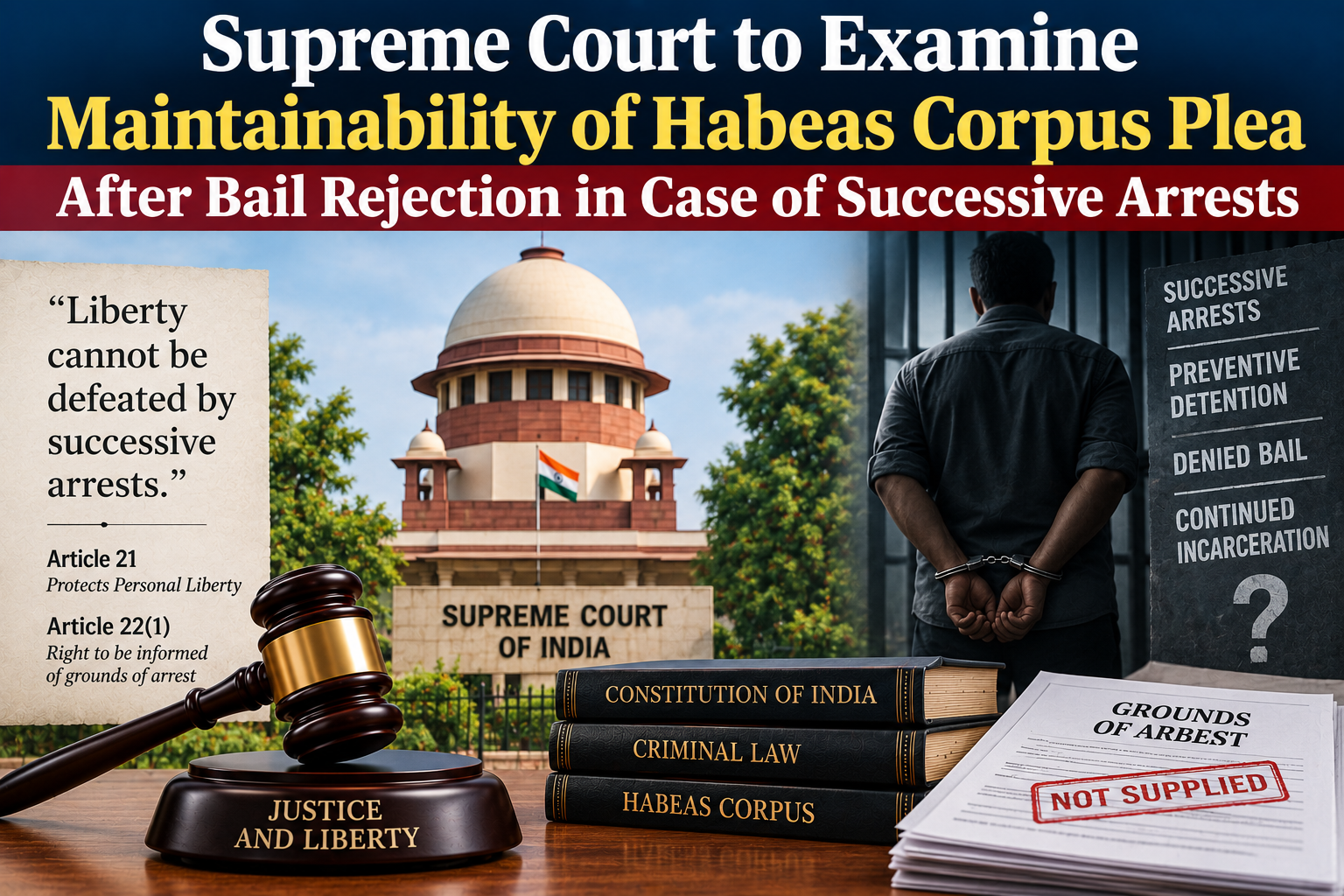
The Supreme Court found that the petition raised a substantial question of law concerning the interaction between habeas corpus jurisdiction, successive arrests and rejected bail applications.
Judgement Details
Court
Supreme Court of India
Date of Decision
17 August 2026
Judges
Justice M.M. Sundresh and Justice Sheel Nagu
Citation
Acts / Provisions
Facts of the Case
-
Haji Abdul Razzak was initially arrested in August 2021 in connection with an offence under Section 307 IPC and claims to have remained in custody through successive criminal proceedings.
-
Preventive-detention orders under the National Security Act were passed against him in August 2021, April 2022 and January 2023, but according to the petitioner, each order was subsequently revoked for want of approval by the State Advisory Board.
-
The petitioner alleged that whenever his release became imminent, fresh criminal cases and coercive proceedings were initiated, resulting in continued deprivation of his liberty.
-
He alleged a broader pattern of executive action against him and his family, including freezing of bank accounts, demolition proceedings and suspension of mining operations.
-
The petitioner approached the Madhya Pradesh High Court seeking, among other reliefs, a writ of habeas corpus challenging the alleged continuing pattern of detention arising from successive arrests and prosecutions.
-
The High Court dismissed the habeas corpus challenge, principally relying upon State of Madhya Pradesh v. Kusum Sahu, holding that the petitioner was in custody pursuant to criminal proceedings and had the ordinary remedy of seeking bail. The petitioner also contended that the grounds of arrest were never supplied to him in writing, despite the constitutional requirement under Article 22(1), and relied upon Prabir Purkayastha, Pankaj Bansal and Mihir Rajesh Shah.
-
The Supreme Court, while hearing the Special Leave Petition, indicated that the question involved a larger issue of law and issued notice to the State.
Issues
-
Whether a writ of habeas corpus is maintainable when a person remains in custody pursuant to successive arrests and criminal proceedings despite rejection of his bail applications?
-
Whether continued detention can be constitutionally challenged through habeas corpus where the petitioner alleges a deliberate pattern of successive arrests designed to defeat his release?
-
Whether non-supply of written grounds of arrest violates Article 22(1) and affects the legality of the petitioner's detention?
-
Whether the constitutional protection under Article 22(1) applies irrespective of the nature of the offence involved?
-
Whether the decision in Mihir Rajesh Shah can be relied upon by the petitioner where the issue concerning non-supply of grounds of arrest had already been raised before that judgment was delivered?
-
Whether the High Court erred in treating bail rejection as an absolute bar to entertaining the petitioner's constitutional challenge to his continued detention?
Judgement
-
The Supreme Court did not finally decide the maintainability issue at this stage.
-
The Bench considered the question sufficiently important to require further examination and therefore issued notice to the State of Madhya Pradesh.
-
The State was directed to file its counter-affidavit, with the matter made returnable on 17 August 2026.
-
Justice M.M. Sundresh observed that, notwithstanding the rejection of bail, a larger legal issue concerning the maintainability and scope of habeas corpus required consideration.
-
The Supreme Court therefore left open the question whether judicial custody following successive arrests and bail rejection can nevertheless be examined through the constitutional jurisdiction of habeas corpus.
Held
-
No final holding on maintainability was made.
-
The allegation regarding non-supply of written grounds of arrest was also considered significant enough to warrant examination.
-
The Court's issuance of notice indicates that rejection of bail cannot, at this preliminary stage, be treated as conclusively disposing of the broader constitutional questions raised by the petitioner.
Analysis
-
The case raises an important distinction between an ordinary bail challenge and a constitutional challenge to the legality or continuity of detention.
-
Ordinarily, when an accused is in judicial custody pursuant to a valid remand order, the appropriate remedy is bail rather than habeas corpus. The controversy here is whether that principle remains absolute where the accused alleges that successive proceedings have been deliberately used to perpetuate incarceration.
-
The petitioner's case is particularly significant because he alleges not merely one illegal arrest, but a continuing pattern of detention created through successive criminal cases and previously revoked preventive-detention orders.
-
Article 22(1) requires an arrested person to be informed of the grounds of arrest. The petitioner argues that this constitutional guarantee is not dependent upon whether the underlying offence is an economic offence, violent offence or any other category of offence.
-
The reliance on Prabir Purkayastha and Pankaj Bansal therefore raises the broader question whether procedural safeguards surrounding arrest are universally applicable rather than offence-specific.
-
The petitioner further relies on Mihir Rajesh Shah, contending that the decision merely declared the constitutional requirement and did not create a new substantive right. The Supreme Court will consequently have to consider the significance of the timing of that judgment in relation to Razzak's arrest and earlier challenge.
-
The case also presents a significant separation-of-remedies question: whether a person can invoke Article 226/habeas corpus where the immediate custody is supported by judicial orders, but the very foundation or continuation of that custody is alleged to have been produced through unconstitutional executive conduct.
-
The Supreme Court's decision to issue notice is therefore important because it leaves open the possibility of clarifying the boundaries between bail jurisdiction and habeas corpus jurisdiction, particularly in cases involving alleged successive arrests.
-
At this stage, however, the Court has not held that Razzak's detention is illegal, nor has it ruled that habeas corpus is maintainable after rejection of bail. Those questions remain pending.