
Gurmeet Singh @ Harpreet Singh v. State of NCT of Delhi & Anr., 2026
An accused's liberty cannot be made conditional upon fulfilment of a monetary settlement with the complainant.
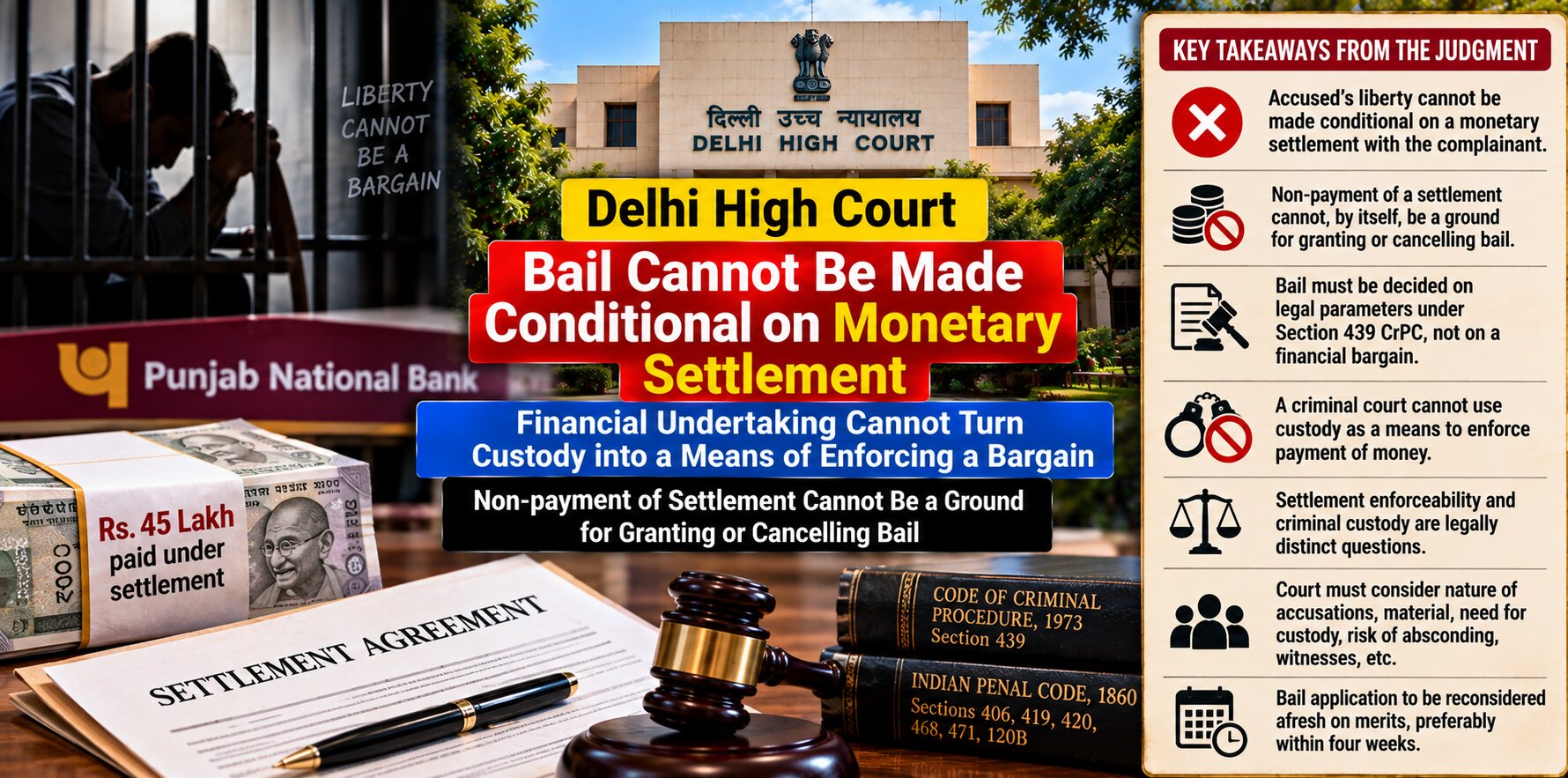
Judgement Details
Court
High Court of Delhi
Date of Decision
24 September 2026
Judges
Justice Sanjeev Narula
Citation
Acts / Provisions
Facts of the Case
-
The case arose from an FIR registered by the Economic Offences Wing, Delhi, concerning an alleged bank fraud.
-
The prosecution alleged offences under Sections 406, 419, 420, 468, 471 and 120-B IPC against the petitioner and other accused persons.
-
The underlying transaction concerned a ₹50 lakh cash-credit facility sanctioned by Punjab National Bank to M/s Dashmesh Enterprises.
-
According to the prosecution, the credit facility was obtained through allegedly forged documents and a guarantee purportedly executed in the name of a person who had already died in 2013.
-
The petitioner, Gurmeet Singh @ Harpreet Singh, was arrested in August 2022.
-
He subsequently applied for regular bail before the Sessions Court.
-
In November 2022, the Sessions Court granted him bail.
-
The bail order took note of a settlement between the parties under which ₹45 lakh was paid to the bank and the petitioner undertook to pay the remaining amount within six months.
-
The bail order expressly made the continuation of bail subject to compliance with the settlement terms.
-
The petitioner did not make the further payments contemplated by the settlement.
-
The bank consequently sought cancellation of his bail on the ground that he had failed to comply with the monetary undertaking.
-
In October 2023, the Sessions Court cancelled the petitioner's bail primarily because of his failure to honour the settlement/payment arrangement.
-
The petitioner challenged both the original bail order and the subsequent cancellation order before the Delhi High Court.
-
Before the High Court, the petitioner argued that bail could not legally be granted on the basis of a monetary settlement and, equally, could not be cancelled merely because the settlement was not performed.
-
The High Court examined whether the Sessions Court had applied the ordinary principles governing bail or had effectively converted the monetary settlement into a condition controlling the petitioner's personal liberty.
-
The Court also considered whether there was any independent conduct by the petitioner after release that could justify cancellation of bail, such as absconding, influencing witnesses, tampering with evidence or obstructing the proceedings.
Issues
-
Whether an accused's bail can lawfully be granted on the basis of a monetary settlement or undertaking to repay money to the complainant?
-
Whether failure to fulfil a monetary settlement entered into between the accused and the complainant can, by itself, constitute a valid ground for cancellation of bail?
-
Whether the Sessions Court erred by making the petitioner's liberty effectively conditional upon payment of the settlement amount without undertaking the ordinary judicial assessment required for deciding a bail application?
-
Whether the subsequent cancellation of bail was justified in the absence of any finding that the petitioner had misused his liberty, absconded, influenced witnesses, tampered with evidence or obstructed the trial?
-
Whether the enforceability of a monetary settlement between the parties is legally distinct from the question of whether an undertrial should remain in custody?
-
Whether the petitioner's bail application was required to be reconsidered afresh on the ordinary merits governing regular bail?
Judgement
-
The Delhi High Court allowed the petition and set aside both the original order granting bail on the basis of the settlement and the subsequent order cancelling bail for non-compliance with that settlement.
-
Justice Sanjeev Narula held that the petitioner's liberty cannot be made conditional upon fulfilment of a monetary obligation arising from a settlement.
-
The Court found that the original bail order did not undertake the ordinary judicial assessment required under the law governing regular bail.
-
The Sessions Court had not adequately considered the material attributed specifically to the petitioner, the necessity of continued custody, the possibility of absconding, the possibility of influencing witnesses or tampering with evidence, the petitioner's antecedents or other relevant bail considerations.
-
Instead, the settlement and the payment of ₹45 lakh had effectively become the basis for the grant of bail.
-
The High Court held that such a financial arrangement cannot displace the judicial assessment required when determining personal liberty.
-
The Court therefore held that the original bail order itself could not be sustained merely because it was founded upon the settlement.
-
At the same time, the High Court held that the subsequent cancellation of bail was equally unsustainable.
-
There was no finding that, after being released, the petitioner had absconded, attempted to evade the proceedings, intimidated witnesses, tampered with evidence, obstructed the trial or otherwise misused the liberty granted to him.
-
The only reason for cancellation was the petitioner's failure to make further payments under the settlement.
-
The Court drew a clear distinction between enforcement of a settlement and deprivation of an undertrial's liberty.
-
Whether a settlement is enforceable between the parties is a separate legal question from whether the accused should remain in custody.
-
The Court directed the Sessions Court to reconsider the petitioner's bail application afresh and independently on merits.
-
The settlement, the payment of ₹45 lakh and the alleged breach of the settlement were directed not to constitute, by themselves, grounds for either granting or refusing bail.
-
The petitioner's liberty could not be made conditional upon fulfilment of the monetary obligation.
-
In the fresh consideration, the Sessions Court was directed to consider the nature and gravity of the accusations, the material specifically attributed to the petitioner, the stage of the proceedings, the status of investigation, the necessity of custodial detention, the period for which the petitioner had remained at liberty and his conduct during that period.
-
The High Court directed that the restored bail application preferably be decided within four weeks.
-
Until such reconsideration, the interim protection already enjoyed by the petitioner was directed to continue, subject to conditions including participation in the trial, appearance when required, not leaving India without permission and not influencing witnesses or tampering with evidence.
-
The High Court expressly refrained from directing immediate refund of the ₹45 lakh already paid to the bank.
-
It left it open to the petitioner to seek a direction regarding refund before the Sessions Court, which was directed to consider such a request in accordance with law.
-
The Court therefore did not decide the petitioner's ultimate entitlement to bail; it only required that the bail application be adjudicated according to the legally relevant considerations rather than the monetary settlement.
Held
-
Bail cannot properly be granted merely because an accused promises to repay money pursuant to a settlement.
-
Conversely, non-payment under such a settlement cannot, by itself, justify cancellation of bail.
-
The grant of bail must be based on the established judicial parameters governing bail and not on a financial bargain between the accused and complainant.
-
The Court must independently examine the nature and gravity of the offence, the material against the accused, the necessity of custody, risk of absconding, possibility of influencing witnesses or tampering with evidence, antecedents and other relevant circumstances.
-
A settlement concerning monetary liability and the accused's entitlement to personal liberty are legally distinct questions.
-
Cancellation of bail ordinarily requires legally relevant circumstances demonstrating misuse of liberty or other grounds recognised by law; mere breach of a monetary settlement is not, by itself, sufficient.
-
A criminal court cannot effectively become a recovery mechanism for enforcing a monetary undertaking by keeping an undertrial in custody.
-
The original bail order, having been founded substantially upon the monetary settlement rather than the ordinary bail considerations, was unsustainable.
-
The subsequent cancellation order was also unsustainable because it was based solely on failure to perform the settlement.
-
The bail application was therefore required to be reconsidered afresh on its own merits.
-
The High Court did not itself grant final bail; it restored the application for a legally proper determination by the Sessions Court.
Analysis
-
Liberty cannot become a bargaining instrument: The central principle of the judgment is that personal liberty cannot be converted into consideration for a financial settlement. An accused's continued liberty cannot depend simply upon whether a promised amount has been paid to the complainant.
-
Bail must be judicially assessed: The Court emphasised that a bail application requires an independent judicial assessment. The judge must consider the circumstances traditionally relevant to bail rather than simply recording that the accused has agreed to pay money.
-
Settlement and bail operate in different legal spheres: A settlement may create contractual or other legal consequences between the parties, but that does not automatically determine whether an accused should be incarcerated pending trial.
-
Original bail order was also problematic: Significantly, the Court did not merely criticise cancellation of bail. It also set aside the original bail order because the Sessions Court had allowed the monetary arrangement to displace the normal bail analysis.
-
Cancellation requires more than non-payment: The Court distinguished breach of a settlement from recognised circumstances justifying cancellation of bail. There was no finding that the petitioner had misused his liberty by absconding, threatening witnesses, tampering with evidence or obstructing the proceedings.
-
Protection against indirect recovery through custody: The judgment prevents the criminal process from being used indirectly to compel payment of a monetary liability. Custody cannot become a mechanism for ensuring compliance with a repayment promise.
-
Personal liberty under Article 21: Although the Court approached the matter principally through the established bail framework, the underlying principle is closely connected with the constitutional protection of personal liberty. Deprivation of liberty must have a legally relevant basis and cannot rest merely upon failure to satisfy a private financial bargain.
-
Criminal proceedings versus monetary recovery: The underlying allegations involved serious offences including cheating, forgery and criminal conspiracy. The existence of such allegations does not, however, permit the court to replace the bail inquiry with a monetary recovery arrangement. The allegations must independently be evaluated under the ordinary bail principles.
-
No automatic entitlement to bail: The judgment should not be understood as holding that the petitioner is necessarily entitled to bail. The High Court expressly remitted the matter so that the Sessions Court could decide the bail application afresh on its merits.
-
Relevant factors for fresh consideration: The High Court specifically identified the nature and gravity of the allegations, material against the petitioner, stage of proceedings, investigation status, necessity of custody, period spent at liberty and conduct during that period as matters to be considered.
-
Interim protection: Until the fresh bail decision, the petitioner was protected subject to conditions designed to ensure his participation in the proceedings and prevent interference with the administration of justice.
-
₹45 lakh payment: The Court deliberately did not decide the question of refund of the ₹45 lakh already paid. It left that issue open for consideration by the Sessions Court if the petitioner sought such relief.
-
Broader significance: The decision is significant for cases in which complainants and accused persons enter monetary settlements during criminal proceedings. It clarifies that such arrangements cannot, by themselves, determine either the grant or cancellation of bail.
-
Practical principle: A useful distinction emerging from the judgment is: “settlement enforceability” and “criminal custody” are separate legal questions. A dispute over the former cannot automatically dictate the latter.
-
Overall significance: The judgment reinforces that bail is a judicial determination concerning liberty and the administration of criminal justice, rather than a mechanism for securing payment of a private monetary obligation.