
Gulla Ganaie @ Gulzar Ahmad Ganaie v. Ghulam Qadir Sheikh, 2026
The ruling reinforces the doctrine of functus officio, ensuring that criminal courts do not exercise jurisdiction after finally disposing of proceedings unless expressly authorized by law.
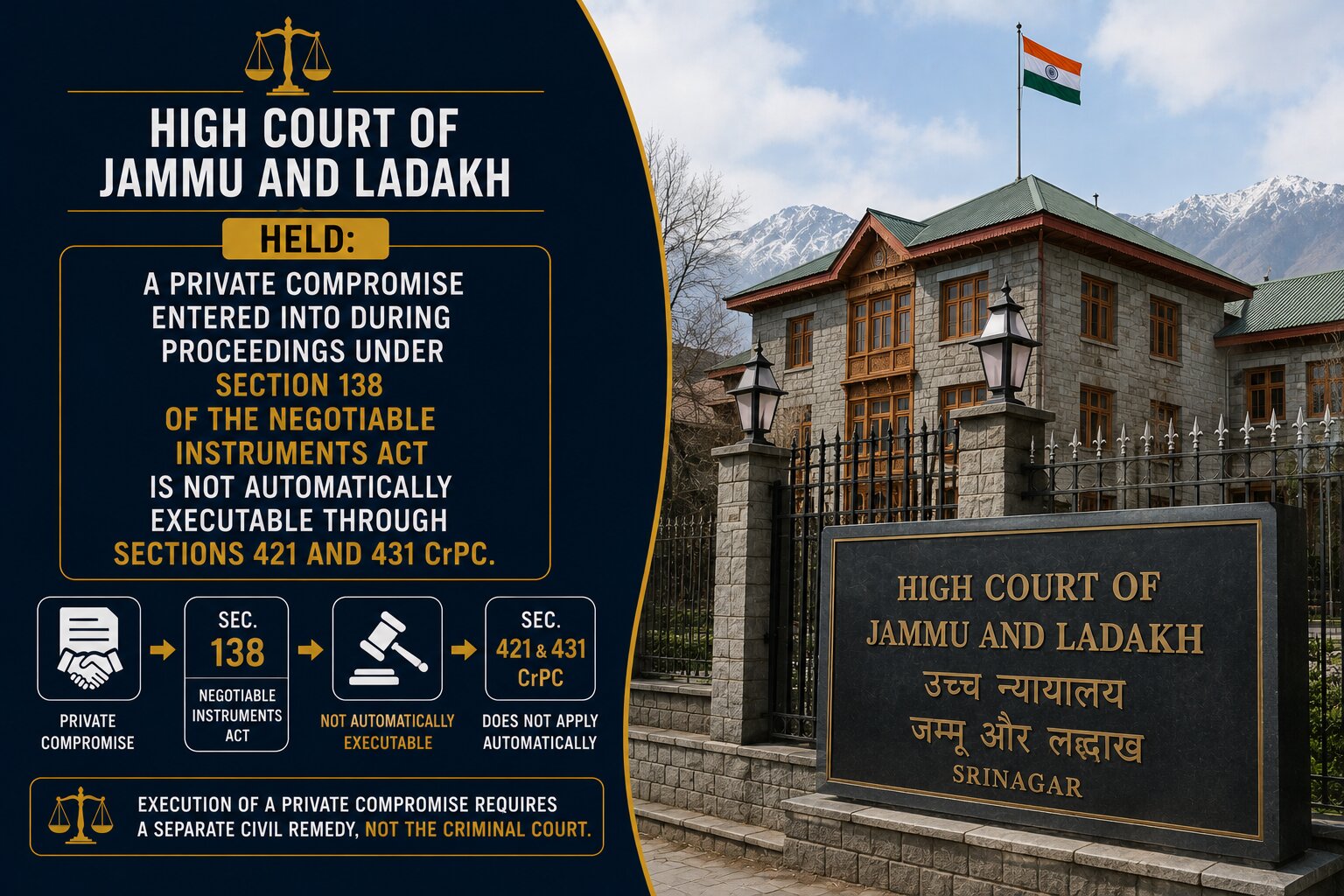
Judgement Details
Court
High Court of Jammu & Kashmir and Ladakh
Date of Decision
15 July 2026
Judges
Justice Wasim Sadiq Nargal
Citation
Acts / Provisions
Facts of the Case
-
The respondent filed a complaint against the petitioner under Section 138 of the Negotiable Instruments Act, 1881 before the Chief Judicial Magistrate (CJM), Budgam.
-
During the pendency of the complaint, the parties entered into a written settlement.
-
Under the compromise, the petitioner agreed to pay ₹6.60 lakh, while the respondent agreed to transfer a parcel of land to the petitioner.
-
Recording the compromise, the Chief Judicial Magistrate dismissed the complaint and acquitted the accused.
-
The order merely noted that the parties had settled the dispute and did not incorporate the detailed terms of the compromise.
-
The Magistrate's order also did not direct that the settlement amount would be recoverable under Sections 421 and 431 CrPC in case of default.
-
Subsequently, alleging breach of the settlement, the respondent filed execution proceedings before the same Magistrate seeking enforcement of the compromise.
-
The Chief Judicial Magistrate entertained the execution petition and directed the respondent to furnish details of the petitioner's properties for attachment.
-
Aggrieved by the execution proceedings and attachment order, the petitioner invoked the High Court's supervisory jurisdiction under Article 227 of the Constitution.
Issues
-
Whether a criminal court retains jurisdiction to execute the terms of a compromise after finally disposing of a complaint under Section 138 of the Negotiable Instruments Act?
-
Whether a private settlement entered into during proceedings under Section 138 of the Negotiable Instruments Act automatically becomes enforceable through Sections 421 and 431 CrPC?
-
Whether Sections 421 and 431 CrPC can be invoked in the absence of an express judicial direction incorporating the compromise into the final order?
-
Whether the Chief Judicial Magistrate became functus officio after dismissing the complaint and acquitting the accused?
Judgement
- The High Court held that a compromise entered into between parties during proceedings under Section 138 of the Negotiable Instruments Act does not automatically become executable under Sections 421 and 431 CrPC.
-
The Court observed that Sections 421 and 431 CrPC operate only where a criminal court has expressly directed recovery of a specified amount as if it were a fine.
-
The Court held that for a settlement to become enforceable through the criminal recovery mechanism, the criminal court must:
-
Incorporate the terms of the settlement into its judicial order.
-
Bind the parties to the settlement.
-
Specifically direct that, upon default, the agreed amount shall be recoverable under Sections 421 and 431 CrPC.
-
-
The Court found that the Chief Judicial Magistrate had merely recorded the fact of settlement and dismissed the complaint without incorporating its terms or providing any executable direction.
-
The Court held that, in the absence of such incorporation, the settlement retained the character of a private contractual arrangement and could not be enforced through criminal execution proceedings.
-
The Court further held that after dismissal of the complaint and acquittal of the accused, the Magistrate became functus officio and lacked jurisdiction to entertain execution proceedings.
-
Relying upon Dayawati v. Yogesh Kumar Gosain, the Court reaffirmed that only a judicially incorporated settlement can be enforced through Sections 421 and 431 CrPC.
-
Referring to Gimpex Private Limited v. Manoj Goel, the Court observed that breach of a settlement may give rise to independent civil or other legal remedies but does not authorize revival of concluded criminal proceedings.
-
Consequently, the High Court allowed the petition, quashed the execution proceedings as well as the attachment order, and granted liberty to the respondent to pursue any other remedy available in law.
Held
-
A private compromise entered into during proceedings under Section 138 of the Negotiable Instruments Act is not automatically executable through Sections 421 and 431 CrPC.
-
Sections 421 and 431 CrPC apply only where the criminal court expressly incorporates the settlement into its final judicial order and directs recovery upon default.
-
Once the complaint is dismissed and the accused is acquitted, the Magistrate becomes functus officio and cannot subsequently execute the compromise.
-
The execution proceedings and consequential attachment order were quashed.
-
The respondent was left free to pursue any other legal remedy for enforcement of the settlement.
Analysis
-
The judgment clearly distinguishes between a private settlement and an executable judicial order, emphasizing that criminal execution powers arise only from judicial directions and not from private agreements.
-
The Court correctly interpreted the scope of Sections 421 and 431 CrPC, holding that these provisions operate only when the court expressly orders recovery of an amount as if it were a fine.
-
By relying upon Dayawati v. Yogesh Kumar Gosain, the Court provides practical guidance to Magistrates dealing with settlements under Section 138 NI Act, encouraging them to expressly incorporate compromise terms into final orders whenever enforcement through criminal machinery is intended.
-
The decision also harmonizes criminal procedure with contractual principles by recognizing that a breached settlement remains enforceable through appropriate civil or other legal remedies, rather than through revival of concluded criminal proceedings.
-
The judgment promotes procedural certainty by preventing criminal courts from assuming execution jurisdiction where the final order does not contain an executable direction.
-
Overall, the ruling safeguards jurisdictional discipline while clarifying the legal requirements necessary for enforcement of settlements arising out of cheque dishonour proceedings.