
Govindappa Jayaramaiah v. State of Madhya Pradesh, 2026
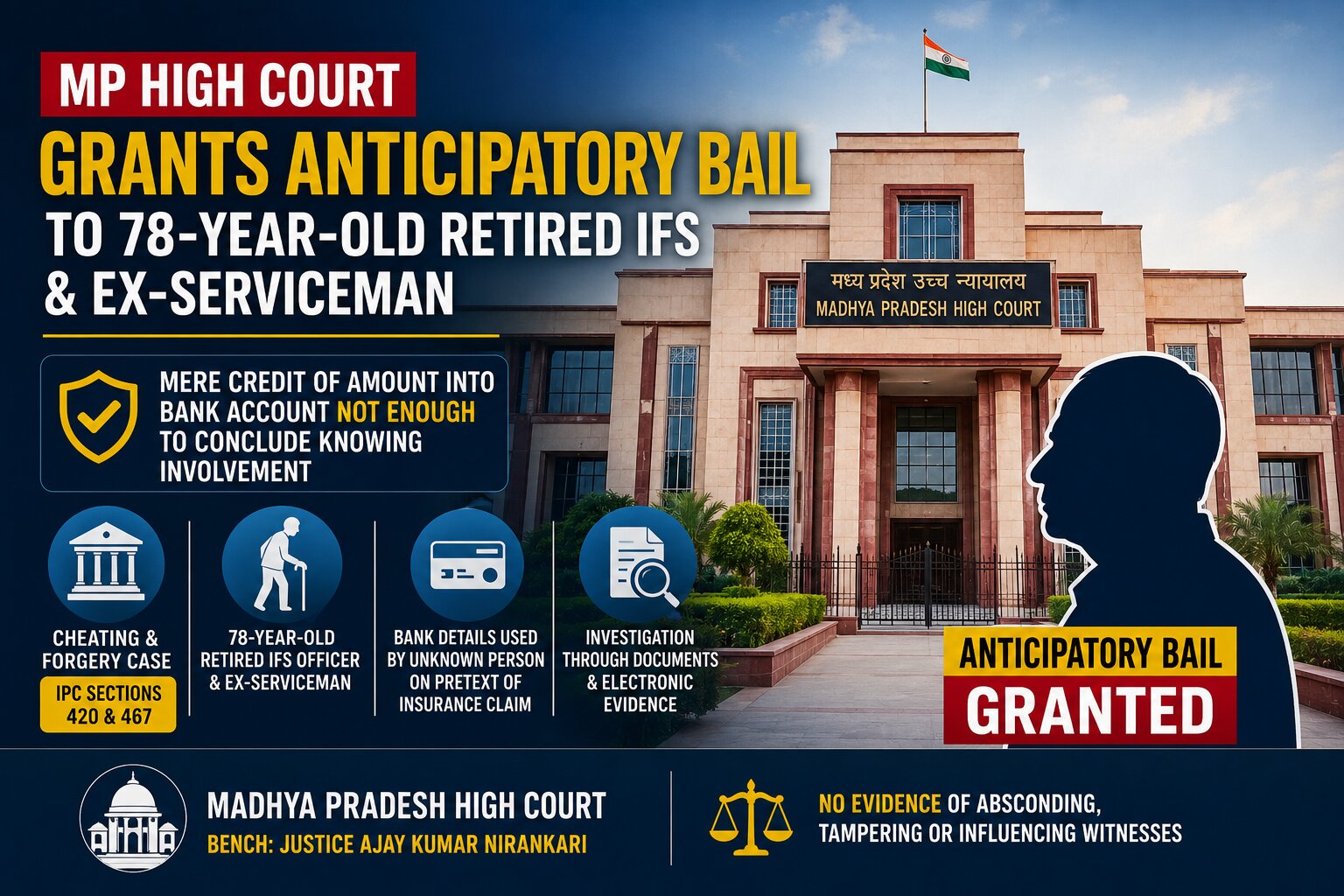
Mere credit of alleged proceeds of crime into a person's bank account is not, by itself, sufficient to establish knowing involvement.
Judgement Details
Court
Madhya Pradesh High Court
Date of Decision
21 August 2026
Judges
Justice Ajay Kumar Nirankari
Citation
Acts / Provisions
Facts of the Case
-
The petitioner, a 78-year-old retired IFS officer and ex-serviceman, sought anticipatory bail in connection with a cheating and forgery case.
-
The prosecution case arose from a complaint lodged on 13 July 2024 concerning an alleged insurance-related fraud.
-
According to the prosecution, persons posing as representatives of SBI Life, Bharti AXA, Kotak Life and other institutions obtained approximately ₹26.11 lakh from the complainant through false representations and forged documents.
-
During investigation, it was found that approximately ₹15.15 lakh had been transferred by the complainant into the petitioner's bank account between 6 July and 26 December 2023.
-
The prosecution treated these transactions as prima facie connected with the alleged proceeds of crime.
-
The petitioner stated that in 2023 an unknown person contacted him and represented that he could assist in obtaining an insurance amount.
-
Believing the representation, the petitioner allegedly provided his bank-account and debit-card details to the person.
-
The petitioner maintained that he had no knowledge of the subsequent transactions or withdrawals involving his account.
-
He was later informed by police that he had been arrayed as Accused No. 9 in the case.
-
The petitioner argued that merely receiving money into his account did not establish that he knowingly participated in cheating or forgery.
-
The State opposed anticipatory bail, contending that the petitioner's account had received alleged proceeds of crime and that custodial interrogation might be necessary to determine how the account was used.
-
The petitioner also relied upon his advanced age, retirement from government service, absence of criminal antecedents and permanent residence in Karnataka.
Issues
-
Whether mere credit of alleged proceeds of crime into the petitioner's bank account is sufficient, by itself, to establish his knowing involvement in the alleged cheating and forgery offences?
-
Whether custodial interrogation of the 78-year-old petitioner was indispensable for investigating the banking and electronic transactions involved in the case?
-
Whether the petitioner's age, retired status, absence of criminal antecedents and explanation regarding the use of his bank details justified the grant of anticipatory bail?
-
Whether the petitioner had established circumstances warranting protection from arrest in the absence of material showing a likelihood of absconding, tampering with evidence or influencing witnesses?
Judgement
-
The Madhya Pradesh High Court granted anticipatory bail to the petitioner.
-
Justice Ajay Kumar Nirankari held that merely because money had been credited into the petitioner's bank account, that fact alone could not establish that he was knowingly involved in the alleged offences.
-
The Court considered the petitioner's specific explanation that an unknown person had obtained his bank and debit-card details on the pretext of helping him obtain an insurance amount.
-
The Court noted that the principal allegations concerned banking and electronic transactions.
-
Such evidence could be investigated through documentary and electronic material without necessarily requiring custodial interrogation.
-
The Court found that custodial detention had not been shown to be indispensable at that stage.
-
The Court also considered the petitioner's advanced age, retired IFS status, ex-serviceman background and absence of criminal antecedents.
-
No sufficient material was shown indicating that the petitioner was likely to abscond, tamper with evidence or influence witnesses.
-
The Court consequently considered it appropriate to extend protection from arrest.
Held
-
Mere credit of money into a person's bank account does not, by itself, establish knowing participation in a criminal offence.
-
A specific and plausible explanation concerning the manner in which bank details were obtained must be considered at the anticipatory-bail stage.
-
Where the investigation primarily concerns banking and electronic transactions, custodial interrogation must be shown to be genuinely necessary.
-
Advanced age and absence of criminal antecedents are relevant considerations in deciding anticipatory bail.
-
The petitioner was granted anticipatory bail, subject to the conditions imposed by the Court.
Analysis
-
Mere receipt is not knowledge: The central principle is that the movement of alleged proceeds through a person's bank account does not automatically establish criminal participation. The prosecution must ultimately establish the necessary mens rea and connection with the alleged offence.
-
Custodial interrogation: The Court distinguished between the need to investigate financial transactions and the need to keep the accused in custody. Where bank records, electronic trails and documentary evidence can be examined independently, custody cannot be treated as automatically necessary.
-
Age as a relevant factor: The petitioner's age of 78 years was an important circumstance. While age does not create immunity from prosecution, it is a relevant factor when determining whether arrest and custodial interrogation are justified.
-
Absence of criminal antecedents: The Court also took note that the petitioner had no previous criminal record, which supported the conclusion that pre-arrest protection was appropriate.
-
Explanation regarding bank details: The petitioner's claim that an unknown person obtained his bank and debit-card details under the guise of helping him obtain an insurance payment created a factual explanation that could not be rejected merely because money subsequently entered his account.
-
Economic offence does not automatically defeat bail: Although the State characterized the matter as a serious economic offence, seriousness alone does not eliminate the requirement to demonstrate why custodial interrogation is necessary.
-
Limited assessment at bail stage: The Court did not finally determine the petitioner's guilt or innocence. The finding was confined to whether arrest and custodial detention were justified at the stage of considering anticipatory bail.
-
Protection with investigation: The judgment reflects the principle that granting anticipatory bail does not prevent investigation. The accused remains subject to investigation and must comply with the conditions imposed by the Court.