
Gopalrao v. State of Karnataka & Others, 2026
Government software cannot override substantive legal rights.
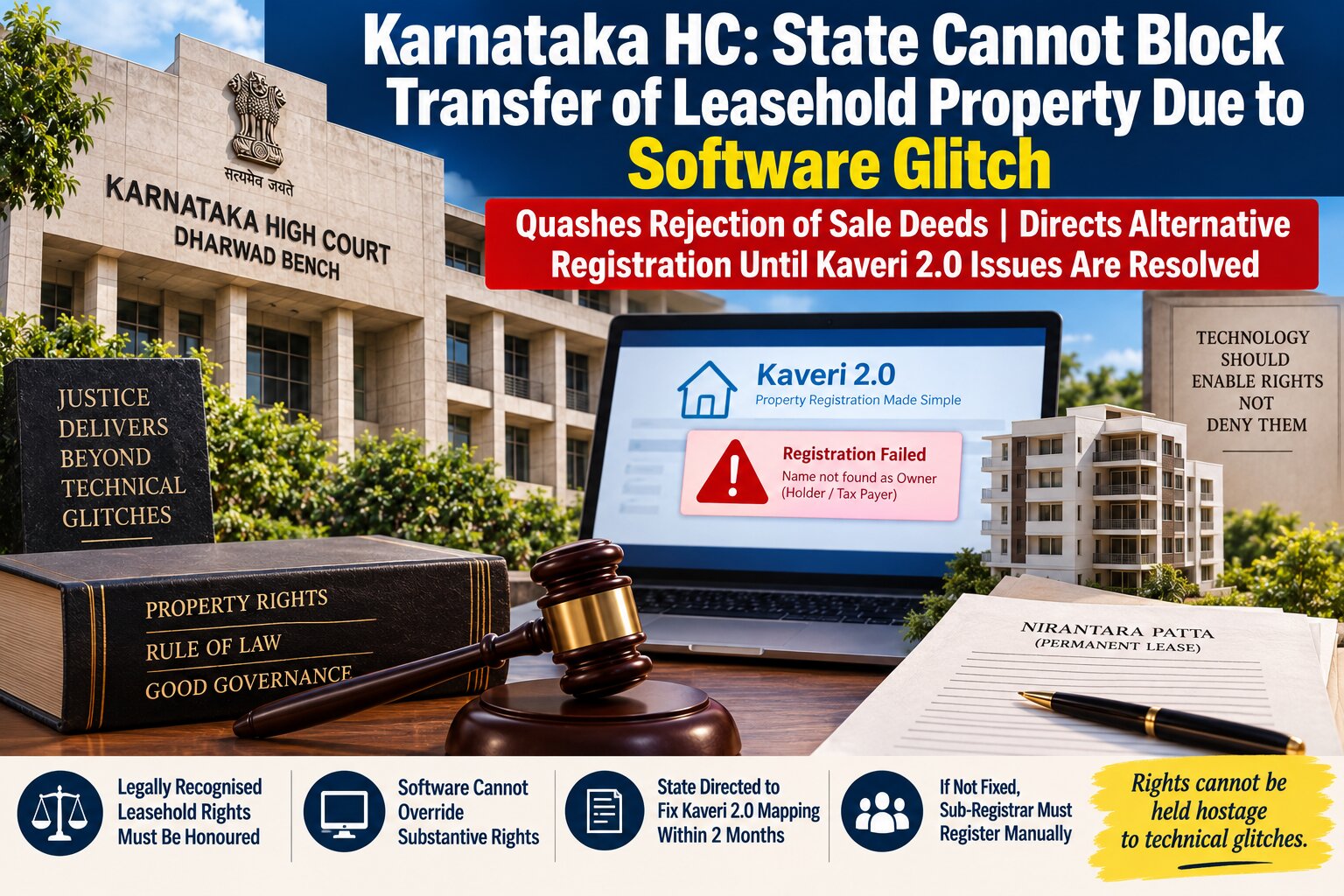
Judgement Details
Court
Karnataka High Court
Date of Decision
14 September 2026
Judges
Justice Sachin Shankar Magadum
Citation
Acts / Provisions
Facts of the Case
-
The petitioner was a builder who had acquired land under Nirantara Patta/permanent lease.
-
The petitioner subsequently constructed a residential building consisting of 34 flats on the property.
-
The petitioner sought to sell individual flats constructed on the leased property.
-
After introduction of the Kaveri 2.0 portal, the sale deeds relating to 13 flats could not be processed.
-
The difficulty arose because the petitioner's name appeared in the municipal/e-property records as “Holder/Tax Payer” rather than as “Owner.”
-
Because of this classification, the petitioner's details were not properly fetched or recognised by the Kaveri 2.0 system for registration of the proposed sale deeds.
-
The petitioner contended that the problem was not a defect in his underlying title but resulted from the manner in which municipal/e-property information had been mapped and transmitted to the Kaveri 2.0 software.
-
The petitioner relied upon the underlying title documents to contend that his interest was a permanent, heritable and transferable leasehold interest.
-
Communications between government authorities also indicated that similar technical difficulties were affecting properties held under Nirantara Patta/perpetual lease arrangements.
-
The petitioner therefore sought directions to the State authorities to accept and register the sale deeds.
-
He also sought an alternative mechanism for registration until the technical problems in the Kaveri 2.0 portal were rectified.
-
The State authorities had themselves recognised the difficulty concerning registration of properties held under perpetual lease arrangements.
-
The authorities had also identified the need to modify the API/data-mapping mechanism so that the leaseholder's name and the correct nature of his interest could be transmitted to Kaveri 2.0.
-
The State authorities nevertheless relied upon the existing electronic records and software classification while the sale deeds were not processed.
-
The High Court examined whether an administrative software system could effectively prevent a citizen from exercising a substantive property right that was otherwise recognised under law and the title documents.
Issues
-
Whether a State authority can prevent registration of sale deeds relating to a legally recognised and transferable leasehold interest merely because the government software does not recognise the leaseholder as the absolute owner?
-
Whether a technical defect in the Kaveri 2.0 portal or the underlying API/data-mapping mechanism can restrict or suspend substantive property rights flowing from valid title documents?
-
Whether the State authorities are required to provide an alternative mechanism for registration when technical deficiencies in the electronic registration system prevent lawful transactions from being processed?
-
Whether the petitioner's permanent leasehold interest under Nirantara Patta, being heritable and transferable, constitutes a legally recognisable interest capable of being conveyed subject to the applicable law and conditions of the grant?
-
Whether statutory scrutiny of a document presented for registration can be replaced by an automated rejection merely because the software fails to recognise the nature of the applicant's lawful interest?
-
Whether the State authorities should amend the API and data-mapping mechanism between municipal e-property records and the Kaveri 2.0 portal to correctly classify the petitioner's leasehold interest?
Judgement
-
The Karnataka High Court allowed the petitioner's challenge to the rejection of the sale deeds based solely upon the technical classification appearing in the electronic property records.
-
The Court held that the State cannot permit a software defect or data-mapping problem to render a legally recognised and transferable leasehold interest incapable of being conveyed.
-
The Court emphasised that technology is intended to facilitate the implementation of law, and cannot become an independent source for restricting substantive legal rights.
-
The Court held that the petitioner's permanent leasehold interest was heritable and transferable, and therefore constituted a legally recognisable interest in the leasehold estate capable of being conveyed, subject to the terms of the grant and applicable law.
-
The Court quashed the communication rejecting the petitioner's sale deeds merely because he was reflected as a perpetual lessee/leaseholder rather than an absolute owner in the municipal/e-property records.
-
The Court also rejected the approach under which the Kaveri 2.0 system's inability to fetch or recognise the petitioner's name could itself prevent registration.
-
The Court clarified that the State remains entitled to conduct statutory scrutiny of documents presented for registration.
-
Such scrutiny may include examination of title, transferability of the interest, compliance with lease conditions, payment of stamp duty and registration fees, and other statutory requirements.
-
However, such statutory scrutiny cannot be replaced by an automated rejection generated solely because the software does not recognise the leaseholder's interest.
-
The Court directed the concerned State authorities to amend the API/data-mapping mechanism between municipal e-property records and the Kaveri 2.0 portal.
-
The authorities were directed to ensure proper classification and transmission of the petitioner's leasehold interest.
-
The authorities were granted two months to carry out the necessary modifications.
-
The Court further directed that if the software and API mechanism were not corrected within the stipulated period, the jurisdictional Sub-Registrar must process and register the sale deeds manually, subject to compliance with all applicable legal requirements.
Held
-
A technical deficiency in an electronic registration system cannot make a legally recognised and transferable leasehold interest incapable of being transferred.
-
A software system is only a means of implementing the law, not a source of law capable of extinguishing or restricting substantive rights.
-
A lawful leasehold interest does not cease to exist merely because the electronic property database describes the holder as a “Holder/Tax Payer” rather than “Owner.”
-
A permanent and transferable leasehold interest can constitute a legally recognisable title to the leasehold estate.
-
The State retains the authority to conduct statutory scrutiny of documents presented for registration.
-
Such scrutiny must be based upon law and the actual legal nature of the interest, rather than an automated software classification alone.
-
An automated rejection cannot substitute for the statutory decision-making process of the registering authority.
-
Where a technical problem prevents lawful registration, the State must provide a functional mechanism for exercising the underlying legal right.
-
The concerned authorities were directed to rectify the API/data-mapping mechanism within two months.
-
If the technical defect remained unresolved after two months, the Sub-Registrar was required to process the documents manually, subject to applicable statutory requirements.
Analysis
-
Technology cannot override law: The central principle of the judgment is that an electronic government system is subordinate to the substantive law it is designed to administer. A database classification cannot determine the existence or extent of a legally recognised property interest.
-
Substantive right versus technical classification: The dispute arose because the petitioner was shown as a “Holder/Tax Payer” rather than an “Owner.” The Court distinguished the electronic description of the property holder from the actual legal character of the petitioner's leasehold interest.
-
Recognition of leasehold rights: The Court accepted that the petitioner's permanent leasehold interest was heritable and transferable. Therefore, the fact that he was not the absolute owner of the underlying land did not automatically prevent him from conveying the interest legally available to him.
-
Important limitation: The judgment does not mean that every leaseholder is automatically entitled to sell or transfer property. Transferability remains subject to the terms of the lease, applicable law and statutory requirements.
-
Automated rejection is insufficient: The Court made an important distinction between genuine statutory scrutiny and a computer-generated rejection. A registering authority must examine the legality of the transaction rather than simply rely on the software's inability to recognise a particular category of interest.
-
Administrative accountability: The State authorities had themselves identified the API/data-mapping problem. The Court therefore required them to correct the technical mechanism instead of allowing citizens to bear the consequences of the State's technological deficiency.
-
Manual registration as a safeguard: The direction permitting manual registration if the software was not corrected within two months ensures that the technical problem does not indefinitely prevent the petitioner from exercising his lawful rights.
-
Digital governance principle: The judgment has broader significance for e-governance. Digitisation is intended to make governmental processes more efficient and accessible; it cannot create new restrictions that do not exist under substantive law.
-
No automatic right to registration: The Court did not eliminate the registering authority's statutory scrutiny. The sale deeds still remain subject to verification of title, transferability, lease conditions, stamp duty, registration fees and other legal requirements.
-
Balance between technology and statutory authority: The decision preserves the State's regulatory authority while making clear that such authority must be exercised through lawful decision-making rather than software limitations.
-
Broader significance: The ruling establishes an important principle for property registration in the digital era: a technical defect in a government portal cannot extinguish, suspend or restrict a substantive property right that otherwise exists under law.