
Ganga Singh v. Devi Singh, 2026
The Court reaffirmed that the statutory obligation of parents extends to maintaining an unmarried adult daughter who is genuinely unable to support herself financially.
Judgement Details
Court
Madhya Pradesh High Court
Date of Decision
14 July 2026
Judges
Justice Dwarka Dhish Bansal
Citation
Acts / Provisions
Facts of the Case
-
The petitioner-father filed a criminal revision challenging the Family Court's order granting maintenance pendente lite of ₹2,000 per month to his major unmarried daughter.
-
The Family Court had refused maintenance to the wife after prima facie finding that she did not appear to be the legally wedded wife of the petitioner.
-
The wife and the unmarried adult daughter had jointly filed an application under Section 125 CrPC, alleging that the petitioner had deserted them and that they were unable to maintain themselves.
-
They also alleged that the petitioner had subjected them to cruelty.
-
The petitioner contended that the application filed by the major unmarried daughter under Section 125 CrPC was not maintainable.
-
He further alleged that the daughter had assaulted him on several occasions and had lodged multiple complaints against him, disentitling her from claiming maintenance.
-
The petitioner argued that an unmarried major daughter could claim maintenance only under Section 20 of the Hindu Adoptions and Maintenance Act, and only if she suffered from some disability.
-
The respondents argued that the Family Court had merely granted interim maintenance to the unmarried daughter during the pendency of the proceedings and that the order was legally justified.
-
The High Court examined whether the unmarried adult daughter was entitled to interim maintenance despite invoking Section 125 CrPC instead of Section 20(3) of HAMA.
Issues
-
Whether an unmarried major daughter is required to prove that she suffers from a disability to claim maintenance under Section 20(3) of the Hindu Adoptions and Maintenance Act, 1956?
-
Whether an unmarried major daughter who is unable to maintain herself from her own earnings or property is entitled to maintenance under Section 20(3) of the Hindu Adoptions and Maintenance Act, 1956?
-
Whether filing an application under Section 125 CrPC instead of Section 20(3) of the Hindu Adoptions and Maintenance Act disentitles an unmarried major daughter from claiming maintenance?
-
Whether the Family Court committed any illegality in granting maintenance pendente lite of ₹2,000 per month to the unmarried adult daughter?
Judgement
-
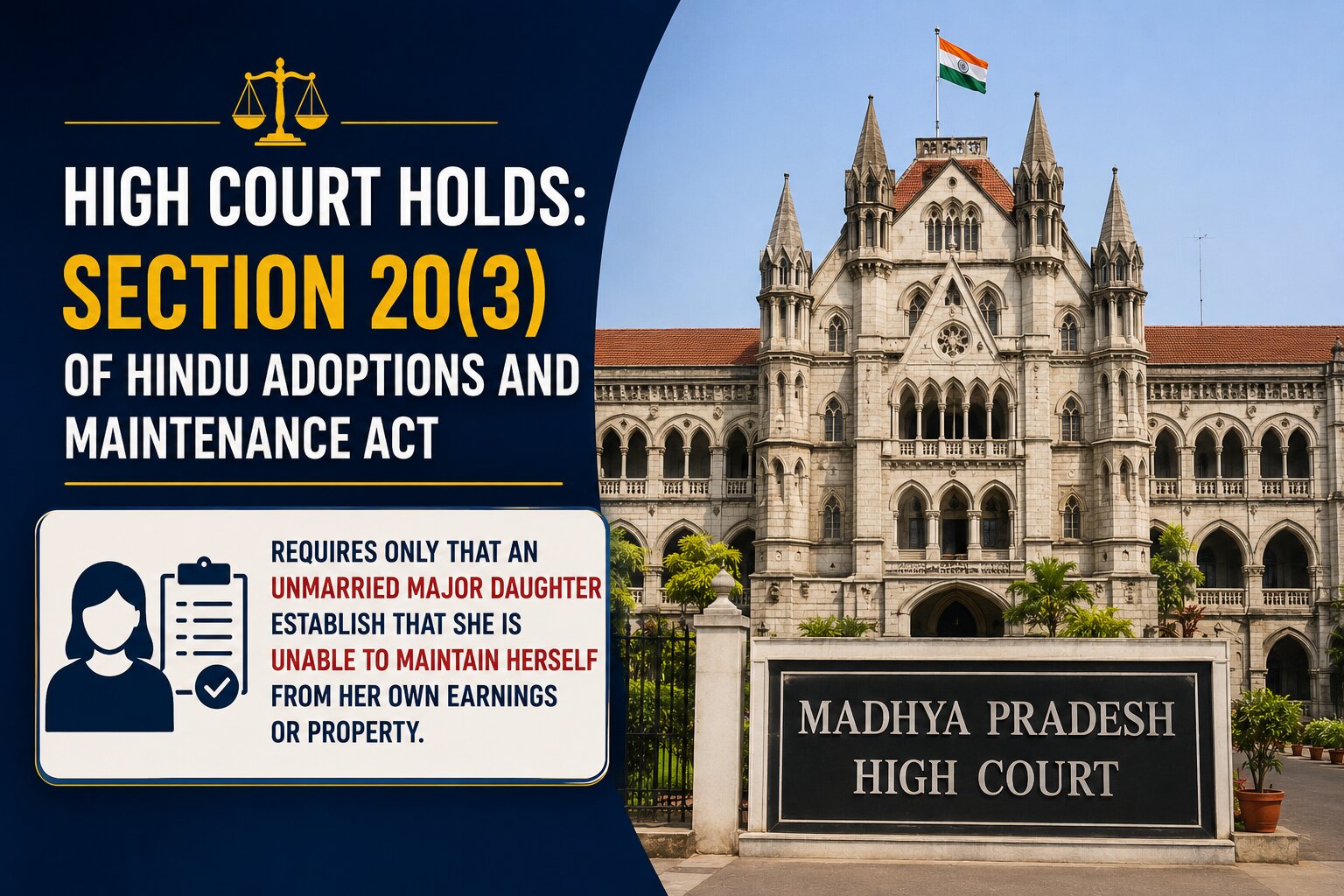
The High Court held that Section 20(3) of the Hindu Adoptions and Maintenance Act requires only that an unmarried major daughter establish that she is unable to maintain herself from her own earnings or property.
-
The Court clarified that the statute does not require the daughter to prove that she suffers from any physical or mental disability.
-
The Court observed that the application filed under Section 125 CrPC was prima facie maintainable only with respect to the wife and not the major unmarried daughter.
-
However, the Court held that merely invoking an incorrect statutory provision cannot defeat a legitimate claim for maintenance.
-
The Court emphasized that procedural errors should not stand in the way of substantive justice where the claimant is otherwise legally entitled to relief.
-
The Court found no illegality or perversity in the Family Court's decision granting interim maintenance to the unmarried daughter.
-
Accordingly, the criminal revision filed by the father was dismissed, and the order granting maintenance pendente lite of ₹2,000 per month to the daughter was upheld.
Held
-
An unmarried major daughter claiming maintenance under Section 20(3) of the Hindu Adoptions and Maintenance Act, 1956 is not required to prove any disability.
-
The only requirement is that she demonstrates her inability to maintain herself from her own earnings or property.
-
Mentioning an incorrect statutory provision does not defeat an otherwise valid claim for maintenance.
-
The Family Court rightly granted maintenance pendente lite of ₹2,000 per month to the unmarried adult daughter.
-
The father's criminal revision was dismissed.
Analysis
-
The judgment clarifies the true scope of Section 20(3) of the Hindu Adoptions and Maintenance Act, removing the misconception that only daughters suffering from disabilities are entitled to maintenance after attaining majority.
-
The decision emphasizes the distinction between Section 125 CrPC and Section 20(3) of HAMA, while ensuring that technical defects in pleadings do not defeat substantive rights.
-
The Court adopted a justice-oriented approach by holding that incorrect citation of a statutory provision cannot override the actual entitlement created by law.
-
The ruling reinforces the principle that procedural law is intended to facilitate justice rather than obstruct it.
-
The judgment is significant because it strengthens the financial protection available to unmarried adult daughters and provides important guidance to Family Courts dealing with maintenance claims.
-
The decision also promotes a liberal interpretation of maintenance laws consistent with their welfare-oriented object.