
Ganapati (Dead) by His LRs v. Prabhakar & Others, 2026
Formal partition is not essential for the limited interest to be enlarged into an absolute interest.
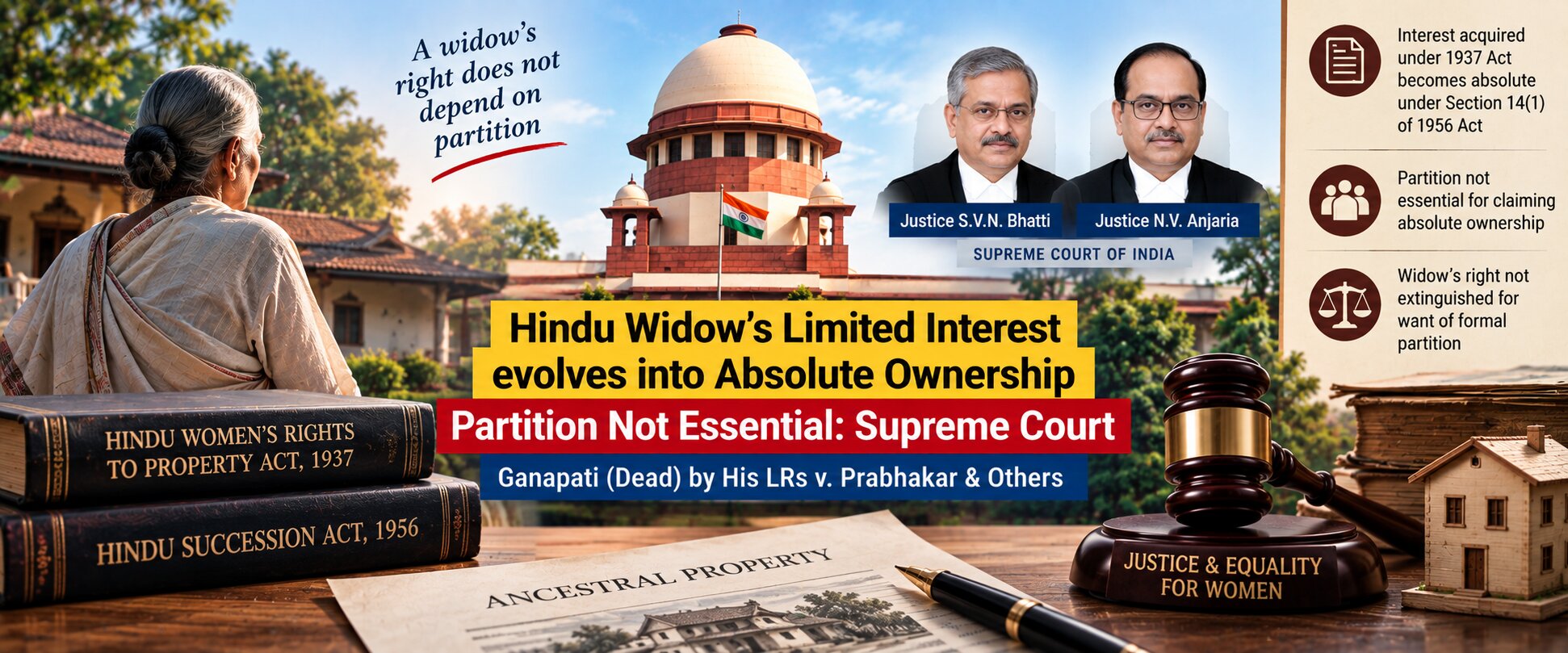
Judgement Details
Court
Supreme Court of India
Date of Decision
22 September 2026
Judges
Justice S.V.N. Bhatti & Justice N.V. Anjaria
Citation
Acts / Provisions
Facts of the Case
-
The dispute concerned the property rights of a Hindu widow whose husband died in 1949, before the enactment of the Hindu Succession Act, 1956.
-
Upon her husband's death, the widow acquired an interest in his property under the Hindu Women's Rights to Property Act, 1937.
-
The widow's interest under the 1937 Act was a limited interest, accompanied by a right to seek partition.
-
The widow did not obtain a formal partition of the property during her lifetime.
-
The plaintiff was the son of the deceased husband through his first wife.
-
After the widow's death, the dispute concerned whether her limited interest had become an absolute ownership interest under Section 14(1) of the Hindu Succession Act, 1956.
-
The Trial Court and the First Appellate Court held against the widow's legal representatives, taking the view that the widow had not obtained partition of the property.
-
The matter reached the Karnataka High Court, Dharwad Bench, in second appeal.
-
The High Court reversed the concurrent findings of the courts below and recognized the widow's absolute ownership in the property.
-
The plaintiff's legal representatives challenged the High Court's decision before the Supreme Court.
-
The principal question before the Supreme Court was whether the absence of a formal partition prevented the widow's limited interest from being enlarged into an absolute interest under Section 14(1) of the Hindu Succession Act.
Issues
-
Whether a Hindu widow who acquired a limited interest in her deceased husband's property under the Hindu Women's Rights to Property Act, 1937 could become the absolute owner of that interest under Section 14(1) of the Hindu Succession Act, 1956?
-
Whether the absence of a formal partition between the widow and the surviving coparceners prevents enlargement of her limited interest into an absolute ownership right under Section 14(1) of the Hindu Succession Act?
-
Whether a widow's failure to seek or obtain partition during her lifetime extinguishes or restricts the absolute ownership that arises under Section 14(1) of the Hindu Succession Act?
-
Whether the widow's interest acquired under the 1937 Act constitutes a pre-existing right capable of being enlarged into an absolute interest under Section 14(1) of the Hindu Succession Act?
-
Whether the High Court was justified in recognizing the absolute ownership rights of the widow despite the absence of proof of a formal partition?
Judgement
-
The Supreme Court dismissed the appeal and affirmed the judgment of the Karnataka High Court.
-
The Court held that the widow's interest in the property, acquired under the Hindu Women's Rights to Property Act, 1937, was capable of being enlarged into an absolute ownership interest under Section 14(1) of the Hindu Succession Act, 1956.
-
The Court held that the absence of a formal partition did not prevent the operation of Section 14(1).
-
The Court observed that the widow, having stepped into her deceased husband's position in respect of the property, possessed a pre-existing right capable of being enlarged into absolute ownership.
-
Even assuming that the legal representatives of the widow could not establish the alleged oral partition, the widow's rights under the 1937 Act read with Section 14(1) of the 1956 Act remained unaffected.
-
The Court held that partition was not a sine qua non for the widow to enjoy the property as an absolute owner.
-
The Court relied upon V. Tulasamma v. Sesha Reddy (1977) and Raghubar Singh v. Gulab Singh (1998).
-
These decisions recognize the broad operation of Section 14(1) in enlarging a Hindu woman's limited interest into an absolute interest where the interest is traceable to a pre-existing right.
-
The Supreme Court therefore upheld the widow's absolute ownership rights and dismissed the appeal.
Held
-
A Hindu widow who acquired an interest in her deceased husband's property under the Hindu Women's Rights to Property Act, 1937 could acquire absolute ownership under Section 14(1) of the Hindu Succession Act, 1956.
-
The widow's failure to obtain partition does not, by itself, extinguish her right.
-
The interest acquired under the 1937 Act constitutes a pre-existing right for the purposes of Section 14(1).
-
The restrictive character of the widow's interest is removed by the operation of Section 14(1).
-
The High Court was justified in recognizing the widow's absolute ownership despite the absence of a proved formal partition.
-
The appeal filed by the plaintiff's legal representatives was therefore dismissed.
Analysis
-
Pre-existing right: The central reasoning is that the widow's interest was not created for the first time by the 1956 Act. It originated from a right already recognized under the 1937 Act.
-
Section 14(1): The provision operates to enlarge a woman's limited interest into an absolute interest where the property is possessed or held by her in recognition of a pre-existing right.
-
Partition not essential: The Court made clear that the absence of partition does not automatically defeat the widow's substantive property rights.
-
Effect of the 1956 Act: The restrictive nature of the widow's interest under the earlier law was removed when Section 14(1) came into operation.
-
Continuity of rights: Even if there was no proven oral or formal partition, the widow's underlying right continued and could mature into absolute ownership.
-
Coparcenary interest: The Court recognized that shares in an undivided coparcenary may fluctuate, but this does not mean that the widow's legally recognized right can simply be denied.
-
Earlier Supreme Court precedents: The Court relied upon V. Tulasamma v. Sesha Reddy and Raghubar Singh v. Gulab Singh to reinforce the broad interpretation of Section 14(1).
-
Substantive ownership over technical partition: The judgment emphasizes that the absence of a formal partition cannot by itself defeat an otherwise established substantive right of a Hindu woman.
-
Legal significance: The decision reinforces the principle that Section 14(1) should be applied to enlarge a Hindu woman's limited property interest where that interest is traceable to a pre-existing legal right.