
Gajendra v. State, 2026
A conviction can be based upon the sole testimony of an injured witness, if found reliable.
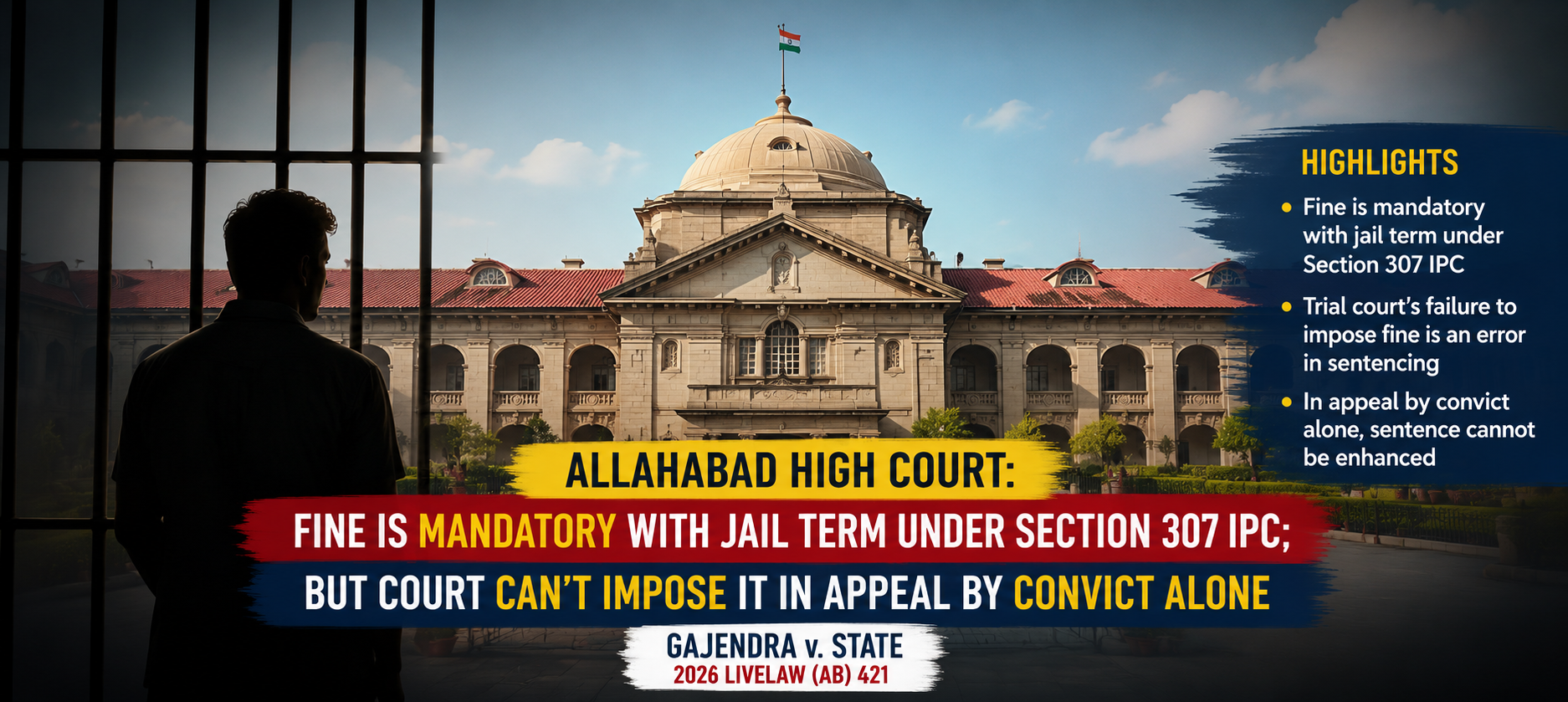
Judgement Details
Court
Allahabad High Court
Date of Decision
17 July 2026
Judges
Justice Santosh Rai
Citation
Acts / Provisions
Facts of the Case
-
On 19 May 1982, at about 9:30 a.m., the appellant, armed with a knife, entered the victim's house.
-
He allegedly caught hold of the victim from behind and inflicted ten incised wounds on different parts of her body with the intention of causing her death.
-
The Trial Court, in November 1982, convicted the appellant under Section 307 IPC and sentenced him to five years' rigorous imprisonment.
-
He was also convicted under Section 452 IPC and sentenced to two years' rigorous imprisonment.
-
The appellant challenged the conviction before the Allahabad High Court, contending that the conviction rested solely on the testimony of the injured victim after independent witnesses turned hostile.
-
It was also argued that the injuries were consistent with some other occurrence and that the possibility of another assailant had not been ruled out.
Issues
-
Whether a conviction under Section 307 IPC can be based solely on the testimony of the injured victim?
-
Whether the prosecution proved beyond reasonable doubt that the appellant committed the offence of attempt to murder?
-
Whether the trial court committed an error by failing to impose a fine along with imprisonment under Section 307 IPC?
-
Whether the High Court could enhance the sentence by imposing a fine in an appeal filed only by the convict under Section 374 CrPC?
-
Whether the appellant was entitled to the benefit of the Probation of Offenders Act?
Judgement
-
The High Court upheld the conviction under Sections 307 and 452 IPC.
-
The Court held that conviction can legally rest upon the testimony of a single witness, provided the witness is wholly reliable.
-
The testimony of the injured victim was found to be trustworthy and substantially corroborated by the medical evidence.
-
The Court observed that Section 307 IPC does not require that the injuries actually inflicted should be sufficient to cause death.
-
What is essential is the intention or knowledge to commit murder, which may be inferred from the surrounding circumstances.
-
The Court noted that the premeditated entry, choice of weapon, number of injuries, and life-threatening chest injury clearly established the appellant's intention to cause death.
-
The Court further held that the trial court committed an error in sentencing by not imposing a fine along with imprisonment under Section 307 IPC.
-
However, since no appeal or revision seeking enhancement of sentence had been filed by the State or the complainant, the High Court held that it could not impose a fine while deciding an appeal filed solely by the convict.
-
The benefit of the Probation of Offenders Act was declined considering the brutal nature of the offence.
-
The appellant was directed to surrender within two weeks to undergo the remaining sentence.
Held
- Section 307 IPC primarily requires proof of intention or knowledge, not necessarily injuries sufficient to cause death.
-
Imposition of fine is mandatory along with imprisonment under Section 307 IPC.
-
Failure to impose a fine amounts to an error in sentencing.
-
In an appeal filed only by the convict, the High Court cannot enhance the sentence by imposing a fine in the absence of an appeal by the State or complainant.
-
The appellant was not entitled to probation.
Analysis
-
The judgment reiterates that the testimony of an injured witness carries great evidentiary value and can independently sustain a conviction if it inspires confidence.
-
The Court clarified the essential ingredients of Section 307 IPC, emphasizing that the decisive factor is the intention to cause death, rather than the actual result of the injuries.
-
The decision also settles an important sentencing principle by holding that where Section 307 IPC prescribes imprisonment and fine, the trial court must impose both.
-
The ruling emphasizes that failure to impose a fine is not a mere procedural irregularity but an error in sentencing.
-
The Court simultaneously reaffirmed the limits of appellate jurisdiction by holding that a sentence cannot be enhanced in an appeal preferred solely by the accused unless the State or the complainant seeks enhancement.
-
The judgment also demonstrates judicial restraint by refusing to correct the sentencing error at the cost of violating the accused's procedural safeguards.
-
By denying the benefit of the Probation of Offenders Act, the Court emphasized that extremely violent offences do not deserve reformative relief merely because considerable time has elapsed.