
Duvvada Srinivas v. State of Andhra Pradesh & Others, 2026
Article 20(3) protects an accused against compelled self-incrimination.
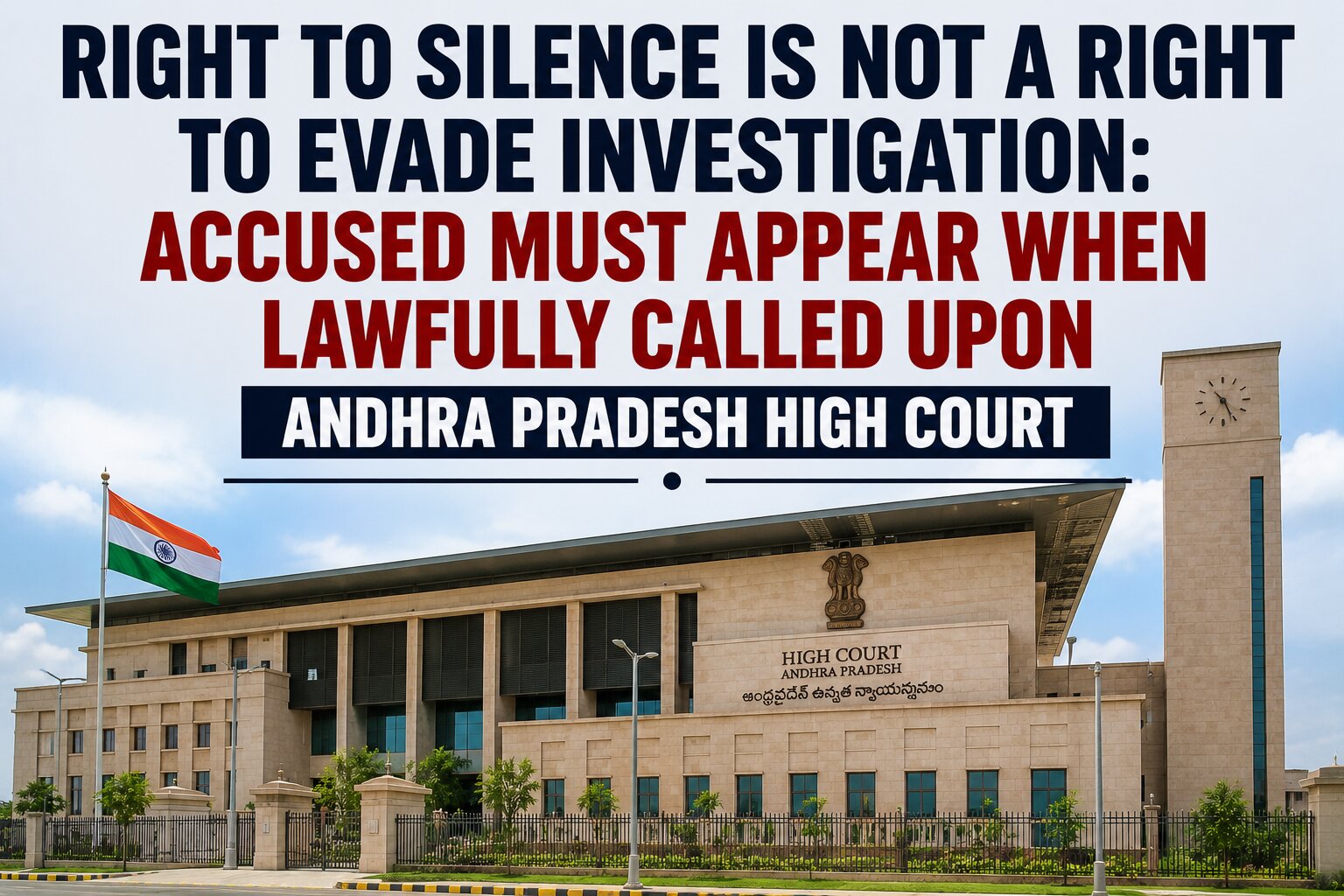
Judgement Details
Court
Andhra Pradesh High Court
Date of Decision
20 August 2026
Judges
Justice Dr. Y. Lakshmana Rao
Citation
Acts / Provisions
Facts of the Case
-
The petitioner, Duvvada Srinivas, challenged repeated notices issued to him under Section 35(3) BNSS during an ongoing criminal investigation.
-
The petitioner contended that he had already cooperated with the investigation and had undergone approximately nine and a half hours of interrogation.
-
He relied upon his medical condition and argued that repeated physical appearance before the Investigating Officer was unnecessary.
-
He also alleged that the criminal allegations were vague and politically motivated.
-
The State opposed the petition and maintained that the petitioner had not fully cooperated with the investigation.
-
According to the State, the petitioner had allegedly given evasive answers to material questions.
-
The State argued that the Investigating Officer was entitled to seek further clarification and conduct necessary interrogation.
-
The High Court therefore examined the relationship between the accused's constitutional right to silence and the Investigating Officer's statutory power to require appearance during investigation.
-
The Court also considered whether repeated notices under Section 35(3) BNSS could become oppressive or arbitrary.
-
The Court emphasized that investigation must remain effective while simultaneously respecting the constitutional protections available to the accused.
Issues
-
Whether the constitutional right against self-incrimination under Article 20(3) includes an absolute right of an accused to refuse every form of participation in a criminal investigation?
-
Whether an accused who is lawfully served with a notice under Section 35(3) BNSS is required to appear before the Investigating Officer despite having a right to remain silent?
-
Whether the Investigating Officer can repeatedly issue notices under Section 35(3) BNSS without specifying a legitimate investigative purpose or reasonable timeframe?
-
Whether repeated summoning of an accused can violate the accused's right to fair and speedy investigation under Article 21 of the Constitution?
-
Whether the Court should completely restrain the Investigating Officer from requiring the petitioner's further appearance during the investigation?
-
Whether a balanced procedure could protect the accused's constitutional rights while preserving the Investigating Officer's authority to complete a legitimate investigation?
Judgement
-
The High Court held that the right to silence under Article 20(3) is a substantive constitutional guarantee.
-
However, the Court clarified that this right does not mean that an accused can avoid every lawful requirement to participate in an investigation.
-
The Court distinguished between the right against self-incrimination and the obligation to appear before the Investigating Officer when lawfully required.
-
The Investigating Officer may require an accused to appear for purposes such as identification, clarification or confrontation with material already collected.
-
At the same time, Section 35(3) BNSS cannot become a mechanism for endless or purposeless summoning.
-
The Court held that investigative discretion must be exercised reasonably and proportionately.
-
The Court emphasized that Article 21 includes the right to a fair and speedy investigation.
-
Where an accused has substantially cooperated and there are genuine health concerns, the investigation should be conducted in a humane, time-bound and proportionate manner.
-
The Court declined to completely prohibit further investigation or quash the proceedings.
-
Instead, it adopted a balanced approach.
-
The Investigating Officer was directed to prepare a schedule specifying the dates and times on which the petitioner would be required to appear.
-
The schedule was to be served upon the petitioner in advance.
-
The Court also permitted the petitioner to appear with Legal Aid Counsel.
-
The Investigating Officer was directed to complete the investigation within a reasonable timeframe and file the appropriate proceedings before the jurisdictional Magistrate.
-
The High Court therefore disposed of the writ petition without imposing costs.
Held
- The right to silence does not create an absolute exemption from every lawful requirement to participate in an investigation.
-
An accused may be required to appear before the Investigating Officer when lawfully called upon under Section 35(3) BNSS.
-
The duty to appear and the right not to incriminate oneself are distinct legal concepts.
-
The Investigating Officer cannot use Section 35(3) BNSS for endless, repetitive or purposeless summoning.
-
Article 21 protects the accused against a vexatious, unnecessarily prolonged or unfair investigation.
-
Investigative discretion must be exercised in a reasonable, humane and proportionate manner.
-
Where further investigation is genuinely necessary, the accused must cooperate with the lawful process.
-
A structured schedule of appearances can balance the interests of the accused and the investigating agency.
-
The investigation should be completed within a reasonable timeframe without unnecessary repetition.
Analysis
-
Right to silence: The judgment strongly reaffirms that Article 20(3) protects an accused from being compelled to provide incriminating testimony against himself. The Court nevertheless refused to equate this protection with a complete right to avoid the investigative process.
-
Appearance versus self-incrimination: The Court draws an important constitutional distinction. Being required to appear before an Investigating Officer does not necessarily amount to being compelled to incriminate oneself.
-
Section 35(3) BNSS: The provision provides an alternative to arrest in appropriate circumstances. Its purpose is to secure the accused's participation in investigation without unnecessarily resorting to arrest.
-
Limits on police power: Although police have investigative discretion, that discretion is not unlimited. Repeated notices without a discernible investigative purpose can become oppressive.
-
Article 21 protection: The Court recognized that fair investigation is part of the constitutional protection of life and personal liberty. Investigation cannot continue indefinitely without justification.
-
Health concerns: The Court gave importance to bona fide medical concerns raised by the petitioner and emphasized that investigative procedures should be humane and proportionate.
-
Balanced approach: Rather than accepting either extreme position, the Court adopted a middle course. It did not allow the accused to completely evade investigation, nor did it permit unrestricted repeated summoning.
-
Advance schedule: Requiring the Investigating Officer to provide a schedule gives the accused certainty about when attendance is required and prevents arbitrary or unpredictable summons.
-
Legal assistance: Allowing the petitioner to appear with Legal Aid Counsel provides an additional safeguard while preserving the investigation.
-
Speedy investigation: The ruling extends the broader principle of speedy justice to the investigative stage itself. An investigation should not become an indefinite burden on an accused.
-
No absolute immunity: The judgment makes clear that Article 20(3) protects against compelled self-incrimination, not against every legitimate investigative procedure.
-
No unlimited police discretion: Conversely, the State cannot rely on investigative discretion as a justification for repeatedly calling an accused without explaining or demonstrating the continuing necessity.
-
Practical significance: The ruling provides a useful framework for courts dealing with disputes concerning repeated Section 35(3) BNSS notices.
-
Broader constitutional significance: The decision attempts to maintain equilibrium between effective criminal investigation and the accused's constitutional protections under Articles 20(3) and 21.
-
BNSS-era importance: Since Section 35(3) BNSS is the successor to Section 41-A CrPC, the judgment is significant for understanding how courts may regulate police notices and appearance requirements under the new criminal procedure regime.