
Dr. Rohit Lalit and Others v. State of Haryana and Another, 2026
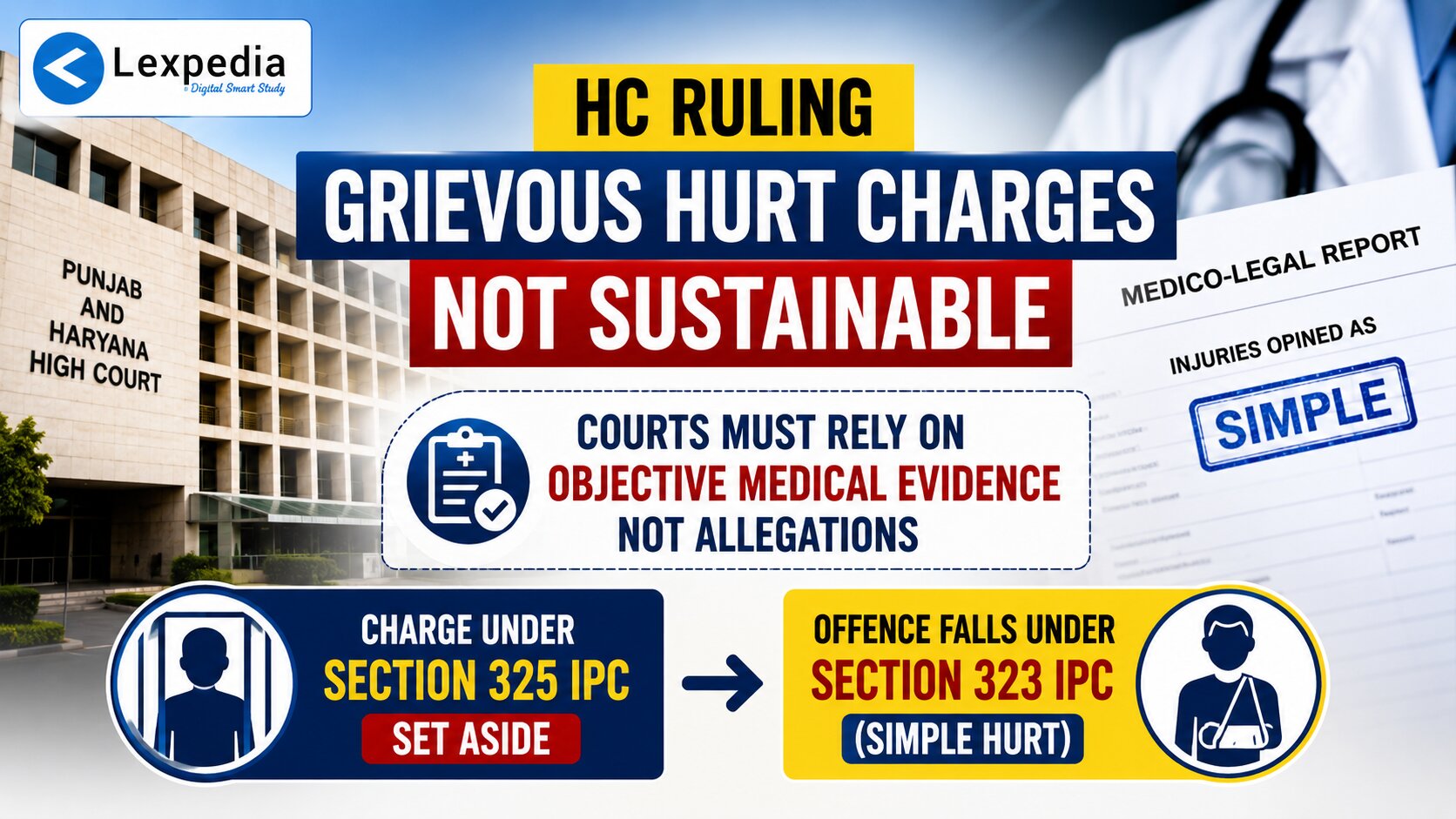
Importance of objective medical evidence in criminal prosecutions involving bodily injuries.
Judgement Details
Court
Punjab and Haryana High Court
Date of Decision
3 June 2026
Judges
Justice Sumeet Goel
Citation
Acts / Provisions
Facts of the Case
-
An FIR was registered alleging offences of assault, wrongful restraint, robbery, and criminal intimidation.
-
The complainant alleged that he sustained multiple injuries during the incident.
-
The Medico-Legal Report (MLR) recorded contusions, swelling, and complaints of pain.
-
Government doctors consistently opined that all injuries were simple in nature.
-
The complainant later underwent private dental treatment, resulting in tooth extraction approximately 2.5 months after the incident.
-
Subsequent medical reviews, even after considering private treatment records, reaffirmed that the injuries were simple injuries.
-
The police filed a chargesheet under Sections 323, 325, 331, 341, 201, 506, and 34 IPC.
-
The trial court framed charges accordingly.
-
The accused challenged the charges under Sections 325 and 331 IPC, contending that there was no evidence of grievous hurt.
Issues
-
Whether charges under Section 325 IPC for grievous hurt could be sustained when medical evidence consistently described the injuries as simple in nature?
-
Whether a court can frame charges for grievous hurt in the absence of prima facie material satisfying the statutory ingredients prescribed under Section 320 IPC?
-
Whether delayed private medical treatment and subsequent tooth extraction could independently establish grievous hurt despite contrary medical opinions from government doctors?
-
Whether, at the stage of framing charges, the court is required to scrutinize objective medical evidence to determine the existence of a prima facie case?
Judgement
-
The High Court held that offences involving grievous hurt require a prima facie foundation satisfying the ingredients of Section 320 IPC.
-
The Court emphasized that the classification of injuries is a matter of scientific determination and not judicial speculation.
-
The Court relied upon the consistent opinions of medical experts, who classified the injuries as simple.
-
It observed that courts must not proceed on speculative, exaggerated, or unsupported claims while framing charges.
-
The Court reiterated that at the stage of framing charges, judges should not act as a “post office” of the prosecution.
-
Simultaneously, courts should not conduct a mini-trial while considering the charge.
-
The Court held that where the material creates only mere suspicion, the accused cannot be forced to face trial for a more serious offence.
-
Delayed medical procedures and allegations unsupported by medical evidence cannot substitute the statutory requirements of Section 320 IPC.
Held
-
The charge under Section 325 IPC (Grievous Hurt) was set aside.
-
The injuries were held to be simple injuries falling under Section 323 IPC.
-
The Court held that objective medical evidence must form the basis of charges relating to grievous hurt.
-
An accused cannot be subjected to trial for an offence that is ex facie legally non-existent.
Analysis
- The judgment reinforces the importance of objective medical evidence in criminal prosecutions involving bodily injuries.
-
The Court strictly applied the statutory requirements of Section 320 IPC before permitting prosecution for grievous hurt.
-
The decision protects accused persons from facing aggravated criminal charges based on mere allegations.
-
It clarifies the scope of judicial scrutiny at the stage of framing charges.
-
The judgment distinguishes between grave suspicion and mere suspicion, emphasizing that only the former justifies framing charges.
-
The ruling highlights the evidentiary value of expert medical opinion in determining the nature of injuries.
-
The Court balanced the interests of the prosecution, victim, and accused, ensuring fairness in criminal proceedings.
-
The decision strengthens the principle that criminal liability must rest upon cogent evidence rather than conjecture.