
Dr. Poonam Mishra v. State & Anr., 2026
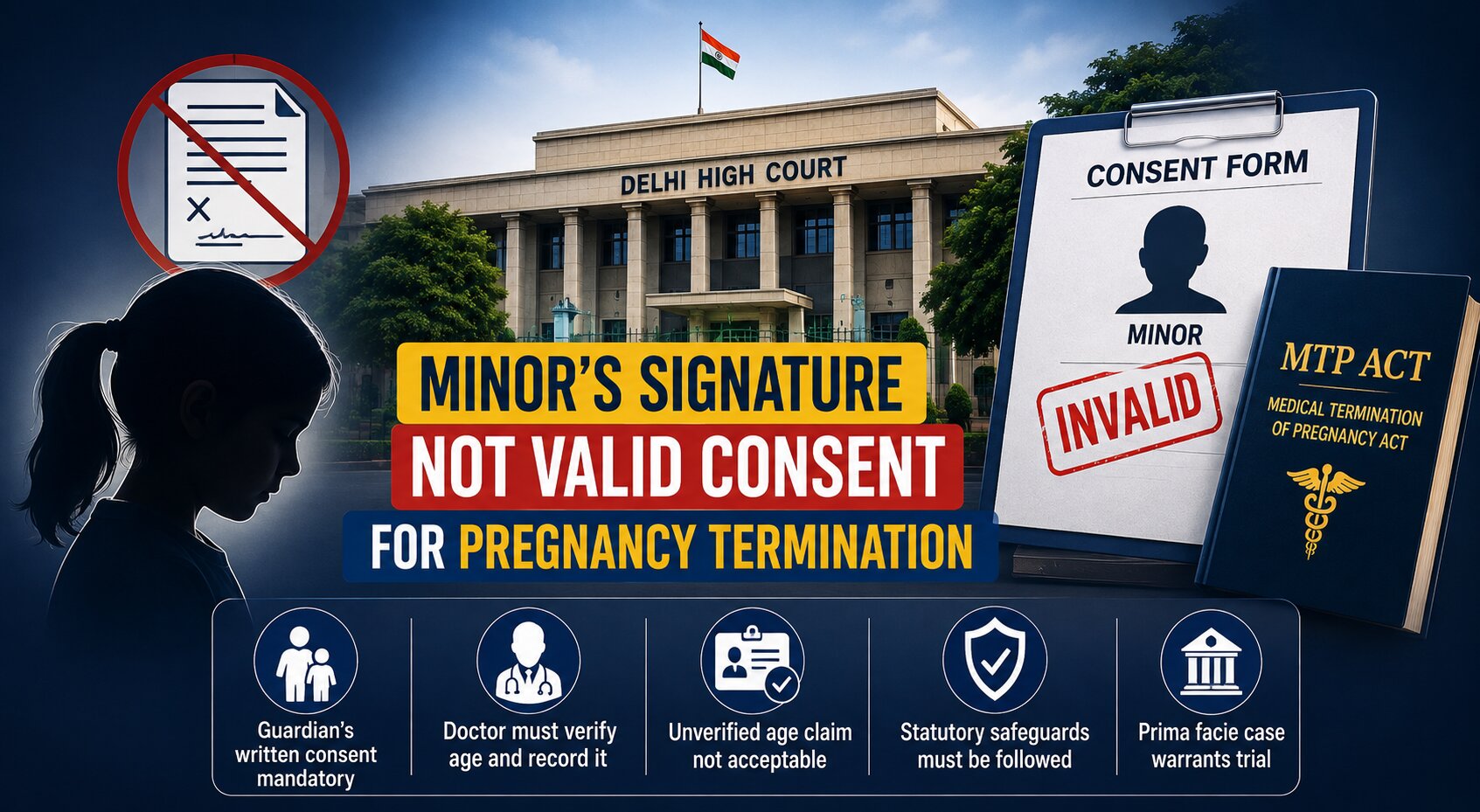
A minor's signature does not constitute the guardian's statutory consent required under the MTP Act.
Judgement Details
Court
Delhi High Court
Date of Decision
10 August 2026
Judges
Justice Purushaindra Kumar Kaurav
Citation
Acts / Provisions
Facts of the Case
-
The case concerned the alleged termination of pregnancy of a minor rape survivor.
-
An FIR was registered in October 2019 concerning the alleged sexual assault of a 16-year-old girl and her resulting pregnancy.
-
According to the prosecution, the petitioner-doctor terminated the minor's pregnancy at a private medical centre in July 2019.
-
The minor had allegedly been brought to the medical centre by a co-accused who represented herself as the girl's aunt.
-
The doctor was initially cited only as a prosecution witness.
-
The prosecutrix subsequently filed a protest petition.
-
Following the protest petition, the Trial Court directed further investigation into whether the pregnancy had been illegally terminated and whether the doctor had knowingly failed to report a POCSO offence.
-
A supplementary chargesheet was subsequently filed against the doctor.
-
The chargesheet invoked Sections 313 and 201 IPC, Section 21 of the POCSO Act and provisions of the MTP Act, as stated in the supplied information.
-
The prosecution alleged that the doctor had failed to properly verify the minor's age before carrying out the procedure.
-
The Court considered whether a genuine signature of the minor on a hospital consent form could satisfy the statutory consent requirement under the MTP Act.
-
The Court held that a minor's own signature cannot substitute for the written consent of the guardian required by the statute.
-
The Court further considered the doctor's obligation to independently ascertain the patient's age where age determines the statutory requirements applicable to termination of pregnancy.
-
The Court observed that an adult accompanying the patient cannot simply provide an unverified statement of age and thereby relieve the registered medical practitioner of the obligation to verify the relevant facts.
-
The investigation allegedly revealed that the person accompanying the prosecutrix was not actually related to her, despite representing herself as her aunt.
-
The Court also noted that no guardian consent had been obtained because the hospital had apparently failed to consider whether guardian consent was legally required.
-
The petitioner sought quashing of the proceedings against her.
-
The Delhi High Court rejected the quashing plea, finding that the prosecution materials disclosed a prima facie case warranting trial.
-
The Court clarified that its observations were limited to determining whether a prima facie case existed and should not influence the Trial Court while deciding the case on merits.
Issues
-
Whether a genuine signature of a minor can constitute valid consent for termination of pregnancy under the Medical Termination of Pregnancy Act?
-
Whether written consent of the guardian is an independent statutory precondition for termination of pregnancy of a minor under the MTP Act?
-
Whether a registered medical practitioner is required to independently ascertain and document the age of a patient where the patient's age determines the statutory requirements for termination of pregnancy?
-
Whether an unverified oral representation regarding the age of a minor made by an adult accompanying the patient can discharge the registered medical practitioner's statutory obligations?
-
Whether the alleged failure to obtain guardian consent and verify the minor's age disclosed a prima facie case against the petitioner-doctor warranting continuation of the criminal proceedings?
-
Whether the alleged failure of the doctor to report knowledge of a POCSO offence attracted liability under the applicable provisions of law?
-
Whether the criminal proceedings against the petitioner-doctor were liable to be quashed when the prosecution material disclosed allegations sufficient to warrant a trial?
Judgement
-
The Delhi High Court dismissed the petitioner's plea for quashing of the criminal proceedings.
-
The Court held that the signature of a minor does not constitute the statutory consent required for termination of pregnancy under the MTP Act.
-
The Court emphasized that the MTP Act requires written consent of the guardian where the patient is a minor.
-
The Court held that guardian consent is an independent statutory precondition and cannot be substituted by the minor's own assent or signature.
-
The Court observed that the MTP Act does not treat a minor as independently capable of providing the statutory consent required for termination in the circumstances addressed by the Act.
-
The Court further held that a registered medical practitioner cannot simply rely upon an unverified statement of age made by an adult accompanying the patient.
-
Where the patient's age has legal significance under the MTP Act, the medical practitioner has an individual obligation to take reasonable steps to ascertain and record the age.
-
The Court found that the prosecution material disclosed allegations sufficient to establish a prima facie case against the petitioner.
-
The Court therefore held that the proceedings could not be quashed at that stage.
-
The Court emphasized that the statutory obligations of an individual registered medical practitioner cannot be avoided merely because of administrative laxity at the medical institution.
-
The Court also considered the alleged failure to report the POCSO offence as part of the prosecution case.
-
The Court directed that the Trial Court should proceed with the matter uninfluenced by the observations made in the High Court order.
-
The Trial Court was directed to decide the case strictly in accordance with law and on the basis of the evidence led during trial.
Held
- For a minor, written consent of the guardian is an independent statutory requirement.
-
A hospital consent form bearing the minor's signature cannot substitute for the guardian's consent required by law.
-
A registered medical practitioner must take appropriate steps to ascertain and document the patient's age where age determines the statutory requirements governing termination of pregnancy.
-
An unverified statement of age made by an accompanying adult does not automatically discharge the doctor's statutory obligations.
-
The doctor's individual statutory duties cannot be avoided merely because of administrative deficiencies of the institution.
-
The prosecution materials disclosed a prima facie case sufficient to warrant trial.
-
The petition seeking quashing of the proceedings was therefore dismissed.
-
The High Court clarified that its observations were confined to the question of whether a prima facie case existed and would not determine the merits of the criminal trial.
Analysis
-
Guardian consent is distinct from minor's assent: The central principle is that the minor's own agreement or signature cannot replace the specific guardian-consent requirement imposed by the MTP Act.
-
Statutory safeguard: The Court treated the guardian's written consent as an independent statutory safeguard rather than a mere administrative formality.
-
Age verification: The judgment emphasizes that age can have direct legal consequences under the MTP framework. Therefore, a medical practitioner cannot simply accept an accompanying person's statement about age without appropriate verification.
-
Doctor's individual responsibility: The Court made clear that the individual obligations of a registered medical practitioner cannot be avoided by pointing to failures or laxity within the hospital administration.
-
Unverified escort's statement: The fact that an adult accompanied the minor and claimed to be her aunt did not, according to the Court's reasoning, remove the need for proper verification—particularly when investigation later indicated that the person was not actually related to the minor.
-
MTP Act is conditional: The Court emphasized that the MTP Act does not create an unrestricted entitlement to terminate a pregnancy on demand. Termination is permitted within the circumstances recognized by the legislation and subject to the statutory safeguards.
-
POCSO reporting obligation: The prosecution also alleged that the doctor knowingly failed to report a POCSO offence. This formed part of the material considered while determining whether the proceedings disclosed a prima facie case.
-
Limited scope of quashing jurisdiction: The High Court did not conduct a full trial or determine the ultimate guilt of the doctor. It only examined whether the prosecution material was sufficient to justify continuation of the proceedings.
-
Prima facie standard: The Court found that the allegations and prosecution materials were sufficient to warrant trial. The question of whether those allegations would ultimately be proved remained for the Trial Court.
-
Protection against prejudging the trial: By expressly directing the Trial Court to remain uninfluenced by the High Court's observations, the Court maintained the distinction between a preliminary assessment of a prima facie case and final adjudication on evidence.
-
Overall significance: The judgment emphasizes that statutory safeguards surrounding medical termination of pregnancy, particularly where a minor is involved, must be strictly observed, and that a medical practitioner cannot rely solely on informal representations where the law requires verification and guardian consent.