
Dr. Abdul Hameed v. State of Rajasthan, 2026
Supreme Court Orders De-Novo Trial
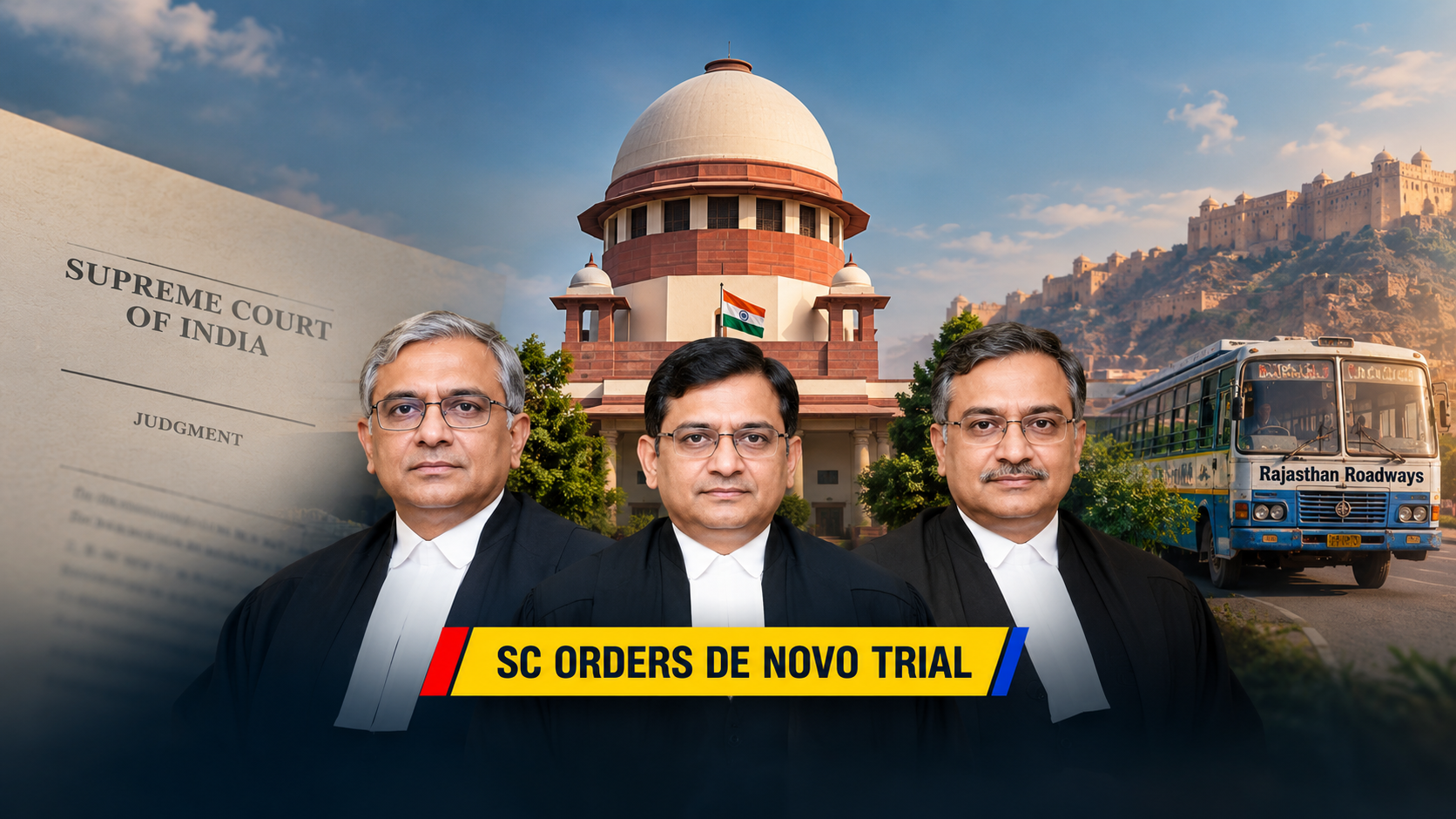
Judgement Details
Court
Supreme Court of India
Date of Decision
23 September 2026
Judges
Justices Vikram Nath, Sanjay Karol and Sandeep Mehta
Citation
Acts / Provisions
Facts of the Case
-
The case arose from the Samleti Bus Bomb Blast in Rajasthan.
-
On 22 May 1996, a Rajasthan Roadways bus travelling from Agra towards Bikaner was carrying approximately 49–50 passengers. After the bus passed Mahwa and travelled towards Dausa, a powerful explosion occurred near Samleti village. The blast killed 14 passengers and injured 37 others.
-
The investigation alleged that an explosive device containing approximately 2.5 kg of RDX had been placed beneath seats in the bus. The prosecution subsequently alleged a wider conspiracy involving several accused persons.
-
Dr. Abdul Hameed was subsequently charged in connection with the blast. The trial court convicted him, including under Section 302 IPC, and imposed the death penalty, along with other sentences under the IPC, Explosive Substances Act and PDPP Act.
-
The Rajasthan High Court ultimately upheld his conviction and death sentence in July 2019. However, the Supreme Court, while examining the matter, found a fundamental problem with the manner in which his trial had been conducted: he had not been provided effective legal representation during the trial, including during the examination and cross-examination of prosecution witnesses.
-
The Supreme Court also considered appeals involving other accused persons, including Pappu @ Salim, and challenges by the State against acquittals of several co-accused.
Issues
-
Whether Dr. Abdul Hameed's trial satisfied the constitutional requirement of a fair trial and due process under Articles 21 and 22.
-
Whether the absence of effective legal representation during the trial vitiated his conviction and sentence.
-
What remedy should follow when a serious criminal conviction is found to have resulted from a constitutionally defective trial — acquittal, confirmation of conviction, or de-novo trial?
-
Whether the evidence and confessional material relied upon against Pappu @ Salim were legally sufficient to sustain his conviction.
-
Whether the prosecution had produced sufficient independent and legally admissible evidence to overturn the acquittals of the other accused.
-
What standard should an appellate court apply when considering a challenge to an acquittal?
Judgement
-
The Supreme Court partly allowed Dr. Abdul Hameed's appeals.
-
The Court set aside the trial court's conviction and sentence against him and also set aside the Rajasthan High Court judgment to that extent. However, it did not acquit him outright. Instead, it ordered a de-novo trial.
-
The case against Abdul Hameed be remitted for a fresh trial.
-
A Special Court at Jaipur be designated for the trial.
-
The Special Court should be headed by a Rajasthan Higher Judicial Service officer with at least seven years' experience of conducting Sessions trials.
-
The fresh trial should commence from the stage of recording prosecution evidence.
-
Abdul Hameed must have effective representation by a lawyer of his choice.
-
If he cannot engage counsel, competent legal representation must be provided through the Rajasthan State Legal Services Authority.
-
He must receive a meaningful opportunity to cross-examine prosecution witnesses.
-
The Special Court should endeavour to conclude the fresh trial within one year from assignment of the case.
-
The Court allowed Pappu @ Salim's appeal and acquitted him of all charges, directing his release unless he was required in another case.
-
The Supreme Court dismissed the State's appeals challenging the acquittals of Javed Khan, Abdul Goni, Lateef Ahmad Baja, Mohammad Ali Bhatt, Mirza Nisar Hussain and Raees Baeg.
Held
The Supreme Court held, in substance, that:
-
A fair trial requires effective legal representation, particularly where an accused faces capital punishment.
-
The Court found that Abdul Hameed had effectively been left to conduct his defence himself during the recording of prosecution evidence. The record did not demonstrate that he had been provided counsel or legal aid, nor that he had consciously waived his right to legal representation.
-
Because this defect went to the constitutional fairness of the trial itself, the Court held that the conviction could not simply be sustained on the existing trial record.
-
At the same time, the Court held that denial of effective representation did not automatically require an acquittal. Considering the seriousness of the allegations and the need for the case to be adjudicated through a constitutionally compliant process, the appropriate remedy was a de-novo trial.
-
The Court also reaffirmed that an accused who has already been acquitted enjoys a reinforced presumption of innocence, and the prosecution must establish sufficient grounds before an appellate court interferes with an acquittal.
Analysis
-
The central constitutional principle is that effective legal representation is an essential component of a fair criminal trial.
-
The Court noted that merely having an accused physically present in court is insufficient. Representation must be real and meaningful, allowing the accused to understand the proceedings, challenge prosecution evidence and exercise available legal rights.
-
This becomes especially important in a capital case involving extensive oral, documentary and forensic evidence.
-
The record showed that Abdul Hameed's cross-examination of prosecution witnesses was undertaken by the accused himself, with no effective legal counsel or legal-aid representation shown in the trial record.
-
The Court therefore treated the problem as going beyond an ordinary procedural irregularity. It affected the legitimacy of the process through which the evidence was recorded.
-
The third option was rejected because affirming a conviction based upon evidence recorded during a constitutionally defective trial would perpetuate the underlying problem.
-
The Court also declined to order an outright acquittal solely because of the defective representation. Instead, it balanced the accused's constitutional rights with the public interest in having serious criminal allegations adjudicated through a lawful process.
-
Regarding the other accused, the Court reiterated the principle that an acquitted person benefits from two layers of presumption of innocence:
-
the ordinary presumption of innocence; and
-
the additional presumption arising from the acquittal.
-
Where two reasonable views of the evidence are possible, the acquittal should not ordinarily be disturbed.
-
The Court also considered the evidentiary value of a confession attributed to a co-accused. It held that such a confession is not substantive evidence by itself and requires independent legally admissible evidence capable of connecting the accused with the offence.
-
The judgment reinforces an important principle: the seriousness of an alleged offence cannot reduce constitutional fair-trial safeguards.
-
At the same time, the judgment demonstrates that the remedy for a defective trial depends on the circumstances. A constitutionally defective trial can result in a fresh trial rather than an automatic acquittal, particularly where the Court considers that justice requires the allegations to be adjudicated through a procedurally fair process.
-
Importantly, the Supreme Court expressly clarified that its observations concerning Abdul Hameed were confined to the fairness and legality of his trial. The Special Court must independently assess the evidence in the fresh trial.