
Dipankar Majumder & Anr. v. The State of Tripura & Anr., 2026
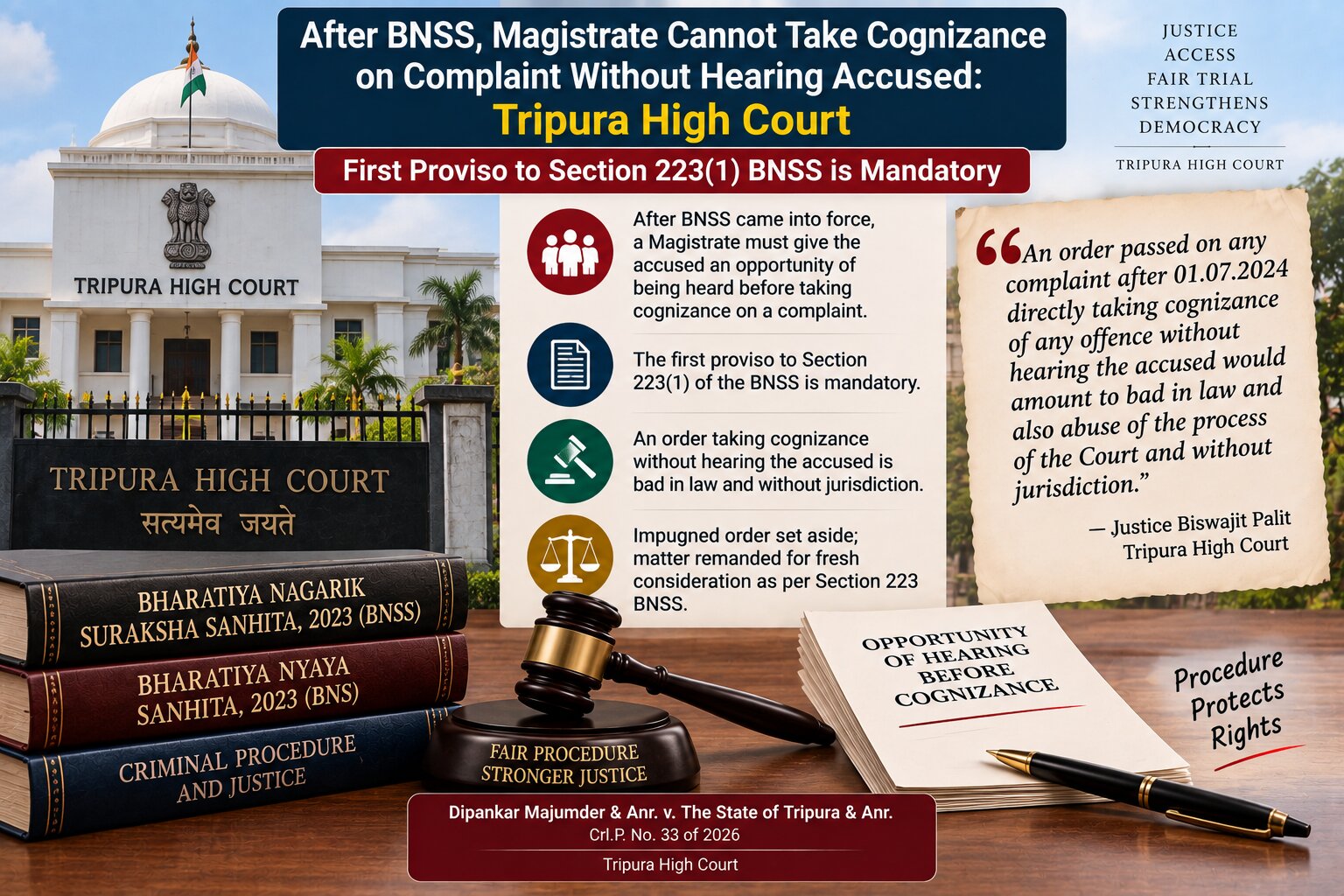
The requirement introduced by the BNSS cannot be bypassed by relying upon the earlier procedure under Section 200 CrPC.
Judgement Details
Court
Tripura High Court
Date of Decision
17 September 2026
Judges
Justice Biswajit Palit
Citation
Acts / Provisions
Facts of the Case
-
Kotak Mahindra Bank Ltd. filed a complaint against the petitioners and others alleging offences under various provisions of the BNS, 2023.
-
The complaint was filed after the BNSS came into force on 1 July 2024.
-
The complaint alleged offences under Sections 61(2), 314, 316, 318, 320, 321, 323 and 324 of the BNS.
-
The Chief Judicial Magistrate, West Tripura, Agartala, passed an order dated 12 July 2024 in CR 209 of 2024.
-
The petitioners contended that the CJM directly took cognizance of the offences on the complaint without first giving them an opportunity of being heard.
-
The petitioners further pointed out that the matter was subsequently transferred to another Magistrate.
-
The State argued that there was no illegality because the CJM had not recorded the statement of the complainant or witnesses and had instead transferred the matter to another Court.
-
The High Court examined the newly introduced first proviso to Section 223(1) BNSS.
-
The proviso expressly states that no cognizance of an offence shall be taken by the Magistrate without giving the accused an opportunity of being heard.
-
The Court also considered the other provisos to Section 223(1), which deal with situations where examination of the complainant or witnesses may be dispensed with.
-
The petitioners argued that the earlier procedure under Section 200 CrPC could not be applied after the BNSS came into force.
-
The High Court agreed that the new statutory requirement under Section 223 BNSS governed the complaint.
-
The Court also considered the Supreme Court's decision in Kushal Kumar Agarwal v. Directorate of Enforcement, which addressed the first proviso to Section 223(1).
-
Since the petitioners had not been heard before cognizance was taken, the High Court found the CJM's order legally unsustainable.
Issues
-
Whether a Magistrate can take cognizance of an offence on a complaint after 1 July 2024 without first providing the accused an opportunity of being heard as mandated by the first proviso to Section 223(1) of the BNSS?
-
Whether the procedure under Section 200 of the CrPC can continue to govern complaints filed after the BNSS came into force when Section 223 of the BNSS prescribes a different procedure?
-
Whether the CJM's order taking cognizance without hearing the accused was legally sustainable merely because the complainant and witnesses had not yet been examined and the matter was subsequently transferred to another Magistrate?
-
Whether the High Court should exercise its jurisdiction under Section 528 of the BNSS to set aside the order and remit the matter for fresh consideration in accordance with Section 223 of the BNSS?
Judgement
-
The Tripura High Court allowed the criminal petition filed under Section 528 BNSS.
-
The Court held that the first proviso to Section 223(1) BNSS is mandatory.
-
After the BNSS came into force on 1 July 2024, a Magistrate dealing with a complaint cannot take cognizance of an offence without first giving the accused an opportunity of being heard, subject to the statutory scheme.
-
The Court rejected the contention that the absence of examination of the complainant or witnesses meant that the requirement of hearing the accused could be ignored.
-
The Court also rejected reliance on the earlier Section 200 CrPC procedure for a complaint governed by the BNSS.
-
The Court relied upon the Supreme Court's decision in Kushal Kumar Agarwal v. Directorate of Enforcement concerning the first proviso to Section 223(1).
-
Since the petitioners had not been afforded an opportunity of hearing before cognizance was taken, the CJM's order dated 12 July 2024 was held unsustainable.
-
The impugned order was therefore set aside.
-
The matter was remanded to the CJM, West Tripura, Agartala, for fresh consideration in accordance with Section 223 BNSS.
-
The parties were directed to appear before the CJM.
-
The High Court also directed that the judgment be circulated to all Criminal Courts across Tripura.
Held
-
The first proviso to Section 223(1) BNSS is mandatory.
-
After 1 July 2024, a Magistrate cannot take cognizance of an offence on a complaint without giving the accused an opportunity of being heard, where the proviso applies.
-
Transfer of the complaint to another Magistrate does not cure the defect in an order by which cognizance was already taken without complying with the mandatory requirement.
-
An order taking cognizance contrary to the first proviso to Section 223(1) is bad in law and without jurisdiction.
-
The CJM's order was accordingly quashed and the matter was remanded for proceedings afresh in accordance with Section 223 BNSS.
Analysis
-
Major procedural change under BNSS: The decision highlights a significant difference between the earlier CrPC framework and the BNSS. The first proviso to Section 223(1) expressly introduces an opportunity of hearing to the accused before cognizance is taken on a complaint.
-
Mandatory requirement: The Court treated the provision as obligatory rather than directory. This means a Magistrate cannot simply overlook the hearing requirement as a matter of procedural convenience.
-
Timing is important: The complaint and cognizance in the present case occurred after 1 July 2024, when the BNSS had already come into force. Therefore, the Court applied the new statutory framework.
-
Cognizance and examination are distinct: The State's argument that the complainant and witnesses had not yet been examined did not remove the statutory requirement. The Court focused on whether cognizance had been taken without the prescribed hearing.
-
CrPC procedure cannot override BNSS: Once the new procedural statute governed the proceeding, the earlier Section 200 CrPC mechanism could not be used to avoid an express requirement contained in Section 223 BNSS.
-
Supreme Court guidance: The reliance on Kushal Kumar Agarwal v. Directorate of Enforcement strengthened the Court's interpretation of the first proviso and its effect on the Magistrate's power to take cognizance.
-
Consequences of non-compliance: The Court characterised an order passed without following the mandatory requirement as legally unsustainable and an abuse of the process of the Court.
-
Remand rather than termination: The High Court did not terminate the complaint itself. Instead, it restored the matter to the CJM for consideration afresh in accordance with the BNSS.
-
Broader significance: The ruling provides guidance to criminal courts in Tripura concerning the procedural requirements applicable to complaints filed after the commencement of the BNSS and reinforces the importance of complying with the newly introduced hearing safeguard.