
Dildar Ali Batt & Others v. State of H.P. & Another, 2026
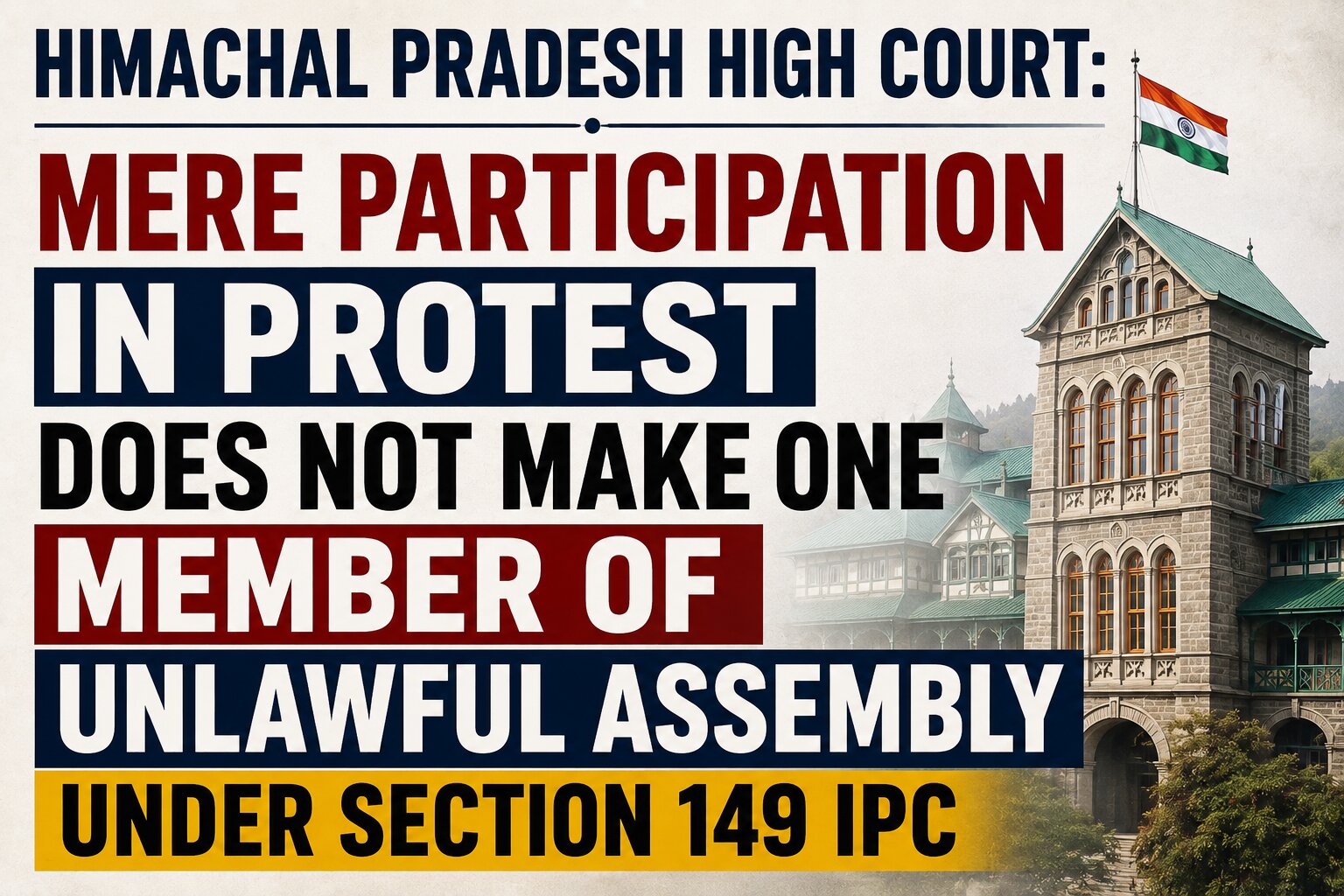
Mere participation in a protest march does not automatically make a person a member of an unlawful assembly.
Judgement Details
Court
High Court of Himachal Pradesh
Date of Decision
15 August 2026
Judges
Justice Sandeep Sharma
Citation
Acts / Provisions
Facts of the Case
-
The case arose from a protest march organised on 29 July 2017.
-
The protest was organised following allegations concerning the sexual harassment of a school student by a teacher at Government Senior Secondary School, Khushinagar, Churah.
-
A large number of persons participated in the protest march.
-
During the protest, some members of the gathering allegedly became violent.
-
Several teachers were allegedly assaulted by persons belonging to the unruly group.
-
The incident resulted in registration of FIR No. 82 of 2017 against several persons, including the present petitioners.
-
The prosecution alleged offences under various provisions of the IPC, including liability arising from Section 149 IPC.
-
The petitioners approached the Himachal Pradesh High Court seeking quashing of the FIR and all consequential criminal proceedings.
-
The petitioners contended that although they had participated in the protest march, they had not assaulted any of the teachers.
-
They further contended that they had not shared the common object of the persons who allegedly became violent.
-
The petitioners specifically relied upon their conduct after the violence began.
-
According to the material before the Court, Dildar Ali Batt and Parvej Ali Batt separated themselves from the unruly group after witnessing the conduct of persons who were assaulting the teachers.
-
They allegedly attempted to save the teachers from being assaulted.
-
The complainant and injured teachers had specifically named the persons who had allegedly assaulted them.
-
The petitioners were not named as the persons who actually assaulted the teachers.
-
The prosecution nevertheless sought to implicate the petitioners by relying upon their presence and participation in the protest march.
-
The petitioners argued that mere participation in a peaceful protest or presence at the scene could not automatically make them members of an unlawful assembly.
-
They further argued that there was no material demonstrating that they knew that some members of the gathering intended to commit violence.
-
The High Court therefore examined whether the ingredients of Section 149 IPC were actually satisfied against the petitioners.
Issues
-
Whether mere participation in a protest march or presence at the place of occurrence is sufficient to establish membership of an unlawful assembly under Section 149 IPC?
-
Whether the petitioners shared the common object of the assembly that allegedly became violent and assaulted the teachers?
-
Whether the conduct of the petitioners in separating themselves from the violent group and attempting to save the teachers negated their alleged membership of the unlawful assembly?
-
Whether the word “knew” occurring in Section 149 IPC requires positive knowledge on the part of the accused regarding the likelihood of the offence being committed?
-
Whether the absence of any allegation that the petitioners themselves assaulted the teachers was relevant to determining their liability under Section 149 IPC?
-
Whether the material collected during investigation disclosed sufficient grounds to proceed against the petitioners for the alleged offences?
-
Whether continuation of the criminal proceedings against the petitioners would amount to an abuse of the process of law when the chances of conviction were very bleak?
-
Whether the FIR and all consequential proceedings against the petitioners were liable to be quashed in exercise of the inherent jurisdiction of the High Court?
Judgement
-
The Himachal Pradesh High Court allowed the petition filed by the petitioners.
-
The Court examined the allegation that the petitioners were members of an unlawful assembly merely because they had participated in the protest march.
-
The Court held that mere presence in a protest march or at the scene of an offence does not ipso facto make a person a member of an unlawful assembly.
-
The Court emphasised that liability under Section 149 IPC depends upon the existence of the necessary connection between the accused and the common object of the unlawful assembly.
-
The Court considered the conduct of the petitioners after the protestors allegedly became violent.
-
It found significance in the fact that the petitioners separated themselves from the unruly mob after witnessing the assault on the teachers.
-
The Court further noted that the petitioners allegedly attempted to save the teachers who were being assaulted.
-
In these circumstances, the Court held that the petitioners could not reasonably be treated as participants in the unlawful object of the violent group.
-
The Court also considered the statements of the complainant and injured teachers.
-
Those persons had specifically identified the individuals who had allegedly assaulted them.
-
The petitioners were not identified as the actual assailants.
-
The Court therefore found that there was insufficient material to establish that the petitioners had participated in the violence or shared the common object of those who committed the assaults.
-
The Court separately examined the word “knew” used in the second part of Section 149 IPC.
-
It held that “knew” requires positive knowledge and cannot simply be equated with a possibility that an offence might occur.
-
The Court found no material demonstrating that the petitioners had prior knowledge that certain members of the protest would assault the teachers.
-
Mere participation in the protest could not be converted into constructive criminal liability without proof of the necessary mental element and common object contemplated by Section 149 IPC.
-
The Court therefore found that the prosecution material was insufficient to establish the petitioners' liability.
-
The Court observed that the chances of conviction were “very bleak.”
-
It concluded that continuation of the criminal proceedings would serve no fruitful purpose.
-
The High Court consequently exercised its inherent jurisdiction to quash the FIR and all consequential proceedings against the petitioners.
Held
-
For Section 149 IPC to apply, there must be material establishing that the accused was a member of the unlawful assembly and that the necessary common object was shared or the requisite knowledge existed.
-
Mere presence at the scene of an offence is not, by itself, sufficient to impose constructive liability under Section 149 IPC.
-
The petitioners' conduct in separating themselves from the violent mob and attempting to protect the teachers was inconsistent with the allegation that they shared the violent common object.
-
The fact that the injured teachers identified the alleged assailants but did not identify the petitioners as assailants was also relevant.
-
The word “knew” in Section 149 IPC requires positive knowledge and cannot be established merely by showing that the accused could possibly have anticipated the offence.
-
There was no sufficient material showing that the petitioners knew that members of the protest intended to assault the teachers.
-
The possibility of conviction against the petitioners was considered very bleak.
-
Continuation of the criminal proceedings in these circumstances would serve no fruitful purpose.
-
The High Court therefore quashed the FIR and all consequential proceedings against the petitioners.
Analysis
-
The judgment reinforces the fundamental distinction between mere presence and criminal participation.
-
A person who happens to be present at the scene of an offence does not automatically become criminally liable for acts committed by others.
-
Section 149 IPC creates a form of constructive liability, but that liability cannot be imposed merely because an accused was physically present among a group of people.
-
The prosecution must establish that the accused was a member of the unlawful assembly and that the statutory requirements concerning its common object or knowledge were satisfied.
-
The Court's reasoning is particularly important in the context of public protests and demonstrations, where large numbers of people may be present but may have different intentions and conduct.
-
The mere fact that some members of a protest subsequently become violent does not automatically make every participant responsible for the violence.
-
The Court appropriately focused upon the individual conduct of the petitioners rather than treating the entire gathering as a single homogeneous group.
-
The conduct of the petitioners in separating themselves from the violent group was significant because it tended to negate the allegation that they shared the violent common object.
-
Their alleged attempt to protect the teachers further weakened the prosecution's case that they intended to participate in the assault.
-
The Court also gave importance to the fact that the injured persons had specifically named the alleged assailants.
-
The absence of the petitioners' names as actual assailants was not by itself conclusive, but it was an important circumstance when considered alongside their conduct and the other evidence.
-
The interpretation of the word “knew” is another important aspect of the judgment.
-
The Court distinguished actual or positive knowledge from mere possibility, suspicion or conjecture.
-
This approach prevents Section 149 IPC from being applied on the basis of speculative assumptions about what an accused might have known.
-
The judgment therefore reinforces the requirement that constructive liability must still have a factual foundation in the evidence.
-
The Court's reasoning also demonstrates that common object cannot simply be presumed from the fact that several people participated in the same protest.
-
The common object must be assessed from the conduct, circumstances and surrounding evidence.
-
A peaceful participant cannot automatically be held liable for a subsequent act of violence merely because the violence occurred within the same gathering.
-
The decision is also significant from the perspective of the High Court's inherent jurisdiction to prevent abuse of process.
-
Where the allegations and evidence are insufficient to establish the necessary ingredients of the offences and the possibility of conviction is extremely remote, continuation of the prosecution may itself become an abuse of the judicial process.
-
The Court therefore did not merely examine whether some allegation had been made against the petitioners; it considered whether the available material could realistically sustain a criminal conviction.
-
The judgment demonstrates the importance of distinguishing between individual criminal responsibility and group-based allegations.
-
Section 149 IPC can extend liability beyond the person who physically commits the offence, but it does not eliminate the requirement of establishing the accused's membership of the unlawful assembly and the relevant common object or knowledge.
-
The decision also protects the legitimate exercise of the right to participate in a protest from being automatically converted into criminal liability when some participants subsequently engage in violence.
-
At the same time, the judgment should not be understood as granting immunity to all protestors from Section 149 IPC.
-
Where evidence establishes that a protest participant shared the common object of violence or had the requisite knowledge contemplated by the statute, constructive liability may still arise.
-
The key distinction in the present case was the absence of such evidence combined with conduct demonstrating separation from the violence.
-
Overall, the judgment emphasises that criminal liability under Section 149 IPC must be based on evidence of common object or legally sufficient knowledge, not merely physical presence or participation in a protest march.