
Dhrub Singh Etc. v. The State of Bihar, 2026
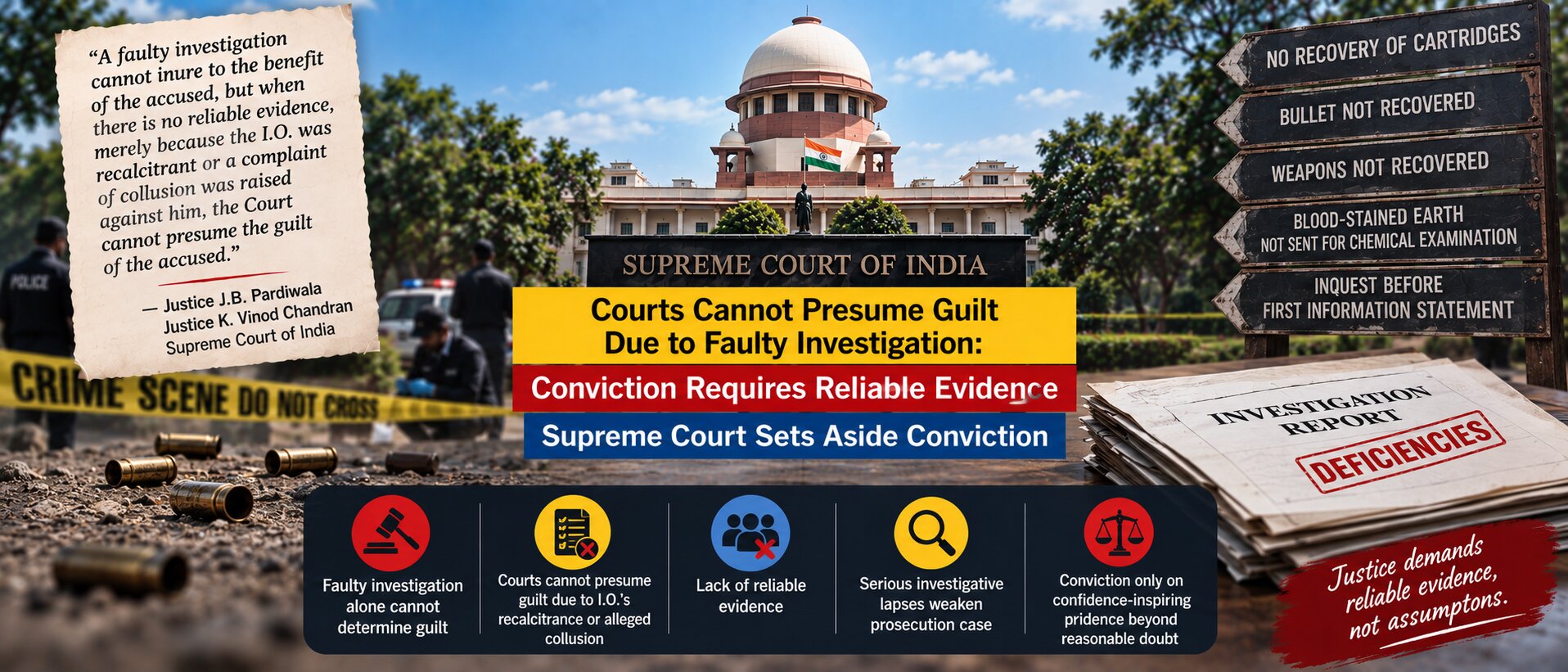
A faulty investigation cannot automatically result in acquittal, but it also cannot be used as a basis to presume the guilt of an accused.
Judgement Details
Court
Supreme Court of India
Date of Decision
1 September 2026
Judges
Justice J.B. Pardiwala and Justice K. Vinod Chandran
Citation
Acts / Provisions
Facts of the Case
-
The prosecution alleged that the deceased was travelling towards the fields along with four other persons, including his son, an employee, a nephew and a villager.
-
According to the prosecution, the accused ambushed the group and opened indiscriminate fire.
-
It was alleged that the deceased was shot in the back and subsequently died from the gunshot injury.
-
A patrolling vehicle carrying a Magistrate reached the place of occurrence, following which the accused allegedly fled from the spot.
-
The prosecution examined nine witnesses during the trial.
-
The accused were convicted under Sections 302 and 307 read with Section 149 IPC.
-
The High Court upheld their conviction.
-
The accused thereafter approached the Supreme Court challenging the conviction.
-
The accused argued that the investigation was seriously defective and that the prosecution had failed to produce reliable evidence proving their guilt beyond reasonable doubt.
-
The State argued that defects in investigation could not automatically benefit the accused, particularly when allegations had been made against the Investigating Officer.
-
During the proceedings, a complaint had allegedly been made against the Investigating Officer accusing him of conducting a collusive investigation.
-
The High Court relied upon this alleged collusion to explain several deficiencies in the prosecution case.
-
These deficiencies included failure to examine independent witnesses, failure to send blood-stained earth for chemical examination and failure to seize blood-stained clothes.
-
The Supreme Court found that the complaint against the Investigating Officer had not been properly brought out through the eyewitnesses and did not satisfactorily explain the deficiencies in the investigation.
-
The Supreme Court also noted that cartridges were not recovered from the alleged scene of indiscriminate firing.
-
The bullet that allegedly caused the fatal injury and exited the deceased's body was also not recovered.
-
There was no effective attempt to recover the weapons allegedly used by the accused.
-
Although blood-stained earth had been collected, it was not sent for chemical examination.
-
The Court also found significance in the fact that the inquest was conducted before the First Information Statement was recorded.
-
The Supreme Court ultimately found that the prosecution evidence did not inspire confidence and that the accused's guilt had not been established beyond reasonable doubt.
Issues
-
Whether a faulty investigation can by itself justify the conviction of an accused when the prosecution evidence does not reliably establish guilt?
-
Whether the alleged collusion of the Investigating Officer can be relied upon by the Court to presume the guilt of the accused?
-
Whether the prosecution established the accused's guilt beyond reasonable doubt through reliable and convincing evidence?
-
Whether the High Court was justified in treating the eyewitness testimony as consistent and clinching evidence despite serious deficiencies in the investigation?
-
Whether the failure to recover cartridges, bullets and weapons, along with other investigative lapses, created reasonable doubt regarding the prosecution case?
-
Whether the convictions under Sections 302 and 307 read with Section 149 IPC could be sustained in the absence of reliable evidence establishing the culpability of the accused?
Judgement
-
The Supreme Court allowed the appeal filed by the accused.
-
The Court held that while a faulty investigation does not automatically operate in favour of an accused, the prosecution must nevertheless establish guilt through reliable evidence.
-
The Court rejected the proposition that an accused's guilt can be presumed merely because the Investigating Officer was allegedly recalcitrant or involved in collusion.
-
The Court found that the prosecution evidence in the present case did not inspire confidence.
-
The Court criticised the High Court for relying upon an alleged complaint against the Investigating Officer that had not been properly established during the trial.
-
The Court held that the complaint against the Investigating Officer could not be used to fill gaps or lacunae in the prosecution case.
-
The Supreme Court observed that the case was not merely one of faulty investigation but one where “no investigation” had effectively been carried out in material respects.
-
The Court noted the failure to recover cartridges despite the allegation of indiscriminate firing.
-
The Court also noted that the fatal bullet was not recovered and the alleged weapons were not recovered.
-
Blood-stained earth collected from the scene was not subjected to chemical examination.
-
The Court found the sequence of the inquest preceding the First Information Statement particularly significant and described it as indicating a pre-meditated process.
-
The Court concluded that the prosecution had failed to establish the culpability of the accused beyond reasonable doubt.
-
The convictions were therefore set aside.
-
The appeal was allowed, paving the way for the release of the accused.
Held
-
A conviction must rest upon reliable and confidence-inspiring evidence.
-
Alleged collusion or misconduct by the Investigating Officer cannot substitute for missing prosecution evidence.
-
The prosecution cannot rely upon an allegation against the Investigating Officer to fill lacunae in its own case.
-
Serious investigative deficiencies, including failure to recover cartridges, bullets and weapons, may become significant when the remaining evidence itself does not inspire confidence.
-
The prosecution failed to prove the accused's guilt beyond reasonable doubt.
-
The convictions under Sections 302 and 307 read with Section 149 IPC were therefore set aside.
Analysis
-
Burden of proof remains with prosecution: The judgment reinforces that the prosecution carries the fundamental burden of proving the accused's guilt beyond reasonable doubt.
-
Faulty investigation is not automatic acquittal: The Court carefully distinguished between a defective investigation and absence of reliable evidence. Investigative lapses do not automatically entitle an accused to acquittal, but the prosecution still cannot obtain conviction without trustworthy evidence.
-
No presumption of guilt: The Court rejected the idea that allegations of collusion against an Investigating Officer can themselves establish the accused's culpability.
-
Evidence cannot be replaced by assumptions: A court cannot compensate for missing evidence by assuming that investigative deficiencies were deliberately caused to benefit the accused.
-
High Court's error: The Supreme Court found that the High Court improperly used the alleged complaint against the Investigating Officer to explain away major gaps in the prosecution evidence.
-
Independent corroboration: The absence of independent witnesses became relevant because the prosecution case depended heavily on eyewitness testimony that the Supreme Court found insufficiently reliable.
-
Physical evidence: The non-recovery of cartridges, the fatal bullet and alleged weapons weakened the prosecution's account of an indiscriminate shooting.
-
Scientific investigation: The failure to send the collected blood-stained earth for chemical examination represented another significant investigative deficiency.
-
Inquest and FIS sequence: The Court attached considerable significance to the fact that the inquest preceded the recording of the First Information Statement and viewed the sequence as raising serious concerns about the investigation.
-
“No investigation” versus “faulty investigation”: This distinction is particularly important. The Court considered the cumulative deficiencies so serious that the case went beyond ordinary investigative mistakes.
-
Standard of criminal proof: Suspicion, allegations of collusion and investigative irregularities cannot replace the requirement of proof beyond reasonable doubt.
-
Impact on criminal trials: The judgment serves as a reminder that courts must independently evaluate the quality and reliability of prosecution evidence rather than allowing investigative shortcomings to be explained away without evidentiary foundation.
-
Benefit of reasonable doubt: Where the prosecution evidence does not inspire confidence and material circumstances remain unexplained, the accused is entitled to the benefit of reasonable doubt.